
Datafi Explained · 03 · A Datafi Position
Security as a First Principle
The industry treats security as the brake on AI. We built it as the engine. Done right, governance is not what slows enterprise AI down. It is the only thing that lets it move at all.
This is the third piece in Datafi Explained. The first two argued that data and AI are one problem, and that the answer is an operating system rather than a pile of tools. This piece is about the layer of that system most companies bolt on last and we built in first. It is the reason the rest of the platform can be trusted with real work.
Ask most enterprises why their AI initiative stalled, and security is somewhere near the top of the list. The pilot worked. Then it had to face the security review, the compliance team, the question of who is allowed to see what, and the initiative slowed to a crawl or quietly died. Security gets cast as the villain of the story, the department that says no, the gate that everything good gets stuck behind.
We think that framing is backwards, and expensive. Security is not what is stopping enterprise AI. The absence of built-in security is. When governance lives outside the system, every new use case reopens the same fight, and the safe answer is always no. When governance lives inside the system, the answer can finally be yes, because the controls travel with the work automatically.
“Security is not the price you pay to use AI. It is the thing that lets you say yes to it.”
Why bolt-on security fails
Most platforms add security at the end. The product is built, and then access controls, audit logging, and policy enforcement are layered on top, often by a different team, sometimes by the customer. This is the architectural equivalent of installing locks after the house is built and the furniture is in. It can be done, but the gaps are already there.
Bolt-on security has a specific failure mode in AI. An agent that can reach data, take action, and chain steps together is only as safe as the weakest seam between the tools it touches. If policy is enforced in one tool but not the next, the agent simply routes around it. You do not find out until something has already happened, and your audit trail, assembled after the fact from several systems that were never designed to agree, cannot tell you exactly what.
“An agent that can act is only as trustworthy as the policy that governs every step it takes.”
What first-principle security means
When security is a first principle, it is not a feature of the platform. It is the architecture of the platform. On Datafi, every agent, every workflow, and every data flow operates inside continuous policy enforcement, because there is nowhere in the system that policy does not reach. It is the same foundation the data and the agents run on, which is the whole point of an operating system: the rules are enforced by the layer underneath everything, not requested politely by each application above it.
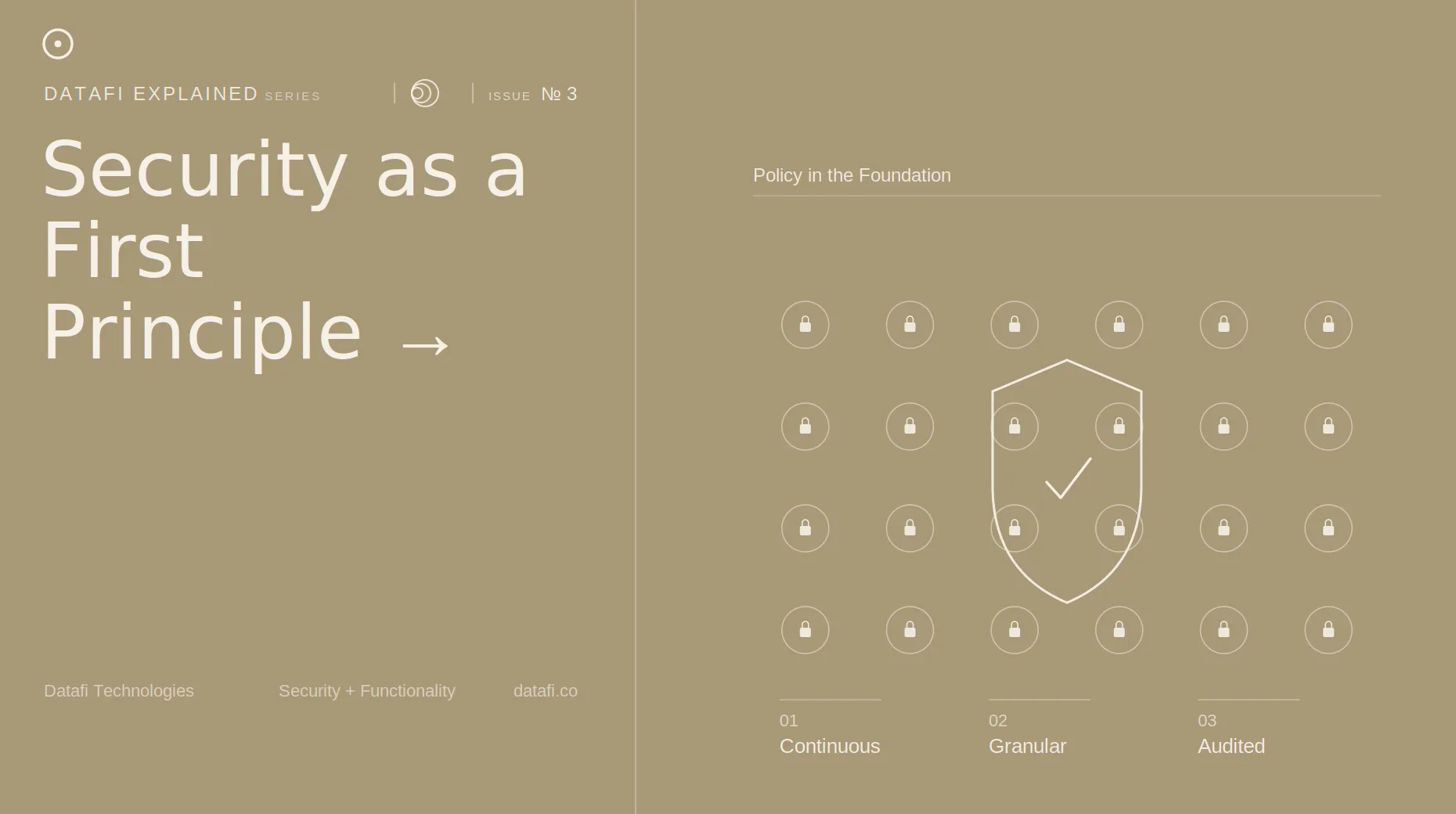
That produces three things bolt-on security cannot. Protection is continuous rather than reactive, applied as work happens instead of reviewed after. Control is granular, defined per agent, per workflow, and per data flow rather than as a coarse perimeter. And the audit trail is complete, because the same system that took every action also recorded it, so you can answer not just what happened but who authorized it and on what basis.
Governance as velocity
Here is the reframe that matters most. The conventional view holds that there is a tradeoff between speed and safety: you can move fast, or you can be governed, but not both. For enterprise AI, the opposite is true. The companies that move fastest are the ones that never have to stop.
When governance is built in, a new use case does not trigger a fresh security project. It inherits the controls already in place. The compliance team is not a gate to clear but a set of policies the system already enforces. That is why governed AI reaches production in weeks rather than stalling for quarters. The control is not slowing the work down. It is the reason the work never has to stop and wait.
“The fastest enterprises are not the ones with the fewest controls. They are the ones whose controls never make them stop.”
What this looks like on the platform
Two layers of the operating system carry this directly. Cyber enforces granular access controls and automated risk policies across every agent, workflow, and data flow, preventing unauthorized exposure and standardizing data integrity so protection is continuous rather than reactive. Control Tower makes all of it observable, delivering real-time visibility and full audit trails across every agent and workflow from one place. Together they mean you do not have to choose between knowing what your AI is doing and letting it do useful work. You get both, by design.
The distinction
Security bolted on
- Reviewed after the fact, when it is too late
- A coarse perimeter around the whole system
- Audit assembled from systems that disagree
- Every new use case reopens the same fight
Security as foundation
- Enforced continuously, as the work happens
- Granular control per agent, workflow, and data flow
- One complete, authoritative trail of every action
- Controls travel with the work, so the answer is yes
The shorter version
Security is a first principle at Datafi because an operating system that cannot be trusted with real work is not worth running. We built governance into the foundation rather than onto the surface, which makes protection continuous, control granular, and the audit trail complete. And it inverts the tradeoff everyone assumes: governance done this way is not a tax on speed. It is what makes speed safe, and therefore possible.
So far this series has been about what Datafi is and how it is built. The next piece turns to who it is for, and why we believe powerful AI cannot stay in the hands of specialists alone.
###
About Datafi
Datafi is the operating system for business AI. It unifies enterprise data, documents, and operational context into one governed layer, so AI can act on how a business actually works, securely and at scale.