
Datafi Explained · 02 · A Datafi Position
An Operating System for AI
Most companies are buying AI one tool at a time. We think that is the wrong unit. The enterprise does not need more applications. It needs an operating system underneath them.
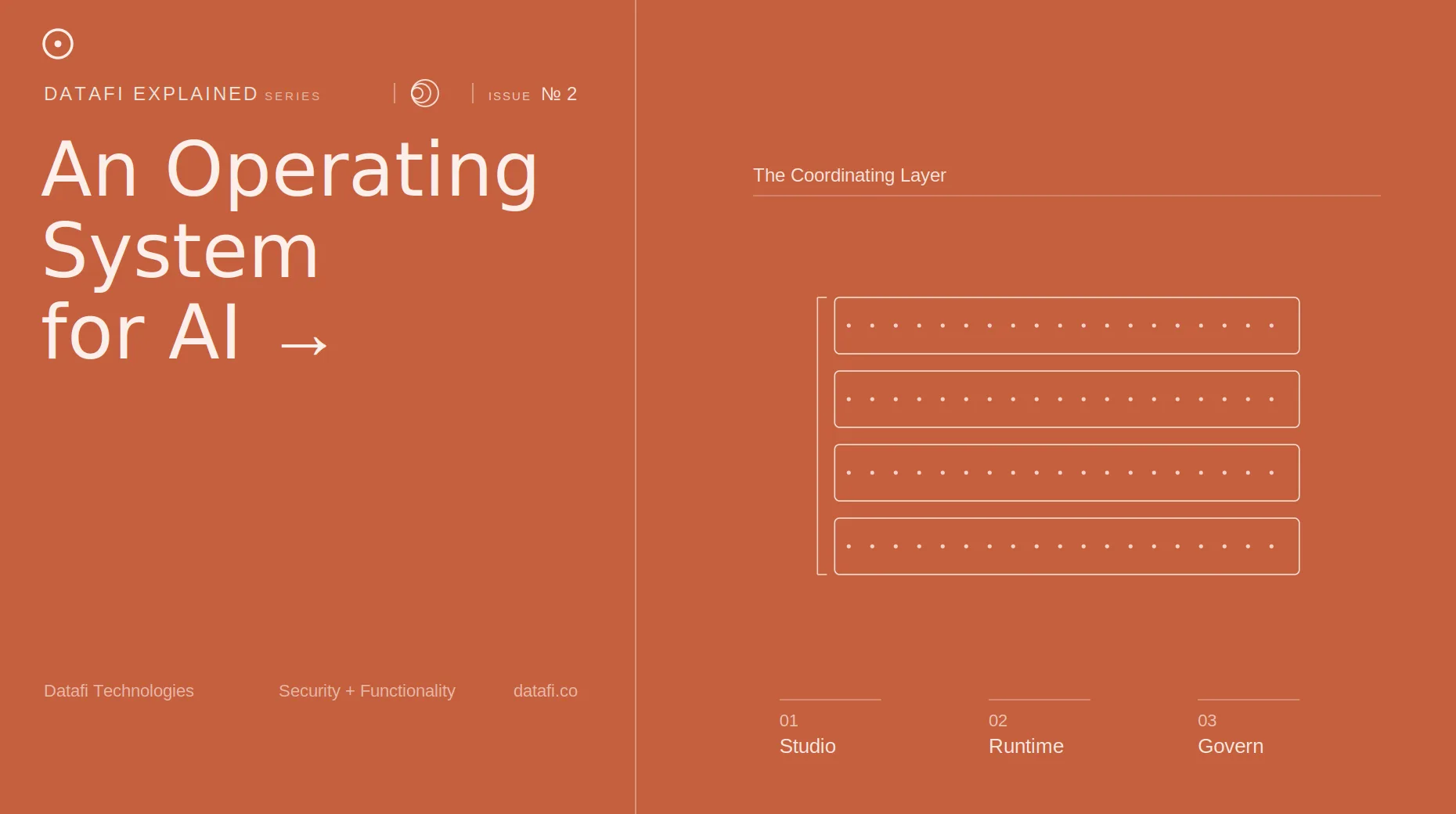
This is the second piece in Datafi Explained. The first argued that data and AI are one problem, not two. This one follows directly from that: if the work is unified, the thing you need is not another app but an operating system. Here we explain what we mean by that, and why the metaphor is precise rather than marketing.
Think about what an operating system does for a computer. You do not interact with raw hardware. You do not write to disk sectors by hand or manage memory addresses to open a document. The operating system sits between you and the machine, managing resources, enforcing permissions, and giving every application a common foundation to build on. It is invisible when it works, and nothing works without it.
Enterprise AI today has no such layer. What it has instead is a drawer full of tools. A chatbot here, a copilot there, a model fine-tuned by one team, a vector database stood up by another, a governance review bolted on at the end. Each is bought separately, connected by hand, and governed by its own rules. The result is not intelligence. It is sprawl.
“A pile of AI tools is not an AI strategy. It is a future integration bill.”
What an operating system actually does
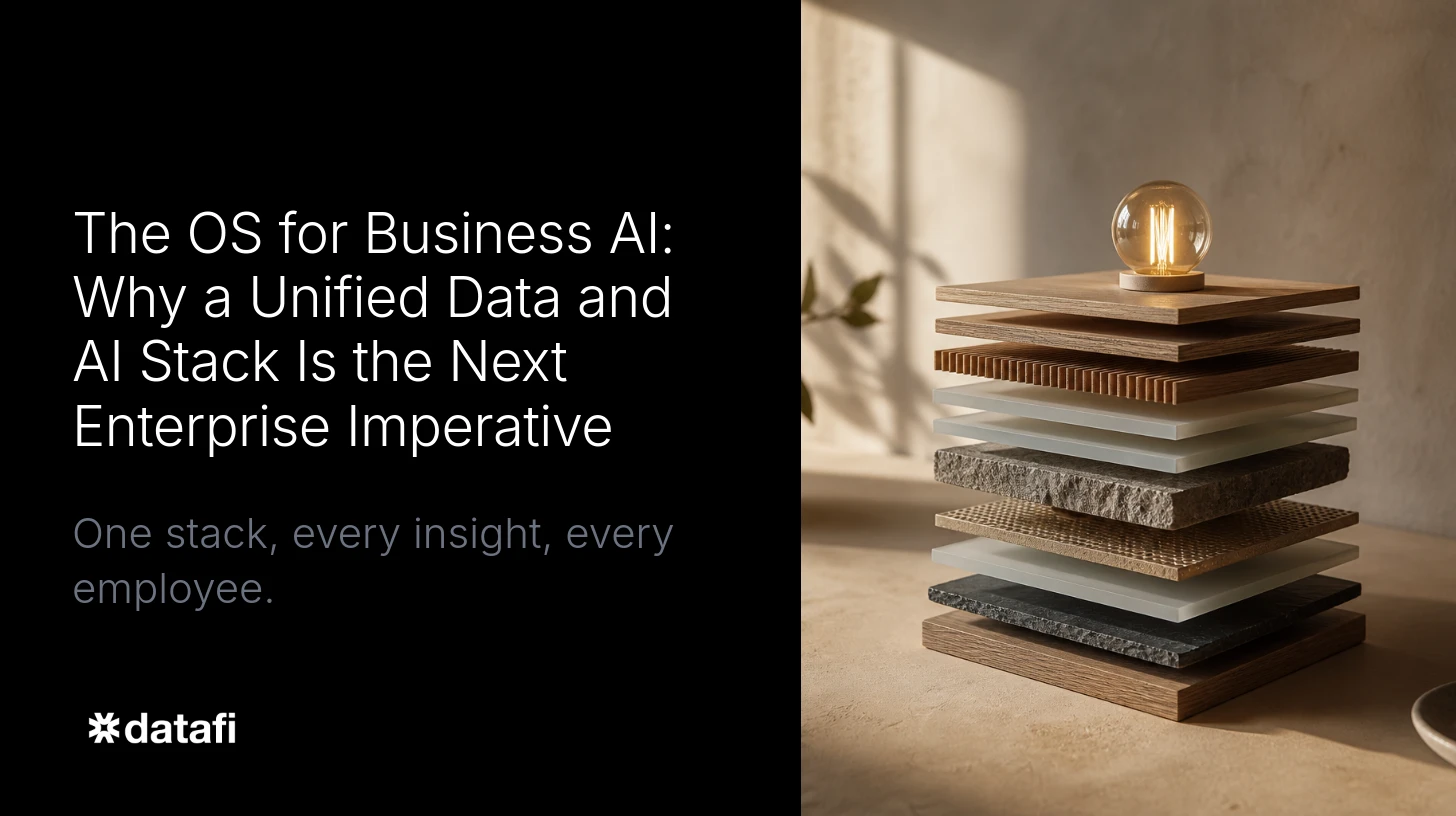
An operating system is not the most visible part of a computer, but it is the part that makes everything else possible. It does a small number of things, and it does them for everyone running on top of it. Datafi does the same things for AI.
It manages resources. Just as an operating system allocates memory and compute, Datafi connects and coordinates your data sources, models, and agents so they draw on a shared foundation instead of each maintaining its own brittle copy of the truth.
It enforces permissions. An operating system decides which program can touch which file. Datafi decides which agent can reach which data, take which action, and on whose authority, with policy applied uniformly rather than reinvented in every tool.
It provides a common foundation. Applications do not each rewrite the basics; they build on the services the operating system provides. On Datafi, new agents and workflows inherit the context, governance, and execution layer already in place, which is why the second use case is far faster to stand up than the first.
“The first agent proves the platform. The platform is what makes the hundredth agent easy.”
Why a platform, not a product
A product solves one problem. An operating system creates the conditions under which any number of problems get solved, including ones you have not named yet. That distinction is the whole point.
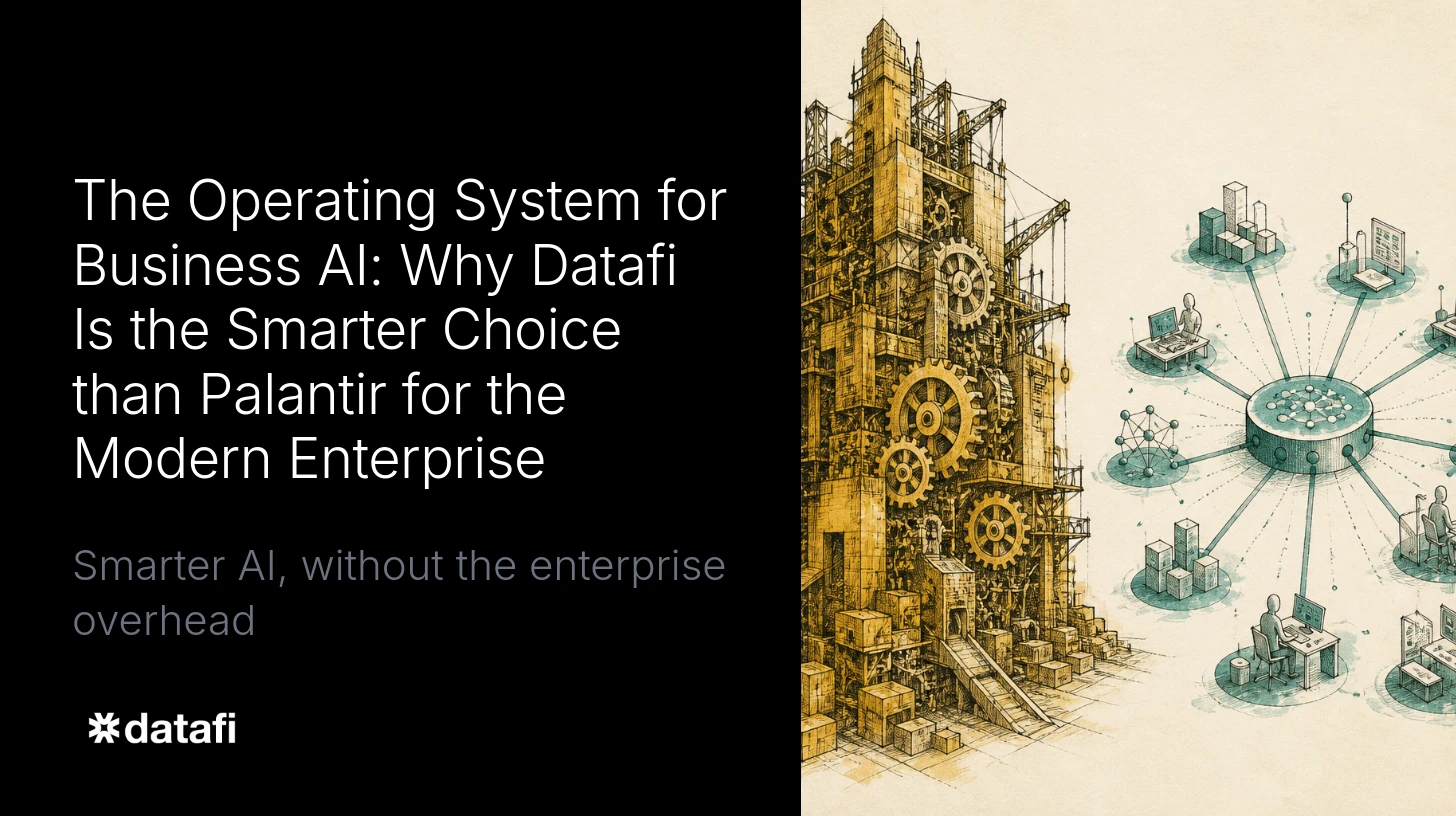
If you buy a point solution for one use case, you have solved one use case, and you will buy, integrate, and govern another tool for the next one. Each addition increases the surface area you have to secure and maintain. Costs compound. So does risk. The tenth tool does not make the ninth easier. It makes the whole estate harder.
An operating system inverts that curve. The foundation is the expensive part, and you pay for it once. Every use case after that is cheaper and faster than the one before, because it stands on infrastructure that already exists. The flywheel runs the right direction: more usage makes the next thing easier, not harder.
The layers of the system
If Datafi is the operating system for business AI, its core services are the layers our customers already work with by name. Studio is where teams build AI applications and agents without writing code, the way you would launch programs on any operating system. Runtime is the execution layer that coordinates agents, services, and workflows across your infrastructure with speed and resilience. Control Tower is the observability layer, giving you real-time visibility and full audit trails across everything the system is doing. And Cyber is continuous protection, enforcing access controls and risk policies across every agent, workflow, and data flow.
These are not four products you assemble. They are the layers of one system, designed to work together, which is exactly what separates an operating system from a bundle.
“Anyone can sell you AI. The hard part, and the valuable part, is the layer that makes all of it run as one.”
The distinction
A drawer of AI tools
- Each tool integrated by hand, one at a time
- Governance reinvented in every separate tool
- Cost and risk compound with each addition
- Tribal knowledge locked inside point solutions
An operating system for AI
- Data, models, and agents on a shared foundation
- One policy layer applied uniformly to everything
- Each new use case cheaper than the last
- Context inherited by every new agent and workflow
The shorter version
Datafi is an operating system for AI because the enterprise does not have an application problem. It has a coordination problem. The value is not in any single agent or model; it is in the layer that lets all of them share data, obey one set of rules, and act safely on the business. Build that layer once and everything above it gets faster, cheaper, and safer.
In the next piece, we turn to the part of that layer most companies treat as an afterthought and we treat as the foundation: security, and why it has to come first.
###
About Datafi
Datafi is the operating system for business AI. It unifies enterprise data, documents, and operational context into one governed layer, so AI can act on how a business actually works, securely and at scale.