
Datafi Explained · 01 · A Datafi Position
Datafi is a Data & AI Company
The industry keeps drawing a line between data companies and AI companies. We think that line is the problem. Here is why Datafi was built to erase it.
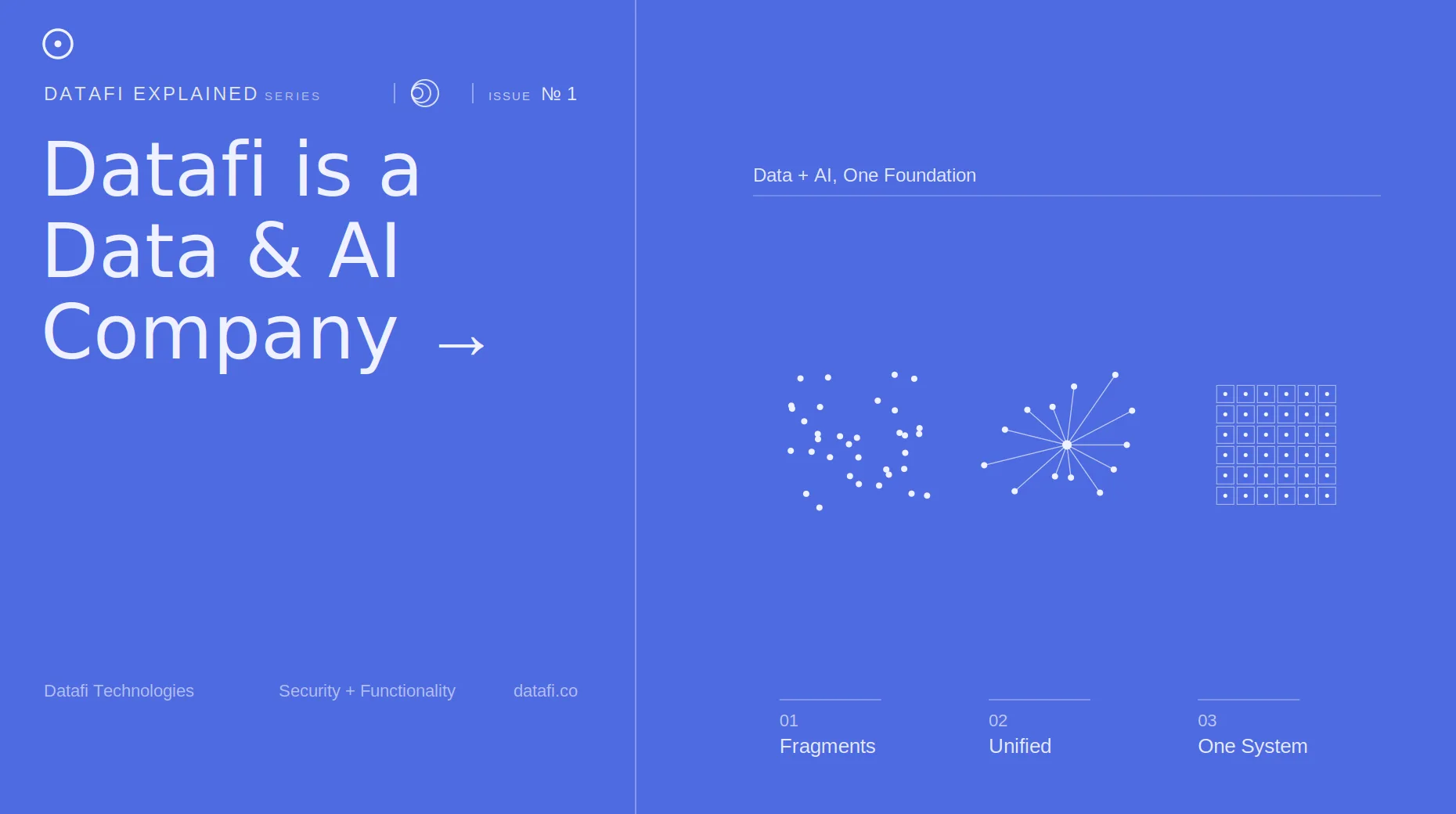
This is the first piece in Datafi Explained, a series that explores how we think about the questions that shape enterprise AI: what an operating system for AI actually is, why security has to come first, who this technology is really for, and more. We write these because the people who trust their business to a platform deserve to understand the convictions behind it.
Ask most technology companies whether they are a data company or an AI company, and they will pick a side. The data companies talk about pipelines, warehouses, and lakes. The AI companies talk about models, agents, and reasoning. Each treats the other half as someone else's problem.
Datafi was founded on the belief that this division is a mistake, and an expensive one. The enterprises we work with do not experience their challenges as a data problem or an AI problem. They experience them as a single problem: they are sitting on more valuable information than they can put to use, and the gap between what they know and what they can act on keeps widening.
You cannot close that gap from one side. AI is only ever as capable as the data it can reach, understand, and act on safely. And data only becomes valuable at the moment intelligence turns it into a decision and a decision into action. Treat them separately and you get exactly what the market has produced: powerful models starved of context, and rich data estates that never change what anyone does on Monday morning.
“The split between data and AI is not a law of nature. It is an accident of how the industry grew up.”
Why the false choice exists
The separation is historical, not logical. Data infrastructure and machine learning matured in different decades, in different teams, sold by different vendors to different buyers. The data team owned the warehouse. A separate team, often years later, was handed a mandate to do something with AI. Two stacks, two budgets, two roadmaps, and a handoff in the middle where most of the value quietly leaks out.
That handoff is where enterprise AI initiatives go to stall. The model demo is impressive. Then it meets the reality of fragmented sources, unclear ownership, governance requirements, and operational systems that the model was never connected to. The pilot never becomes production. Not because the AI was weak, but because it was severed from the data and the context that would have made it useful.
What we actually are
Datafi is a data and AI company in the literal sense: we built both halves into one operating system, designed from the start to work as a single thing. The point is not to own more categories. The point is that the value lives precisely at the seam the rest of the industry leaves unattended.
When data and AI share one foundation, the things that usually break stop breaking. Context does not get lost in a handoff because there is no handoff. Governance is not bolted on afterward because it lives in the same layer the data and the agents do. And intelligence does not stop at the answer, because the operating system that holds your data is the same one that can act on it.
Why this matters for outcomes
This is not a philosophical preference. It is the reason enterprises using Datafi get more value out of the systems they already own without adding cost or complexity, and the reason they reach production in weeks rather than stalling for quarters. Oak Harbor Freight Lines did not change how their teams access data. They changed how their teams use it, turning thousands of daily operational touchpoints from problems they react to into problems they prevent.
That shift, from access to action, is only possible when data and AI are not two separate purchases stitched together by your own people, but one system that was designed to act. That conviction, that AI should drive action rather than just produce answers, is the subject of a later piece in this series.
“We did not choose between being a data company and an AI company. We rejected the premise that you have to.”
The distinction
What Datafi is not
- A warehouse that stops at storing and reporting data
- A model wrapper hoping your context arrives somehow
- A dashboard that describes problems it cannot act on
- Two disconnected stacks with a handoff in the middle
What Datafi is
- A unified operating system for data and AI together
- Intelligence that runs on your full business context
- AI that takes governed action, not just answers
- One foundation, one policy layer, one place to scale
The shorter version
Datafi is a data and AI company because the enterprises we serve cannot afford for those to be two different things. The hard, valuable work is in the unification: bringing data, context, governance, and action into one operating system so that intelligence has something real to stand on and somewhere real to go.
Everything else in this series, the operating system itself, our security model, who we build for, and why licensing beats building, follows from that single decision. It is where Datafi begins.
###
About Datafi
Datafi is the operating system for business AI. It unifies enterprise data, documents, and operational context into one governed layer, so AI can act on how a business actually works, securely and at scale.