


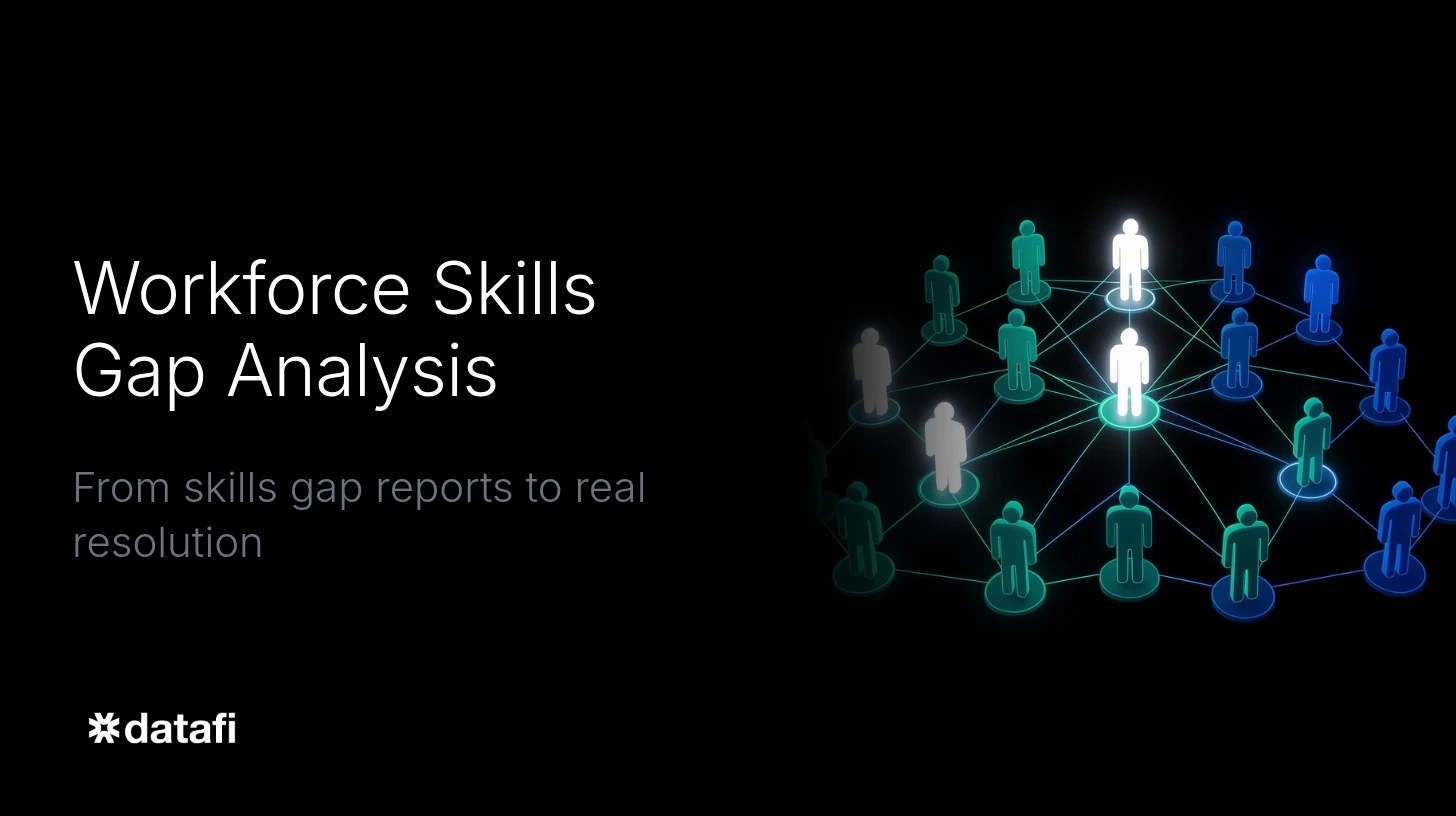
Workforce Skills Gap Analysis
The Question Every Organization is Asking, and the Problem Almost None Can Solve
Every HR leader, operations executive, and board member is asking some version of the same question right now: do we have the skills we need to compete in the next three years? It is one of the most strategically urgent questions in business today. And for the vast majority of organizations, it remains stubbornly unanswerable in any meaningful, actionable way.
Not because the data does not exist. It does. Somewhere in your HRIS sits a trove of employee records, tenure data, role histories, and training completions. Your performance management system holds competency ratings, development goals, and manager feedback. Your learning platform tracks course enrollments and certifications. Your project management tools log who worked on what, with whom, and for how long. Your recruiting system contains a map of the skills you have been hiring for, and those you have been struggling to find. The data exists. The problem is that it lives in fragments, owned by different teams, formatted differently, updated on different schedules, and interpreted through different lenses.
Ask your HRIS for a skills gap report and you get a snapshot of structured data that answers a narrow question. Ask your learning platform and you get utilization numbers. Ask your managers and you get qualitative impressions shaped by proximity and recency bias. No single system sees the full picture. And without the full picture, skills gap analysis becomes an exercise in estimation rather than intelligence, producing recommendations that are too broad to act on and too slow to matter.
This is the problem Datafi was built to solve. Not to answer a question about your workforce. To actually close the gap.
Workforce skills gap analysis fails not because organizations lack data, but because that data lives in disconnected fragments across systems. Datafi unifies that context into a single governed AI platform that reasons across all of it simultaneously, moving organizations from estimation to actionable intelligence.
Why Traditional Approaches Fall Short
The conventional workflow for a workforce skills gap analysis looks something like this: an HR analyst pulls data exports from three or four systems, normalizes them in a spreadsheet, builds a pivot table or a dashboard, and presents findings to leadership in a deck. This process takes weeks. By the time the analysis is complete, the business context that prompted it has already shifted. The recommendations are generic. The path from insight to action requires a separate project entirely.
More sophisticated organizations have invested in dedicated talent intelligence platforms. These tools are an improvement, but they introduce their own constraints. They require significant implementation effort, expensive integrations, and ongoing data governance work. They are built for HR professionals, not for the business leaders who actually make workforce decisions. And critically, they remain analysis tools. They surface patterns. They do not navigate the complexity of acting on them.
The fundamental issue is that workforce skills gap analysis is not a data retrieval problem. It is a reasoning problem. It requires an intelligence that can hold your organizational structure, your business strategy, your talent data, your market context, and your operational constraints simultaneously, and reason across all of them to produce decisions that are specific, prioritized, and ready to execute. That kind of intelligence has not been available to most organizations until now.
What Datafi Makes Possible

Datafi is a vertically integrated data and AI platform that gives large language models full access to your business ecosystem, governed and in context. That architecture distinction matters enormously for a use case like workforce skills gap analysis, because the quality of the output is a direct function of the breadth and depth of the input.
When a business leader or HR executive initiates a skills gap analysis through Datafi’s Chat UI, they are not sending a query to a disconnected AI that will reason from generic knowledge. They are engaging an AI that has been given coherent, governed access to your actual workforce data, your organizational taxonomy, your strategic planning documents, your learning catalog, your performance records, and your market intelligence, all at once, all in context.
The difference between that and a traditional analysis tool is not incremental. It is categorical.
A question like “where are our most critical skills gaps in the engineering organization heading into next year’s product roadmap?” is not a simple query. It requires cross-referencing the product roadmap for upcoming technical requirements, evaluating current engineering headcount against those requirements, assessing existing competency ratings and development trajectories, identifying which gaps can be closed through internal development versus external hiring, estimating timelines for each path, and surfacing the highest-priority interventions. Datafi reasons across all of that simultaneously, in a single conversational exchange, and produces output that is specific enough to act on today.
The Use Case in Practice
Consider a mid-sized technology company preparing for a significant platform modernization. The CTO and CHRO need to understand whether the engineering and product organization has the skills to execute the transition from a legacy architecture to a cloud-native, API-first platform over an 18-month runway.
In a traditional workflow, this analysis would involve a consulting engagement or months of internal project work. With Datafi, the conversation starts immediately.
The Datafi platform ingests the existing skills taxonomy from the HRIS, current role profiles and competency frameworks, performance data and manager assessments from the past two review cycles, training completion records from the learning management system, job description history from the recruiting system, and the technical requirements embedded in the product roadmap. None of this data needs to be manually prepared or reformatted. Datafi’s governed integration layer handles that.
The CHRO opens the Datafi Chat UI and asks a direct question: “Given our platform modernization roadmap, what are the top five skills gaps we need to address in the next six months, and what is the fastest path to closing each one?”
Datafi does not return a dashboard. It returns a reasoned, prioritized analysis. It identifies, for example, that cloud infrastructure competency is the most critical gap, that 14 engineers have adjacent skills that make them strong internal development candidates, that the current learning catalog has relevant content but completion rates for that content are low and suggest a delivery or motivation problem rather than a content problem, and that for two specialized capabilities, the internal development timeline exceeds the roadmap requirement, making targeted hiring the more viable path.
Each finding comes with a specific recommended action. Not “consider upskilling in cloud technologies.” Rather: enroll these 14 engineers in this accelerated program by this date, assign them to these projects for applied learning, and open two senior roles with these specific specifications by this quarter. The analysis does not end with insight. It ends with a plan.
The analysis does not end with insight. It ends with a plan.
Agentic Capacity: From Plan to Execution
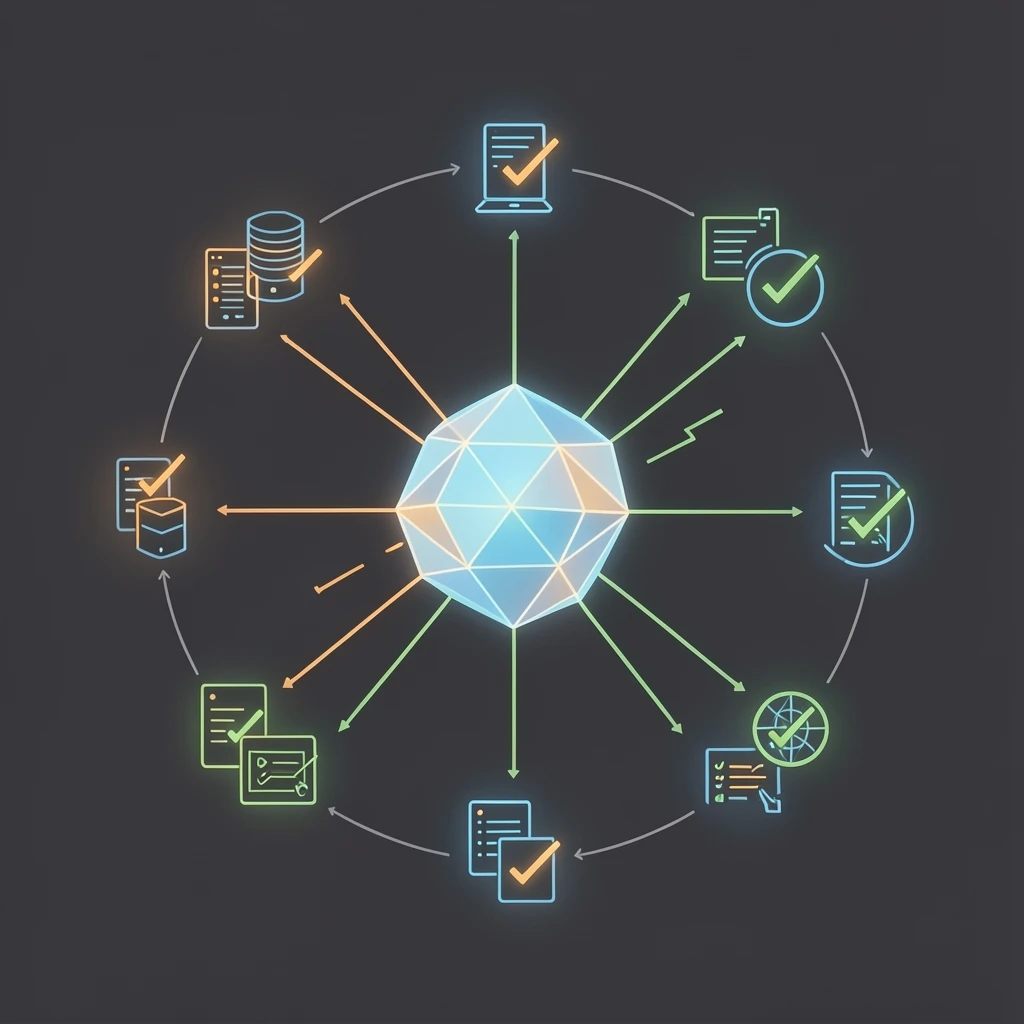
What separates Datafi from an intelligent analytics layer is its agentic capacity. Once the analysis has produced a prioritized action plan, Datafi can begin executing against it autonomously, within governed boundaries that your organization defines.
That means drafting and routing learning program enrollment communications. Updating development plans in your performance management system. Creating project assignments that align skill-building goals with active work. Flagging employees approaching certification milestones. Surfacing early indicators that a development track is not progressing as planned. Generating updated gap analyses as new data flows in, without waiting for the next quarterly review cycle.
The workforce does not stand still between planning cycles, and neither does Datafi. Skills gap analysis in the Datafi model is not a periodic report. It is a continuously maintained intelligence that acts as well as informs, closing the loop between strategy and execution in a way that static tools simply cannot.
Governance, Compliance, and Trust
Workforce data is among the most sensitive data an organization manages. Any platform that touches it must meet a high bar for privacy, access control, and auditability. Datafi was built with compliance-ready governance as a foundational capability, not a feature added after the fact.
Role-based access controls ensure that executives, managers, HR business partners, and individual contributors each see only what they are entitled to see. Every query, every AI-generated output, and every automated action is logged and auditable. Organizations operating under regulatory frameworks, whether in financial services, healthcare, government, or other governed industries, can configure Datafi to enforce the data handling rules that apply to their context. The AI works within your governance structure, not around it.
This matters especially in workforce contexts where the risk of AI-generated insight influencing consequential decisions about people, compensation, development, and career trajectory is real and serious. Datafi’s architecture ensures that the humans responsible for those decisions remain in control, with AI that augments and accelerates their judgment rather than displacing it.
Accessible to Organizations of Every Size
One of the persistent frustrations with talent intelligence in the market is that the most powerful tools have been built for the largest enterprises, with implementation costs, licensing structures, and complexity levels that put them out of reach for mid-market organizations. The skills gap problem is not unique to large enterprises. A 200-person professional services firm competing for specialized talent faces exactly the same strategic challenge as a company ten times its size.
Datafi’s vertically integrated architecture is designed to make the full capability of governed, contextual AI accessible regardless of organizational scale. The depth of analysis is not a function of how large your IT team is or how many systems you have successfully integrated. It scales with the data you have, delivered through a Chat UI that requires no technical expertise to use. Business leaders and HR professionals engage with Datafi in natural language and get the intelligence they need to make better decisions faster, whether they are operating at a hundred employees or a hundred thousand.
The Broader Opportunity
Workforce skills gap analysis is a compelling use case on its own. But it is also a window into a broader transformation in how organizations can use data to make decisions about their most important asset.
When the same platform that closes a skills gap analysis can also reason about succession planning, internal mobility, organizational design, learning investment prioritization, and workforce forecasting, the compound value of having full business context in a single governed AI platform becomes clear. These challenges are not separate problems. They are facets of the same problem: understanding what your organization is capable of today, and what it needs to become.
Every organization is trying to close the distance between the workforce it has and the workforce it needs. Most are doing it slowly, expensively, and with incomplete information. Datafi changes that, not by answering the question of where the gap is, but by actively closing it.
Getting Started
Datafi connects to the systems you already use, so the path to workforce skills gap analysis does not require a rip-and-replace of your HR technology stack. Integration is governed and incremental. Value is immediate. The first insight delivered through a conversational exchange with your own workforce data tends to change how executives think about what AI is actually capable of doing for them.
If your organization is ready to move from skills gap reports to skills gap resolution, Datafi is built for exactly that.
Ready to see what Datafi can do with your workforce data? Request a demo and let us show you what it looks like when AI stops answering questions and starts solving problems.