


For the accounting and finance function of a multinational corporation, fixed asset management has long been a discipline defined by its friction. Disparate systems, manual reconciliations, inconsistent depreciation schedules across jurisdictions, and the ever-present risk of audit exposure make asset management one of the most resource-intensive workflows in the enterprise. The underlying data exists, scattered across ERP platforms, procurement systems, facility management tools, and spreadsheet-based registers maintained by teams in different countries and currencies. The problem has never been a lack of data. It has always been the inability to act on it.
Datafi changes that equation entirely.
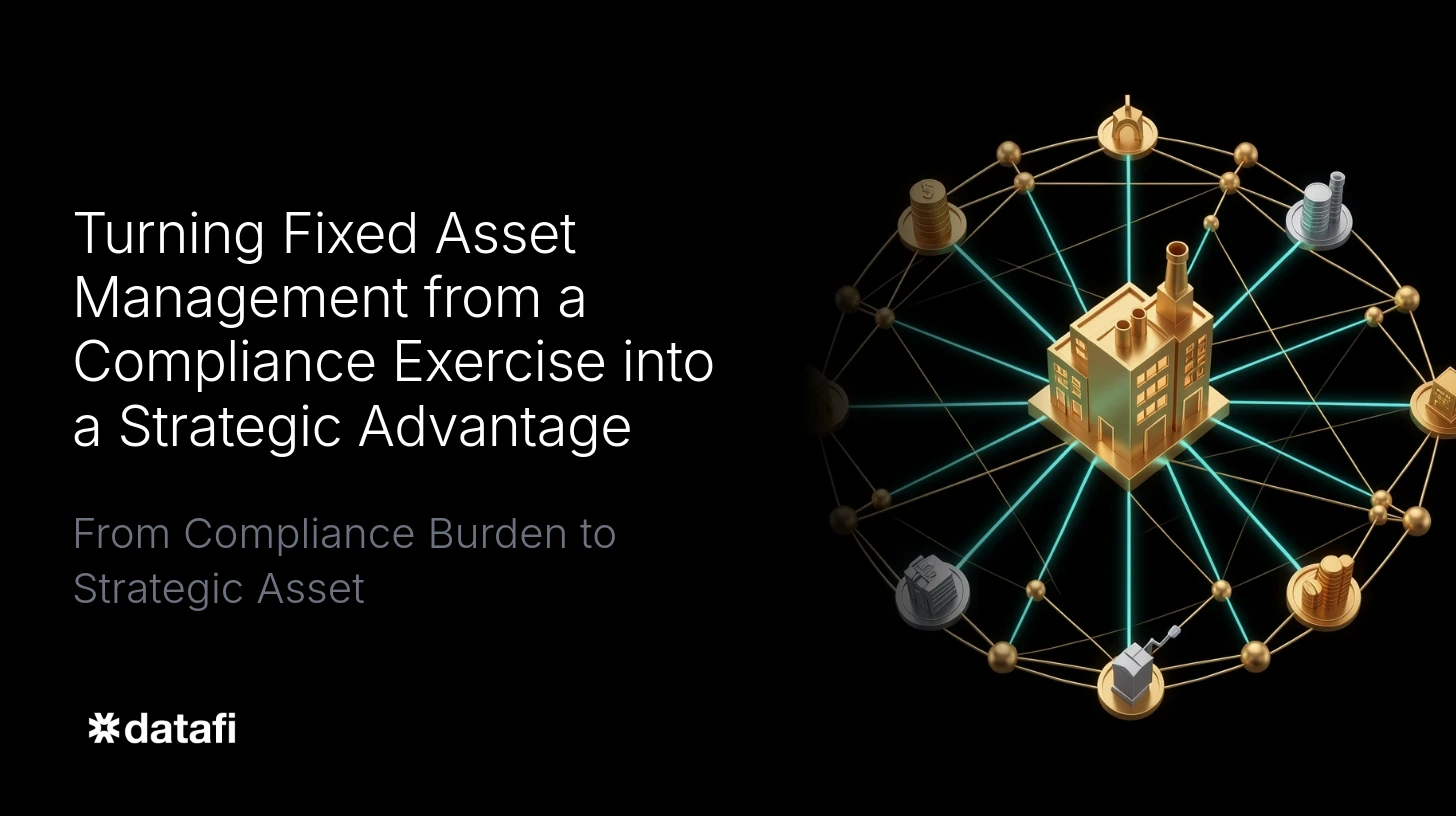
The core challenge in fixed asset management is not a lack of data; it is the inability to act on it. Datafi bridges the gap between scattered enterprise data and the strategic insight finance teams need to drive decisions.
The Challenge: Data Exists, Insight Does Not

Consider the reality facing a Global Controller or VP of Finance in a corporation operating across 20 or more countries. The fixed asset register might live in SAP in Germany, Oracle in the United States, and a combination of regional ERPs and local tools across Asia-Pacific. Depreciation policies vary by jurisdiction. Tax treatment of assets differs by country. Impairment reviews are triggered manually, often late, and without a consistent methodology. Meanwhile, lease classification under IFRS 16 and ASC 842 adds another layer of data complexity, with right-of-use assets that must be tracked, reassessed, and disclosed alongside traditional fixed assets.
The finance team is not short of reports. They are short of answers. And the gap between a report and an answer is exactly where Datafi operates.
The Datafi Workflow: From Data to Decision
Datafi connects directly to the enterprise data sources that house asset-related information: ERP systems, procurement platforms, lease management tools, maintenance databases, and external market data feeds. Rather than asking finance teams to export, consolidate, and interpret, Datafi’s AI workflow layer ingests the data, understands its context, and surfaces the insight that drives action.
Asset Register Reconciliation and Anomaly Detection
A Datafi workflow continuously monitors the fixed asset register across all connected systems, identifying discrepancies in asset classification, useful life assumptions, and book value versus insured value. When an asset in the Singapore entity carries a depreciable life of 10 years for a category that the global policy specifies at 7 years, Datafi flags it, attributes it to the responsible team, and routes it through a remediation workflow, complete with supporting policy documentation. What previously required a quarterly manual review becomes a continuous, automated quality layer.
Impairment Trigger Monitoring
Under IAS 36, impairment indicators must be assessed at each reporting date. But identifying those indicators has always relied on human judgment applied inconsistently across regions. A Datafi workflow integrates operational data (utilization rates, maintenance frequency, revenue generated per asset) with external market signals (commodity prices, real estate indices, sector-specific benchmarks) to proactively surface assets where impairment testing is warranted. The AI does not replace the accountant’s judgment. It ensures that judgment is applied to the right assets, with the right evidence, at the right time.
Depreciation Optimization and Scenario Modeling
Datafi enables finance teams to ask forward-looking questions that traditional asset management tools cannot answer. What is the P&L impact if we accelerate depreciation on our North American manufacturing fleet ahead of a capital refresh program? How does a change in residual value assumptions for our leased vehicle portfolio affect EBITDA across reporting segments? The Datafi platform translates these questions into structured data workflows, executes the analysis across connected systems, and returns scenario outputs in the format the finance team actually uses, whether that is a board-ready summary, a disclosure-ready footnote draft, or a model feed for the CFO’s planning team.
Disposal and Write-Off Workflow Automation
Asset disposals are among the most manual and error-prone processes in corporate accounting. Gains and losses must be calculated, journal entries prepared, fixed asset registers updated, tax bases adjusted, and disclosures reviewed, all across multiple entities and accounting frameworks. A Datafi workflow orchestrates this entire process from a single trigger event, coordinating the data transformations required across systems, generating draft journal entries for review, and flagging any disposal where the accounting treatment differs from what tax would require.
Audit Readiness as a Continuous State

Rather than building audit files at year-end, Datafi maintains a living, audit-ready evidence layer throughout the year. Every asset movement, revaluation, impairment charge, and disposal is traced to its source data, its policy basis, and the human reviewer who approved it. When auditors request support for the machinery and equipment balance, the Datafi platform surfaces the complete chain of evidence in minutes, not weeks.
The Outcome: Finance as a Strategic Function
The finance teams that implement Datafi’s asset management workflow do not just close faster and audit cleaner. They recover capacity. Controllers and technical accounting specialists stop spending their most valuable hours on data wrangling and start spending them on the judgment-intensive work that drives enterprise value. Capital allocation conversations become richer because the data is trustworthy and timely. Impairment risks surface before they become disclosure surprises. And the asset register, historically a static ledger, becomes a dynamic input to strategic planning.
The asset register, historically a static ledger, becomes a dynamic input to strategic planning.
Datafi does not replace the expertise of the finance professional. It removes every obstacle that prevents that expertise from being applied where it matters most.
This is what it means to action your data.