


The Challenge: Complexity at the Speed of Global Business
For the accounting and finance function of a multinational corporation, every day is a race against complexity. Treasury teams manage liquidity across dozens of banking relationships, legal entities, and currencies. Accounts payable and receivable teams reconcile transactions against bank statements, ERP records, and intercompany ledgers that rarely agree on the first pass. Controllers chase month-end close across time zones. And through it all, the CFO needs a real-time view of cash positioning, exposure, and risk that no single system can reliably provide.
The data exists. It sits in bank portals, SWIFT feeds, ERP systems like SAP and Oracle, treasury management systems, Excel workbooks, and email inboxes. The problem has never been a lack of data. The problem is that assembling it into actionable intelligence has required armies of analysts, days of manual effort, and tolerance for a version of the truth that is always slightly out of date.
Datafi changes this equation entirely.
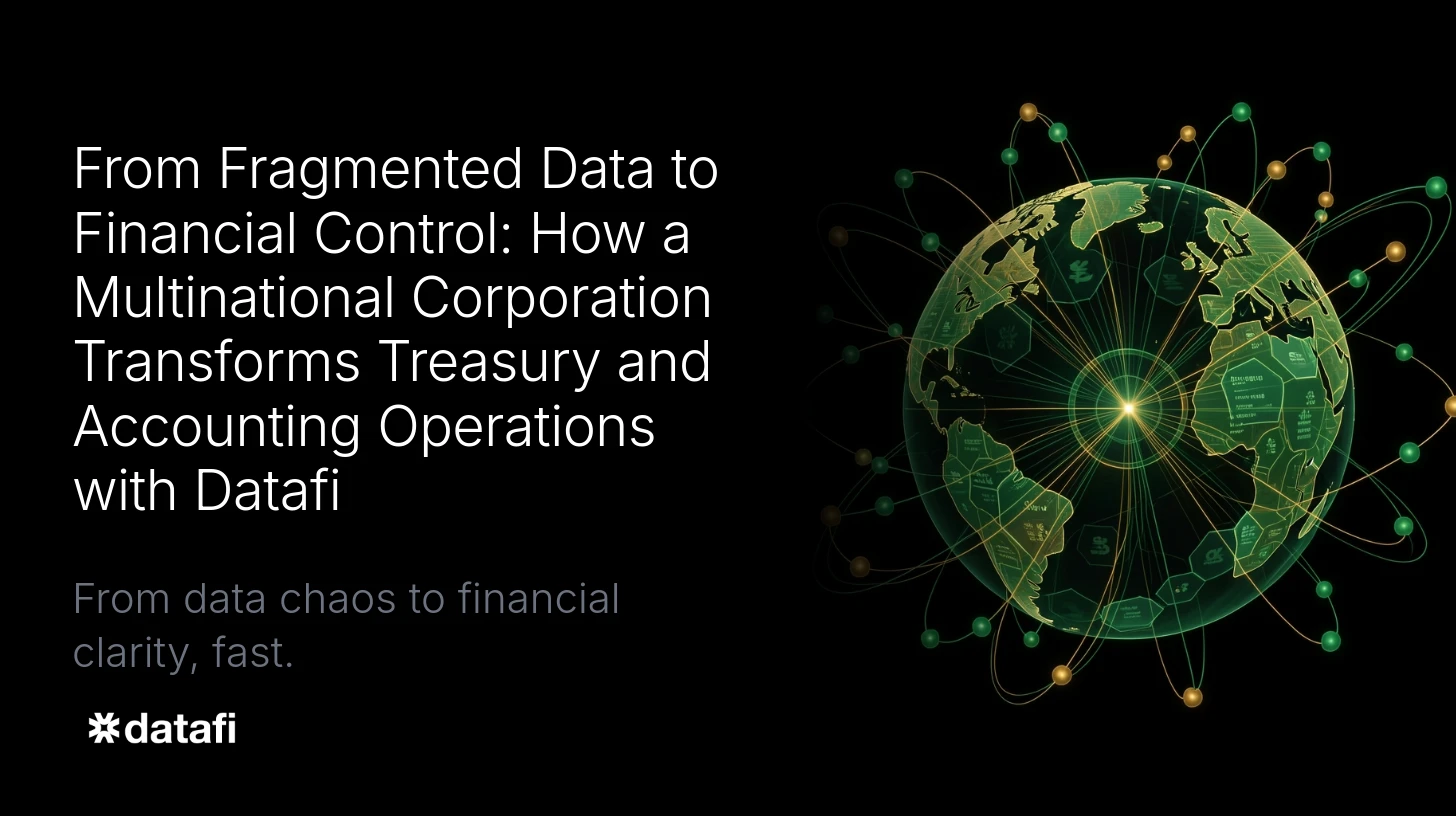
The core challenge for multinational finance teams is not a lack of data; it is the inability to assemble fragmented data into trusted, actionable intelligence quickly enough to drive decisions. Datafi solves this by connecting every relevant source and enabling action within a single governed workflow.
The Datafi Approach: Connecting, Contextualizing, and Acting on Financial Data
Datafi is an applied AI platform built on a foundational insight: transformative outcomes require more than answering questions. They require the ability to take action on data, within the systems and workflows where work actually happens. For corporate banking and treasury operations, this means Datafi does not simply surface information. It connects to every relevant data source, understands the business context, and enables finance teams to move from insight to action in a single, governed workflow.
A global manufacturer with operations across 40 countries and banking relationships with 18 financial institutions illustrates exactly how this works in practice.
Use Case: End-to-End Treasury and Accounts Payable Workflow Automation
Step 1: Unified Cash Visibility Across All Banking Relationships

The treasury team begins each morning with a fragmented picture. Bank statement files arrive via SWIFT MT940 and BAI2 feeds at different times from different banks, each formatted slightly differently. Subsidiaries report local balances through manual spreadsheet submissions. The TMS aggregates what it can, but reconciliation gaps mean the global cash position is never fully trusted before 11am.
With Datafi, all bank data feeds, TMS exports, and subsidiary reports are connected through a unified data fabric. The platform’s AI continuously normalizes, reconciles, and validates incoming data against expected patterns, flagging discrepancies proactively rather than waiting for a human to notice them. By the time the treasury analyst opens their morning dashboard, Datafi has already ingested overnight feeds, reconciled them against the prior day’s closing positions, and surfaced any exceptions that require attention, with supporting context drawn from the transaction history and counterparty records.
The result is a real, trusted global cash position available at the start of business. Not an approximation. A defensible, auditable number.
Step 2: Intelligent Intercompany Reconciliation
Month-end close for a multinational is routinely delayed by intercompany reconciliation. Entity A books a payment to Entity B. Entity B has not yet recorded the receipt. The difference sits in a reconciling items list that grows longer every quarter, consuming weeks of senior accountant time.
Datafi applies AI-driven matching logic across intercompany transaction records sourced directly from each entity’s ERP instance. It identifies unmatched pairs, determines the likely root cause (timing, currency translation variance, coding error), and routes each exception to the appropriate owner with a suggested resolution. Accountants do not start from a spreadsheet. They start from a Datafi workflow that presents the discrepancy, the relevant transaction detail from both entities, the suggested fix, and the ability to approve and post the correcting entry directly from the interface.
What previously took three weeks of back-and-forth now closes in days, with a complete audit trail that satisfies both internal controls and external auditors.
Step 3: Accounts Payable Intelligence and Payment Orchestration
The accounts payable team processes thousands of supplier invoices each month. Matching invoices to purchase orders and goods receipts is labor-intensive, and exceptions create bottlenecks. Late payments erode supplier relationships and forfeit early payment discounts. Fraudulent invoices slip through when volume overwhelms manual review.
Datafi ingests invoices from every channel, including scanned paper, PDF email attachments, EDI, and supplier portals, and applies AI extraction and classification to normalize them into structured records. Three-way matching against PO and GR data happens automatically, with Datafi resolving the straightforward matches and presenting only true exceptions to the AP team, ranked by financial risk and payment deadline.
Critically, Datafi also analyzes cash positioning alongside payment terms to recommend optimal payment timing. When the treasury position supports it, the system identifies invoices eligible for dynamic discounting and surfaces them as an action, allowing a single click to authorize early payment and capture the discount. This is the kind of working capital intelligence that treasury and AP teams have always wanted but could never operationalize because the data lived in too many places.
Step 4: Regulatory and Compliance Reporting
Multinational treasury operations carry significant regulatory reporting obligations, from FBAR filings and country-by-country reporting to in-country VAT reconciliations and bank covenant compliance. Each requires assembling financial data from multiple sources into formats that satisfy specific regulatory standards.
Datafi maintains a continuously updated, jurisdiction-aware data model for each entity. Compliance workflows trigger automatically based on filing calendars, drawing on the underlying financial data to pre-populate reports, run validation checks, and route drafts for review and sign-off. What was previously a manual extraction and formatting exercise becomes a governed, repeatable workflow with built-in quality controls.
The Outcome: Finance as a Strategic Function
When Datafi powers the accounting and finance function of a multinational corporation, the transformation is not incremental. Treasury moves from reactive cash management to proactive liquidity optimization. The close cycle compresses. Working capital performance improves because the data to act on it is finally available at the moment decisions are made. Compliance risk decreases. And the finance team, freed from the grind of manual data assembly, becomes the strategic partner the business needs.
This is what Datafi means by actioning data. Not dashboards. Not answers. Outcomes.
Ready to see how Datafi can transform financial operations at your organization? [Request a demo]