


Stop Losing Your Best People Before You Know They Are Already Gone
The resignation letter lands on a manager’s desk and the reaction is always the same: “I had no idea.” But the signals were there. They were scattered across a dozen systems, buried in unread reports, hidden in plain sight inside the data your organization already owns. The problem was never a lack of information. The problem was that the information never came together in a way that made the risk visible, actionable, and early enough to matter.
This is where Datafi changes everything.
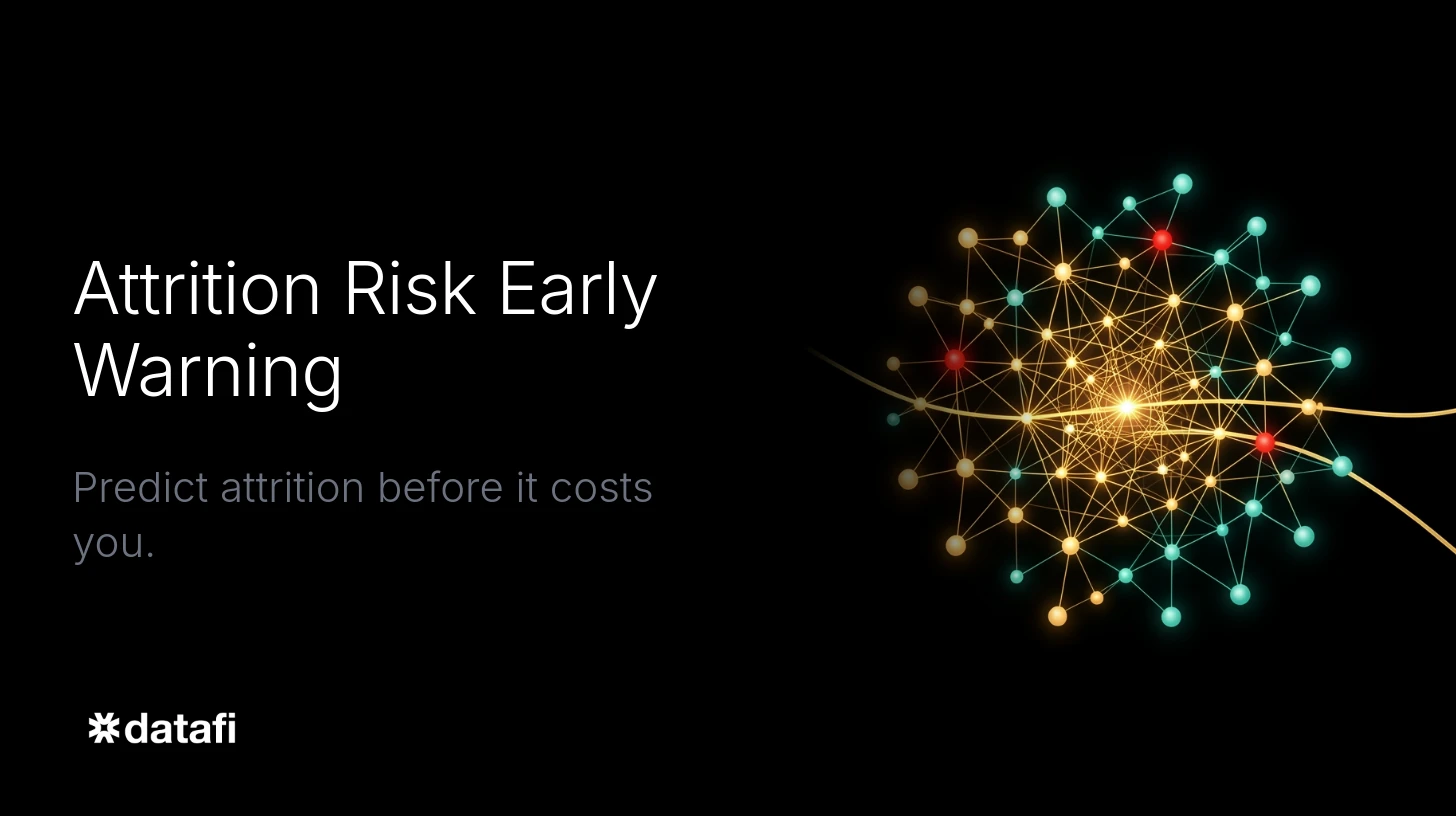
Attrition risk is not a people problem, it is a data synthesis problem. The signals that predict departure are already inside your systems. Datafi connects them, reasons across them in real time, and triggers coordinated retention action before the resignation letter ever arrives.
The True Cost of Attrition Is What You Cannot See

Most organizations measure attrition after the fact. Turnover rate, time-to-fill, cost-per-hire. These are lagging indicators. They describe what already happened. By the time they appear in a dashboard, the employee is gone, the institutional knowledge has walked out the door, and the team has begun absorbing the disruption.
The research is consistent: replacing a mid-level professional costs between 50 and 200 percent of their annual salary when you account for recruiting, onboarding, productivity ramp-up, and the cultural ripple effects on those who remain. For a senior technical contributor or a high-performing sales team member, the number is higher. For a specialized role in a tight labor market, it can be devastating.
But the cost that never appears on a spreadsheet is the one that often matters most. Attrition is contagious. When a valued team member leaves, others recalibrate. They ask themselves the question that retention strategy must answer before they ask it out loud: is this still the right place for me?
Early warning is not just a talent metric. It is a business continuity imperative.
Why Current Approaches Fall Short
The standard playbook for attrition risk runs into the same wall every time: data fragmentation.
Human resources teams own engagement survey results but rarely have visibility into performance trajectory or project workload. Finance has compensation benchmarking data but it lives in a separate system from promotion histories. Managers observe behavioral changes in day-to-day interactions but those observations never make it into any structured record. Collaboration platforms hold patterns of participation and energy that no one is formally analyzing.
Even organizations that have invested in people analytics tools find that they produce reports, not responses. A score appears on a screen. An employee gets flagged. And then what? Who sees it? Who is responsible for acting? What do they do? Within what timeframe? With what context about the individual, the team, the manager, the compensation gap, the career trajectory?
The gap between insight and intervention is where attrition risk lives. Datafi closes that gap.
How Datafi Approaches Attrition Risk Early Warning
Datafi is not a reporting tool with a chatbot layered on top. It is a vertically integrated AI platform that connects to your full data ecosystem, builds the business context required to reason meaningfully across it, and delivers AI agents that take structured action rather than simply generating information.
Attrition risk is exactly the kind of problem Datafi was built to solve, because it is fundamentally a problem of synthesis across complex, distributed, and semantically rich data.
Connecting the Full Picture
Datafi integrates with your HRIS, your performance management system, your payroll and compensation data, your project and workload management tools, your engagement survey platform, and where appropriate with appropriate governance controls, your collaboration data. It does not require you to move all of that data into a single warehouse first. Datafi meets your data where it lives.
What this creates is something no individual system can produce on its own: a unified, continuously updated view of each employee as a whole person within a whole organization. Not a row in a database. A context.
Building Risk Intelligence That Understands Your Business
Risk scoring for attrition is only meaningful when it is calibrated to your organization. A compensation gap that represents moderate risk at one company is a critical signal at another. A pattern of reduced collaboration that suggests disengagement in one team culture is completely normal in another.
Datafi’s AI is trained on your business context, not on a generic model of what attrition looks like everywhere. It learns the specific patterns, thresholds, and combinations of signals that have historically preceded departures at your company, in your industry, and within different functions and levels of your organization.
The result is a risk model that speaks the language of your business and earns trust precisely because it does not produce unexplainable black-box scores. Datafi surfaces the reasoning. It shows the contributing factors. It gives managers and HR partners the narrative they need to have a confident, informed conversation.
Signals That Matter, Synthesized in Real Time

Datafi continuously monitors and synthesizes a rich signal set across connected systems, including:
Compensation gaps relative to internal equity benchmarks and external market data, flagging employees whose total compensation has drifted meaningfully below what comparable roles command in the current market.
Performance and recognition patterns, identifying individuals whose trajectory has plateaued or whose contributions have gone unacknowledged for extended periods relative to organizational norms.
Career progression velocity, surfacing employees who have been in role longer than comparable peers without a visible path to advancement, particularly those in the early and mid-career stages where opportunity cost sensitivity is highest.
Manager relationship dynamics, including recent manager changes, team restructuring events, or patterns in feedback and one-on-one activity that correlate with increased risk in your historical data.
Workload and project patterns, detecting signs of either chronic overload without recognition or sudden underutilization that can signal disengagement or organizational marginalization.
Engagement survey response patterns, including non-response rates, sentiment trajectory, and specific thematic signals that precede disengagement.
None of these signals alone tells the story. Datafi brings them together.
From Risk Score to Coordinated Action
This is where Datafi separates itself from every people analytics tool that came before it. Identifying risk is the beginning of the process, not the end.
When Datafi surfaces an attrition risk, it does not deliver a number and leave the organization to figure out what to do next. It initiates a coordinated response workflow.
The relevant HR business partner receives a contextual briefing that includes the risk profile, the key contributing factors, and suggested intervention approaches tailored to the specific situation. The manager receives a targeted prompt with conversation guidance that does not feel like a corporate script because it is grounded in what Datafi actually knows about that employee’s experience. Compensation review is flagged where a gap exists. Succession planning is updated where a departure would create a critical knowledge or role coverage risk.
Every step is governed, auditable, and aligned with your organizational policies and data access controls. Datafi’s approach to AI governance means that the right information reaches the right people, and only the right people, at every stage of the workflow.
What This Looks Like in Practice
Consider a scenario that plays out in organizations of every size and industry.
A senior engineer on a product team has been with the company for four years. Their performance ratings have been consistently strong. They were promoted three years ago but have not advanced since. In the past six months, their manager changed twice due to a reorganization. Their compensation, benchmarked when they were hired, now sits 18 percent below market rate for their role and experience level. Their participation in company-wide collaboration channels has decreased steadily. They skipped the last engagement survey.
No single system flags this person as at risk. Their last performance review was positive. They have not complained to HR. Their manager, new in the role, does not yet have the full context of their history.
Datafi sees the complete picture. It surfaces this employee as high risk, explains the contributing factors in plain language, and initiates a coordinated response. The HRBP is briefed. The manager is provided with specific guidance for a stay conversation. A compensation review request is generated. A career development conversation is recommended within a defined timeframe.
That intervention happens before the resignation letter. That is the difference.
The Organizational Capabilities Datafi Builds Over Time
Every intervention, every outcome, every retention or departure becomes part of an organizational learning loop within Datafi. The platform’s risk models grow more precise over time. The signals that matter most for your specific organization become more clearly weighted. The speed and accuracy of early detection improves.
Organizations using Datafi for attrition risk do not just get better at responding to risk. They build institutional intelligence about what makes their people stay, grow, and thrive, and that intelligence becomes a lasting competitive advantage in the talent market.
Who This Is For
Attrition risk early warning with Datafi is built for organizations that are serious about treating talent as a strategic asset, not just an operational input. It is for CHROs and people analytics leaders who are tired of explaining retention failures after the fact and want to be in a position to prevent them. It is for CFOs who understand that the real cost of attrition is a multiple of what appears in the recruiting budget. It is for business leaders who have learned the hard way that the knowledge, relationships, and institutional memory that leave with a valued employee are rarely fully recovered.
It is for any organization that believes the answer to “why didn’t we see this coming?” should be: “we did.”
Ready to See What Your Data Already Knows?
Your organization is already generating the signals that predict attrition risk. They are scattered across your systems, waiting to be connected and understood. Datafi brings them together, reasons across them with full business context, and transforms what was once hindsight into early warning and coordinated action.
The best time to act on attrition risk is before the conversation an employee is already having with someone else.
Let Datafi show you what is already visible in your data.
Explore how Datafi’s vertically integrated AI platform connects your data ecosystem, builds business context, and delivers AI agents that act. Not just answers. Outcomes.