


Post 2 of 3 in the series “The Limits of AI Point Solutions”
Nobody in your organization ever decided to build a monolith. And yet, somewhere around the eleventh AI tool, you have one. It just happens to be assembled from parts you cannot see into, cannot govern together, and cannot take apart.
The first post in this series argued that point solutions leave the process intact while raising activity inside a single step. That is the visible cost, and it is the one that shows up in the quarterly readout as a number that fails to move.
This post is about the invisible cost, which is larger, and which behaves differently than most leaders expect. The costs of fragmentation are not additive. They compound.
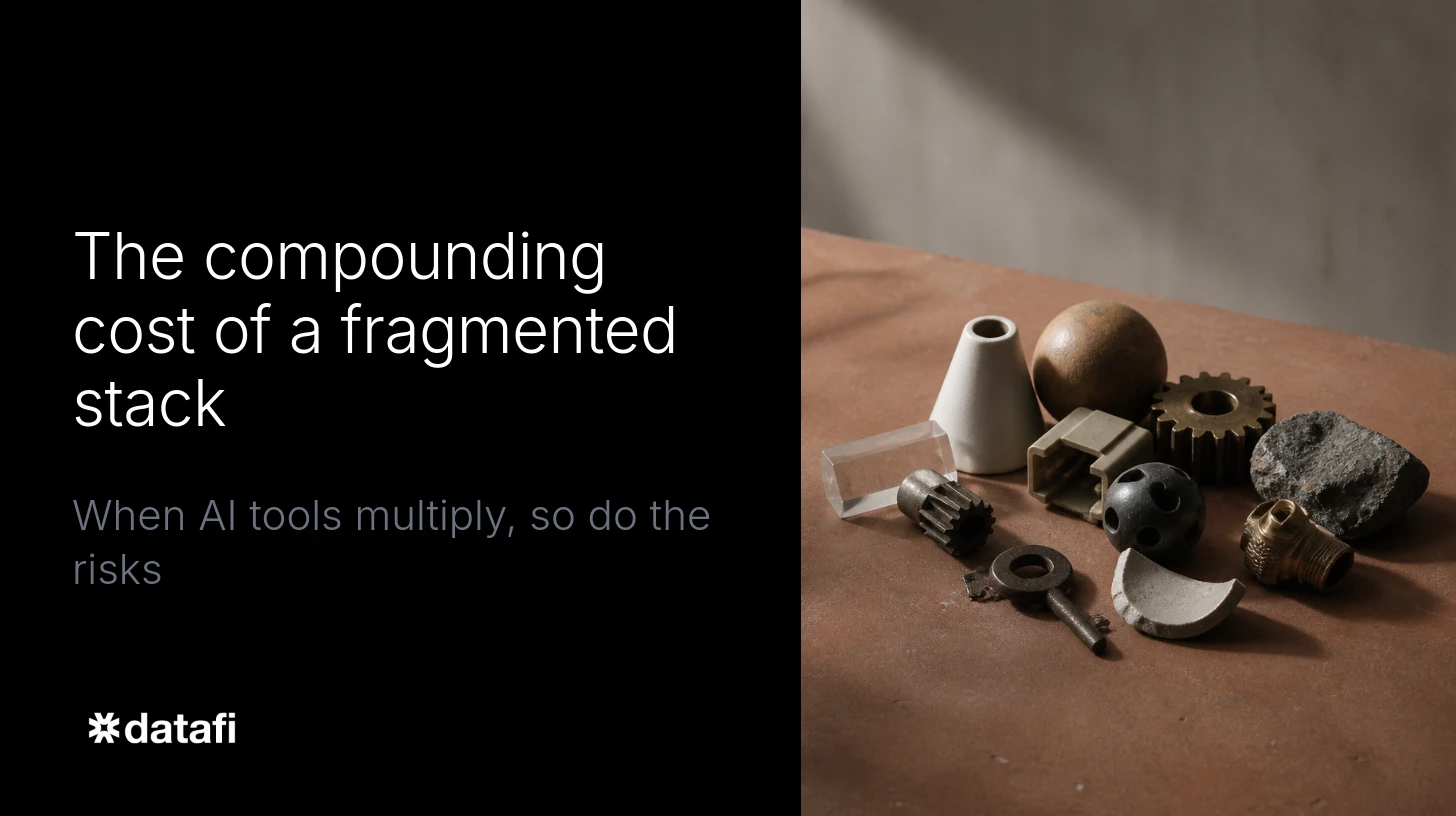
The cost of a fragmented AI stack is not the sum of its tools. It is the product of their interactions. Governance debt scales with pairs, not parts. Context fragmentation multiplies bad interpretations rather than averaging them. And in an agentic architecture, both of these become executable.
The premise worth questioning
The standard mental model for a tool portfolio is a line item. Eleven tools, eleven contracts, eleven renewal dates, eleven vendors to manage. Annoying, certainly, but linear. You can put it on a spreadsheet and the spreadsheet tells you what it costs.
The spreadsheet is wrong, because it counts the tools and not the spaces between them. And in an agentic architecture, the spaces between the tools are where the risk lives.
Consider what actually accumulates when eleven vendors each independently solve the same four problems for you: who is allowed to see what, what the business means by a customer, what happened and why, and how to get out. Each vendor solved these problems for themselves, competently and in isolation, using their own definitions. You did not buy eleven solutions. You bought eleven answers to the same four questions, none of which agree with each other, and no way to reconcile them.
That is not a line item. That is a structural liability with a growth rate.
In fairness: the case for accumulating
Before I make the argument against, I want to make the argument for honestly, because the leaders who assembled these portfolios are not careless people.
Buying incrementally is how you preserve optionality in a market that is moving this fast. Committing early to a single platform in a category that is reinventing itself every six months is a real risk, and the executive who declined to make that bet was exercising judgment, not avoiding it. Point solutions also let you fund AI without a board conversation, prove value in one function before asking for enterprise budget, and fail cheaply when something does not work.
McKinsey names the underlying dynamic without judgment: vertical use cases at most companies have been identified through a bottom-up, highly granular approach within individual functions, and fewer than thirty percent of companies report that their CEO directly sponsors the AI agenda. Fragmentation is not a failure of individual judgment. It is what happens when good local decisions are made without an enterprise-level coordinating structure, which is to say, it is the predictable output of the system as designed.
The problem is that optionality purchased this way is an illusion. You do not stay flexible by accumulating. You stay flexible by owning the layer underneath.
Four costs that compound
One: governance debt
Every tool you add builds its own access model. It has its own notion of roles, its own mapping to your identity provider, its own idea of what a permission is, and its own audit log in its own format.
Ask a simple question across that estate: which of our AI systems can currently read the compensation data, and who approved that? In a fragmented stack, answering it is a project. It requires eleven investigations, eleven exports, and a human to reconcile eleven vocabularies. By the time you have the answer, it is out of date, because someone in marketing enabled a new connector on Tuesday.
Governance debt compounds because the reconciliation cost is not linear in the number of tools. It is a function of the number of pairs. And because the answer decays continuously, you are not paying it once. You are paying it every time anyone asks.
Two: context fragmentation
This is the cost I find most consequential and least discussed.
Every AI vendor you onboard must build some model of your business in order to be useful. They index your documents. They map your schema. They infer your entities. And because each one only has access to the system it was bolted onto, each one builds a partial picture and treats it as complete.
Now you have eleven partial pictures of your business, all of them confidently wrong in different places, none of them authoritative, and all of them being used to make decisions. The support tool thinks a customer is an account in the ticketing system. Finance thinks a customer is a billing entity. The CRM thinks a customer is a logo. When an agent reasons across that, it does not detect the disagreement. It picks one and proceeds.
McKinsey observes that data accessibility and quality gaps persist across both structured and unstructured data, with unstructured material remaining largely ungoverned in most organizations. Fragmentation makes this worse rather than better, because every additional tool creates one more ungoverned interpretation of the same underlying reality, and none of them can be corrected centrally.
Context, unlike storage, does not benefit from redundancy. Eleven copies of a partial truth do not converge into a whole one.
Three: agentic blast radius
Everything above was tolerable when AI answered questions. A wrong answer from a tool with a partial view of the business is an inconvenience. A human reads it, applies judgment, and moves on.
Agentic AI removes the human from the loop. That is the entire value proposition, and it is also what changes the risk calculus completely. An agent with a partial view of the business and permission to act does not produce a wrong answer. It produces a wrong action, at machine speed, across systems, without anyone reading it first.
McKinsey is direct about this. Agents introduce a class of systemic risk that earlier architectures were never designed to handle: uncontrolled autonomy, fragmented system access, lack of observability and traceability, an expanding attack surface, and agent sprawl. They warn explicitly about the risk of agent sprawl, the uncontrolled proliferation of redundant, fragmented, and ungoverned agents across teams as low-code platforms make agent creation available to anyone, producing a new kind of shadow IT. They also identify limiting the blast radius of a compromised agent as a core architectural capability, not an operational afterthought.
Four: lock-in by accumulation
The final cost is the one that arrives last and hurts most.
Each individual tool was easy to leave. That was the pitch, and at the time it was true. But leaving is easy only when nothing depends on you. Two years in, the tool is wired to four systems, its outputs feed three reports, a function has built its operating rhythm around it, and the context it constructed about your business lives inside it and nowhere else. Rip it out and you lose the context, because you never owned it. You rented it.
Multiply by eleven and the position is clear. You never chose a monolith. You assembled one, incrementally, in the name of avoiding one. And unlike a monolith you chose deliberately, this one has no coherent exit, because it has no coherent inside.
McKinsey’s architectural prescription points the same direction. They argue for vendor neutrality as a design principle, where components can be independently updated or replaced as technology advances, and for open standards such as the Model Context Protocol over proprietary protocols. That is not achievable tool by tool. It is achievable only at a layer.
What has to be true instead
If the costs compound through the spaces between tools, then the remedy cannot be another tool. It has to be the thing that occupies the space.
This is the architectural claim behind Datafi. Governance is not a feature of each application; it is enforced once, in Sentinel, against a single expression of who may see and do what, so the question of which systems can read compensation data has an answer rather than a project. Context is not reconstructed privately by each vendor; it lives in a global business contextual layer that holds the authoritative definition of your entities and your policies, so that agents reason over the business rather than over one system’s misreading of it. Autonomy is not unbounded in the gaps; agents run through Orchestrate against that governed layer, which means the boundary is expressed in the one place that spans all the systems the agent touches. And what those agents actually did is visible in Control Tower, because observability that stops at a tool boundary is not observability at all in a workflow that crosses four of them.
None of this requires replacing the systems you run. That claim deserves its own post, and it gets one next.
Where this goes
The uncomfortable arithmetic of fragmentation is that doing nothing is not neutral. The portfolio does not hold steady while you decide. Governance debt accrues, context diverges, agents proliferate, and the exit cost rises, all without anyone approving any of it.
The good news is that the alternative is not the thing most leaders fear it is. The choice is not between tool sprawl and a rip-and-replace program that consumes two years and all your credibility.
In the final post of this series, I will make the case that integration and ownership are separable: that you can unify context, governance, and orchestration across your enterprise without surrendering your systems, your data, or your choice of model, and that this is what a Business AI Operating System actually is.
Datafi is a Business AI Operating System for mid-enterprise organizations, built to activate the systems you already own so AI can solve business problems rather than simply answer questions about them. Learn more at datafi.co.
Series: The Limits of AI Point Solutions
Post 1: The activity trap: why your AI pilots feel productive and change nothing
Post 2: The compounding cost of a fragmented stack
Post 3: The operating system alternative: integration and ownership are separable