


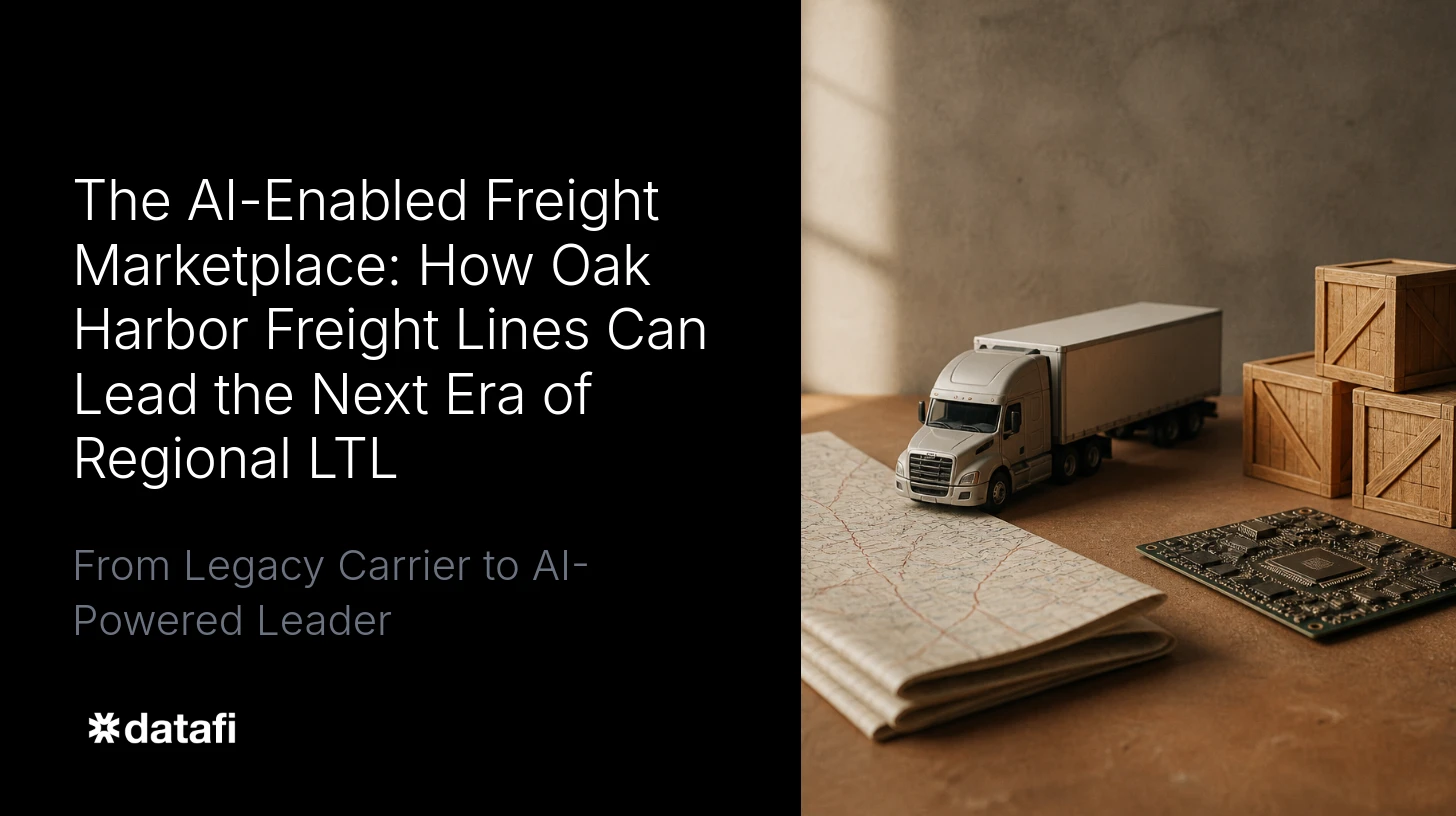
For over a century, Oak Harbor Freight Lines has been the West Coast’s most trusted regional LTL carrier, connecting shippers across Arizona, California, Idaho, Nevada, Oregon, Utah, and Washington. Built on a promise of peace of mind, Oak Harbor has grown to 40 terminals, 1,800 employees, and a network that stretches across the U.S. and Canada through strategic partnerships. That legacy is the foundation. What comes next is the transformation.
The carriers who build a vertically integrated AI operating infrastructure now, rather than assembling disconnected point solutions, will define regional LTL excellence for the next decade. Context is everything, and no point solution can provide it.
Freight transportation is entering a new operating era, one defined not by incremental efficiency gains but by the emergence of AI-enabled freight marketplaces that dynamically match supply and demand, anticipate disruption, and automate decisions at a scale no human workforce can match alone. The carriers who understand this shift and build the right AI infrastructure now will define the regional LTL landscape for the next decade.
The Freight Market Is Changing Faster Than the Tools
The LTL market in 2025 is a study in structural pressure. Rate and classification changes, network consolidation following Yellow’s collapse, rising fuel and labor costs, and the growing complexity of cross-border and last-mile demand have compressed margins industry-wide. At the same time, the technology gap between leading and lagging carriers is widening fast.
Competitors are already moving. Predictive analytics tools are enabling real-time rerouting that cuts delay incidents by over a third. The question is no longer whether AI will reshape regional freight. It already is. The question is whether the companies building the infrastructure of the next era will be the established regional carriers or the new platforms that replace them.
The Limits of Answering Questions
Most freight technology investments today share a common flaw: they are built to answer questions rather than solve problems. A dashboard that shows on-time delivery rates answers a question. A TMS that surfaces the lowest-cost lane option answers a question. Real-time tracking tells you where a shipment is right now. These are useful, but they are not transformative.
Transformative AI requires something different. It requires systems that know the full context of the business, not just the data in one system, but the complete operational, financial, and customer ecosystem. It requires access to every relevant data source, from telematics and maintenance logs to shipper demand signals and weather forecasts. And it requires the ability to act autonomously, not just flag an issue for a human to resolve, but initiate the workflow, reroute the load, schedule the repair, update the customer, and log the outcome.
This is the difference between AI that observes and AI that operates.
What an AI-Enabled Freight Marketplace Actually Looks Like
For Oak Harbor Freight Lines, an AI-enabled freight marketplace built on a vertically integrated data and AI platform would change how the entire organization functions.
Supply and demand automation means AI agents continuously monitor shipper demand signals, capacity availability across the terminal network, and market rate dynamics, then automatically match and price freight without human intervention. Load boards stop being reactive. Pricing becomes dynamic. Capacity utilization climbs because the system can see imbalances before they become problems.
Predictive maintenance and asset management means Oak Harbor’s fleet of 850+ tractors and 2,400 trailers is monitored in real time against maintenance history, telematics data, and manufacturer specifications. AI agents predict component failure before it happens, schedule maintenance proactively, and optimize asset utilization across terminals. The cost of unplanned downtime drops. Asset life extends.
Operations optimization means route planning is no longer a manual process run at the start of a shift. AI continuously recalculates optimal delivery sequences as new loads are tendered, traffic conditions change, and weather events develop. Driver time is better utilized. Fuel consumption decreases. On-time performance improves.
Shipper and customer experience means every Oak Harbor customer, regardless of whether they are a national retailer or a small manufacturer in Wenatchee, gets an AI-powered interface that answers questions, provides proactive shipment updates, and surfaces options when exceptions occur. Customer service becomes intelligent, not reactive.
Strategic planning means leadership has access to an AI layer that synthesizes demand forecasts, terminal capacity data, partnership performance, and market signals into forward-looking recommendations. Decisions about network expansion, pricing strategy, and capital allocation are grounded in predictive intelligence rather than historical reporting.
Why Vertical Integration Is the Prerequisite
It would be tempting to solve each of these challenges with a separate point solution: one vendor for predictive maintenance, another for route optimization, a third for dynamic pricing. This is how most enterprises have approached AI so far, and it is why most have not achieved transformative outcomes.
The problem is context. Each point solution only knows its own data. Predictive maintenance software does not know that the trailer it wants to pull from service is carrying a high-priority shipment with a guaranteed delivery commitment. A route optimization engine does not know that a driver is reaching hours-of-service limits unless it can see the ELD data. Dynamic pricing logic does not know that a shipper is at risk of churning unless it has visibility into customer relationship history.
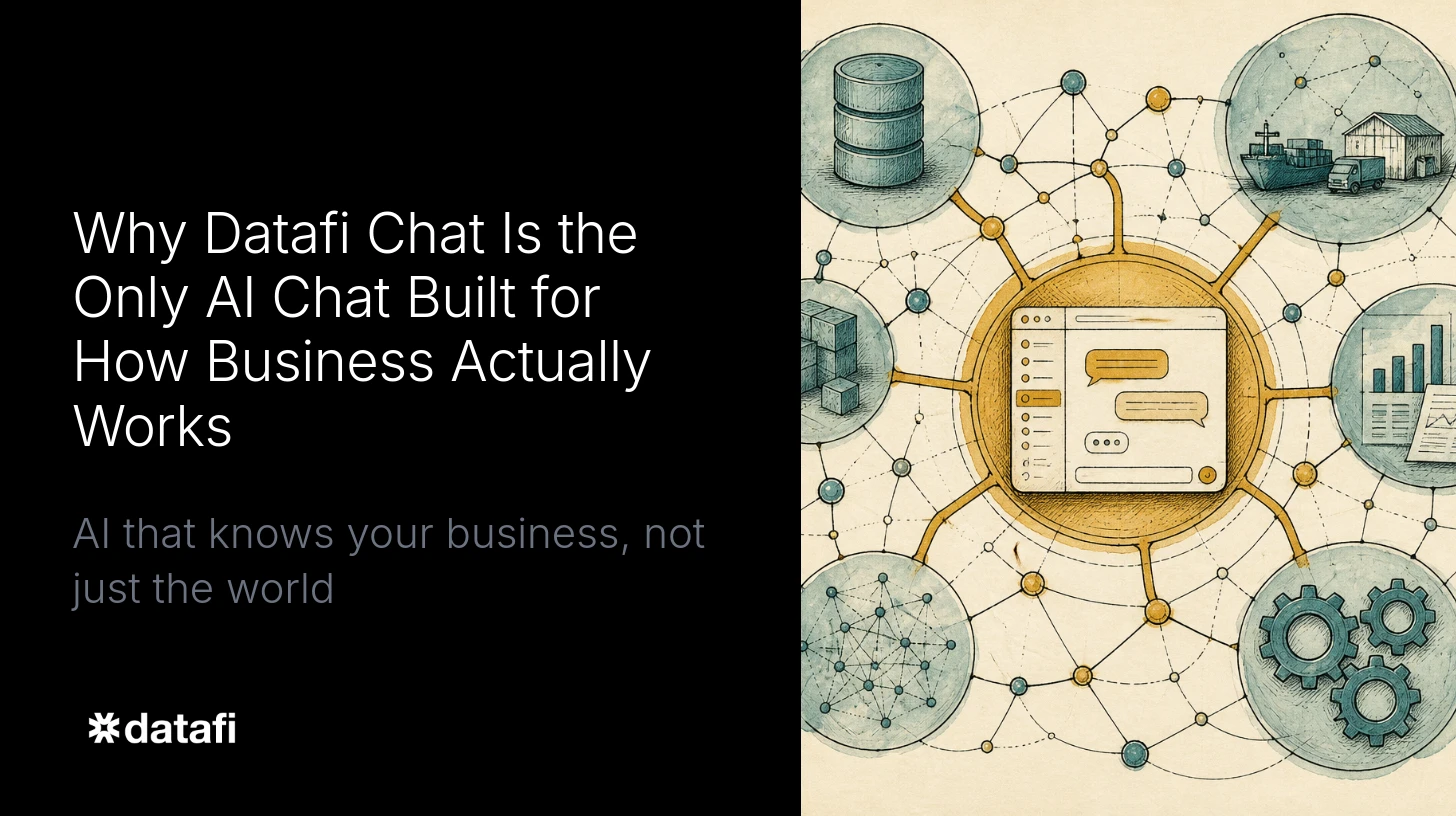
Transformative AI requires a vertically integrated data and AI platform that unifies access to the complete data ecosystem, enforces governance and policy across every workflow, and gives non-technical users a Chat UI that lets them ask complex questions and initiate actions without needing to understand the underlying systems.
This is what Datafi delivers. The Datafi Business AI Operating System is built on the premise that LLMs need the full context of the business, access to the complete data ecosystem, and the capacity to operate autonomously in order to move from answering questions to solving hard operational problems. The platform provides unified data access across every source, AI agents and workflows that execute across the enterprise, embedded governance and policy controls, and a Chat UI designed specifically for non-technical users, from drivers to dispatchers to senior operations leaders.
The Contextual Layer Advantage
What separates the carriers who will lead the next era from those who will follow is the development of a contextual layer: the accumulated, structured understanding of how their specific business operates, what their customers need, how their assets perform, and where their network is most and least efficient.
This contextual layer cannot be purchased from a vendor. It is built over time as AI agents learn from operational data, interact with users across the business, and refine their understanding of what good outcomes look like for Oak Harbor specifically. It becomes a durable competitive moat. The more deeply AI is embedded in daily operations, the more the contextual layer develops, and the more capable the agents become.
For a carrier with Oak Harbor’s 110-year operating history, the data assets to build this layer already exist. Maintenance records, customer histories, terminal performance data, route logs, and shipper relationship data represent an extraordinary foundation. The missing piece is the AI operating infrastructure to activate it.
A Century of Peace of Mind, Powered by Intelligence
Oak Harbor Freight Lines was built on the promise of reliability. Every terminal opened, every driver hired, every technology investment made has been in service of that promise. The next chapter of that story is not about replacing what has made Oak Harbor exceptional. It is about giving the entire organization, from the dock to the boardroom, the intelligence layer required to deliver on that promise at a level that was previously impossible.
The freight marketplace of the future will be AI-enabled, dynamically matched, and fully automated in the back-office workflows that currently consume hours of human effort every day. The carriers who build that capability on a vertically integrated platform, rather than assembling disconnected point solutions, will define what regional LTL excellence looks like for the next generation.
Oak Harbor has the network, the relationships, the operational history, and the culture to lead that transformation. The infrastructure to power it is available today.
Datafi is an applied AI software company building the Business AI Operating System for enterprises. Learn more at datafi.co.