


Post 1 of 3 in the series “The Limits of AI Point Solutions”
The AI dashboard is green. Adoption is up. Seat licenses are being used. Three functions have their own copilot, two more have a vendor pilot in flight, and the quarterly readout has a slide with a number on it that everyone nods at.
And the P&L has not moved.
This is not a hypothetical. McKinsey’s own research puts a hard number on it: nearly eight in ten companies have deployed generative AI in some form, and roughly the same proportion report no material impact on earnings. They call it the gen AI paradox. Widespread deployment, minimal impact. Only one percent of the enterprises they surveyed described their AI strategy as mature.
If almost everyone is deploying and almost no one is capturing value, the problem is not the technology. It is the shape of what we have been buying.
Adoption is not a proxy for transformation. A point solution can raise activity inside a step while leaving the process, the decision, and the economics of that process entirely intact. The unit of value in enterprise AI is not the tool. It is the workflow.
The premise worth questioning
The assumption underneath most enterprise AI portfolios is that transformation is cumulative. Buy a tool for support. Buy a tool for sales. Buy a tool for procurement. Each one is defensible on its own terms, each one has a champion, and each one produces a metric that goes up. Stack enough of them together and, the logic goes, you have transformed.
The math does not work that way. What you have after eighteen months of that strategy is a portfolio of point solutions, each one optimizing a single step inside a process that was never redesigned. The tool made the step faster. The process did not change. And a process is not the sum of its steps.
McKinsey’s framing here is the sharpest I have seen. They separate horizontal use cases, the enterprise-wide copilots and chatbots, from vertical use cases embedded in a specific business function. The horizontal ones scale beautifully and deliver gains that are real but spread so thinly across the workforce that they never surface in top-line or bottom-line results. The vertical ones carry the actual economic weight, and fewer than ten percent of them ever make it past the pilot stage. Even when they do ship, they typically support one isolated step of a process and sit there waiting to be prompted.
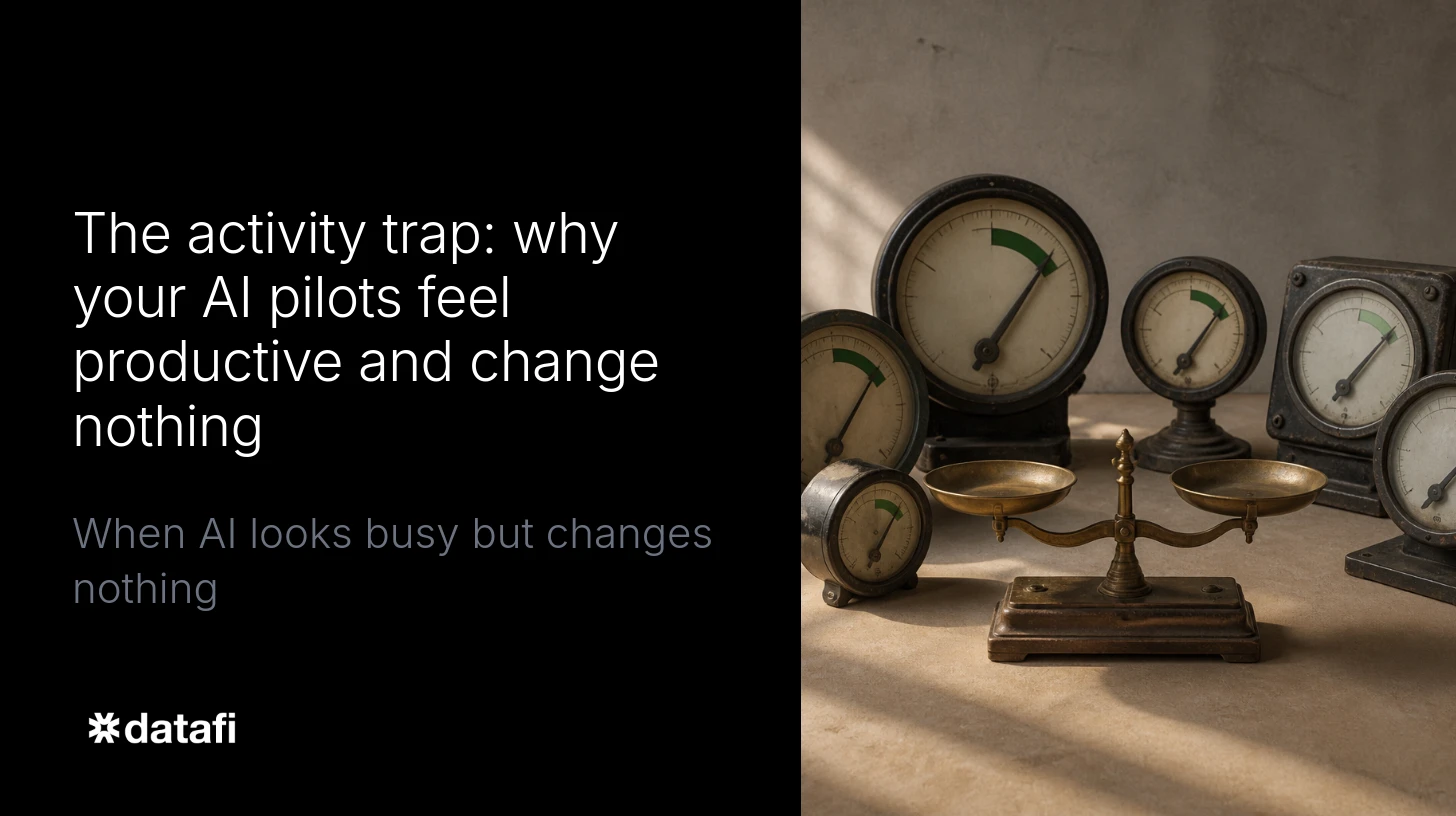
That is the activity trap. Everything is busy. Nothing compounds.
The case for the point solution, made fairly
It would be easy, and wrong, to treat every point solution purchase as a mistake. They win for reasons that deserve respect.
They are fast. Enabling a copilot can be as simple as activating an extension on a contract you already have, with no workflow redesign and no change management program. They are cheap to justify. A single function can fund one out of its own budget without a board conversation. They are low risk in the narrow sense: if it fails, you turn it off. And in many organizations, the internal chatbot was a deliberate act of risk management, a secure alternative deployed because employees were already pasting company data into consumer models.
Those are good reasons. A leader who bought a point solution for those reasons made a rational decision with the information available.
The trouble is that the decision was rational in isolation, and isolation is exactly the condition that guarantees it will not compound.
Answering questions versus solving problems
Here is the distinction I keep coming back to, and it is the one that separates the AI that shows well in a demo from the AI that shows up in the P&L.
Most of what has been deployed answers questions. Summarize this ticket history. Draft this email. Retrieve the relevant clause. Tell me what happened to margin in the Southeast region. These are genuinely useful and they are genuinely limited, because answering a question returns the work to the human, who still has to decide what to do and then go do it across four systems that do not know about each other.
Solving a problem means the work closes. The exception gets routed. The order gets reallocated. The memo gets drafted, scored for confidence, and queued for the reviewer who actually needs to see it. The refund gets issued. Nothing comes back to a human except the cases where human judgment is the point.
McKinsey’s call center example makes the gap concrete. Use generative AI to assist the human at each step and you get perhaps five to ten percent improvement in resolution time. Insert agents into the existing workflow without reconfiguring how work is routed and you get twenty to forty percent. Redesign the process around agent autonomy and you can resolve up to eighty percent of common incidents automatically, with resolution time falling by sixty to ninety percent. Same technology. Three orders of magnitude of difference in outcome, and the variable is not the model. It is whether anyone was willing to change the process.
Point solutions cannot change the process. Structurally, they cannot. A vendor who owns one step has no mandate, no permission, and no visibility to touch the other nine.
Same technology. Three orders of magnitude of difference in outcome. The variable is not the model. It is whether anyone was willing to change the process.
What a point solution cannot see
The deeper limitation is not scope. It is context.
Ask what any single AI tool actually knows about your business and the answer is: whatever was in the system it was bolted onto. The support copilot knows tickets. The sales assistant knows the CRM. The procurement tool knows the contracts it was pointed at. Each one has assembled a partial, private, and non-authoritative picture of your organization, and none of them can see the others.
So when the underwriting question depends on claims history, and the claims history lives in a system the underwriting tool has never heard of, and the policy language that governs both sits in a document repository nobody has governed in a decade, the tool does what it must: it answers confidently from the fragment it can see. McKinsey names this directly among the barriers holding vertical use cases in pilot. Data accessibility and quality gaps across both structured and unstructured data, with unstructured material remaining largely ungoverned in most organizations.
Context is not a feature you can add to a point solution. It is a property of the layer underneath all of them, or it does not exist at all.
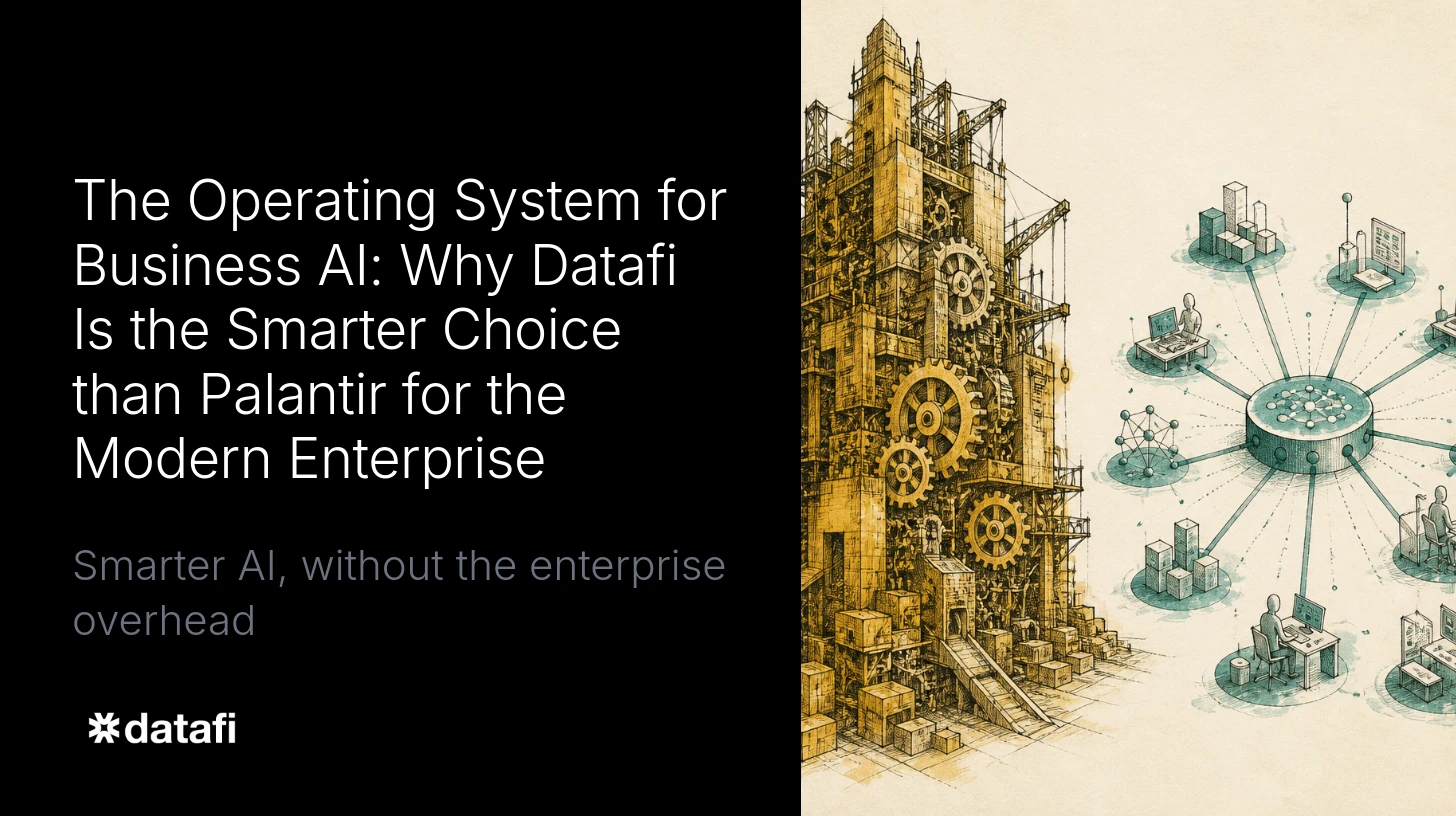
The alternative: a layer, not a lineup
This is the problem Datafi was built to solve, and it is why we describe what we are building as a Business AI Operating System rather than another application.
The premise is that context belongs in a global business contextual layer that sits across the systems you already run, rather than being reconstructed badly and privately inside every tool you buy. That layer knows what your entities are, what your policies say, which system is authoritative for which fact, and who is permitted to see what. Governance is enforced there, through Sentinel, once, rather than reimplemented eleven times with eleven different definitions of who counts as an underwriter. Agents run against it through Orchestrate, so they are reasoning over the business rather than over one system’s view of the business. And what they do is visible through Control Tower, because autonomy without observability is not automation, it is exposure.
The consequence is that the unit of work stops being the task and becomes the workflow. An agent can span the four systems the process actually touches, because the layer beneath it spans them. That is not a bigger point solution. It is a different architecture, and it is the only one in which the process can be redesigned at all.
We hold to one more principle that matters here, and I will spend a full post on it later in this series: integration and ownership are separable. Nothing about unifying your context requires surrendering your systems, your data, or your choice of model.
Where this goes
The point solution question is not really a buying question. It is an architecture question that most organizations have been answering, by default, one purchase at a time.
McKinsey’s conclusion is the right one and it is worth repeating in plain terms: the opportunity is no longer in optimizing isolated tasks. It is in transforming entire business processes. The organizations that capture value in the agentic era will not be the ones with the most agents. They will be the ones who rebuilt how decisions get made.
In the next post, I will look at what happens when a portfolio of point solutions is left to accumulate, and why the costs of fragmentation are not additive but compounding: governance debt, context fragmentation, agentic blast radius, and lock-in you never chose.
Datafi is a Business AI Operating System for mid-enterprise organizations, built to activate the systems you already own so AI can solve business problems rather than simply answer questions about them. Learn more at datafi.co.
Series: The Limits of AI Point Solutions
Post 1: The activity trap: why your AI pilots feel productive and change nothing
Post 2: The compounding cost of a fragmented stack
Post 3: The operating system alternative: integration and ownership are separable