


When a supplier fails, the question is never whether your data saw it coming. The question is whether your AI did anything about it.
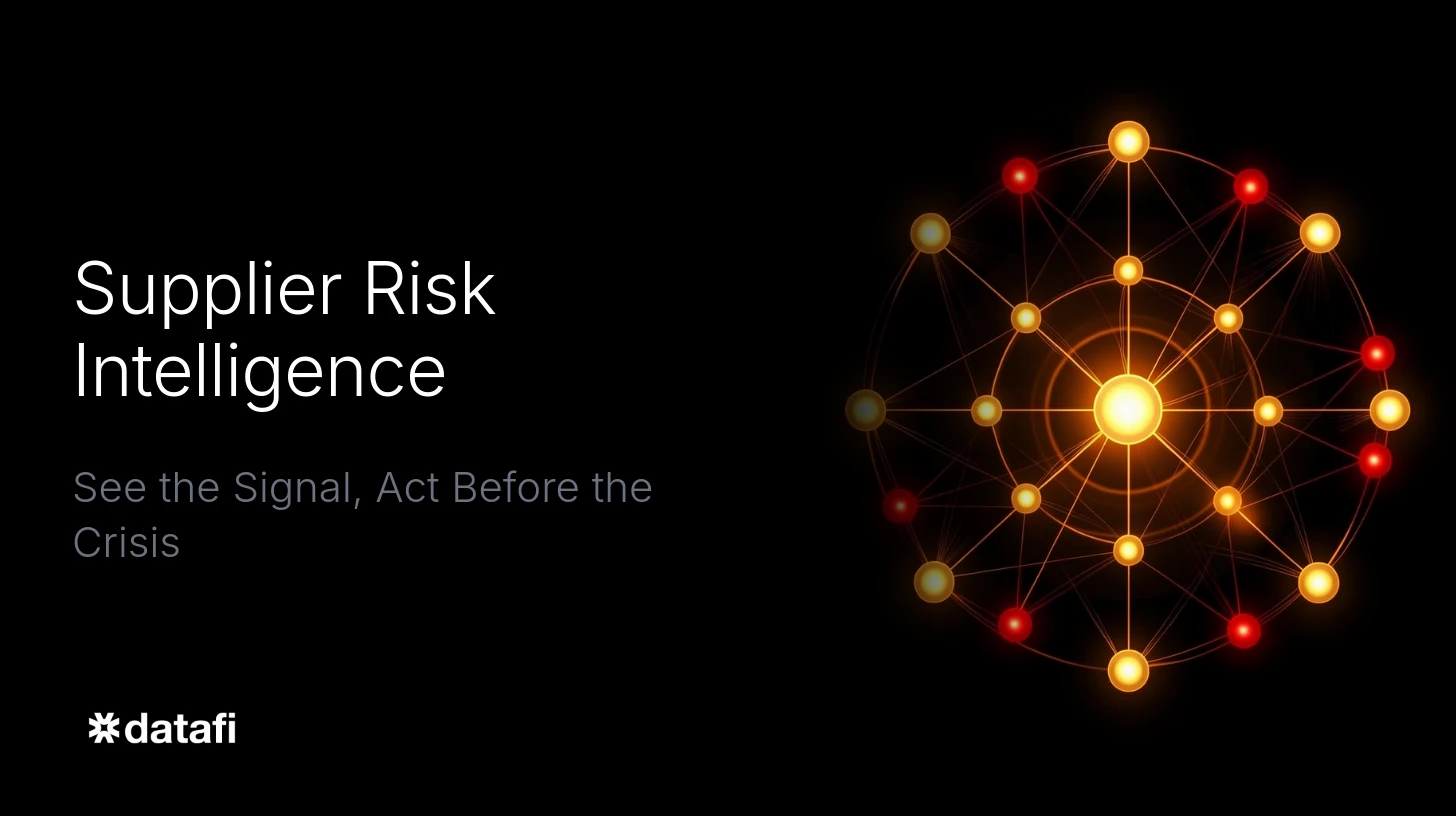
Supplier risk signals almost always exist before a failure occurs. The real problem is the architecture that fails to turn fragmented, cross-system intelligence into timely, contextual action.
The Problem with Knowing Too Late
Every procurement and supply chain team will tell you the same thing: the warning signs were there. A supplier slips a payment term. A quality report surfaces an anomaly. A news feed mentions regulatory action in a key sourcing region. A financial data feed flags a deteriorating current ratio. The signals exist. They always exist.
What fails is not intelligence. What fails is the architecture that is supposed to turn intelligence into action.
Most organizations today are equipped with data tools that can answer the question “what is happening with our suppliers?” with varying degrees of latency and effort. Procurement analysts run reports. Risk teams build dashboards. Finance monitors exposure. Compliance reviews certifications. Each team produces a version of supplier reality shaped entirely by the slice of data they have access to. And when a supplier failure actually occurs, the post-mortem almost always reveals the same thing: the information was there, scattered across systems that never spoke to each other, sitting in reports that no one had time to correlate, generating alerts that had no workflow attached to them.
This is not an analytics problem. It is a context problem. And context, at the scale and complexity of modern supplier networks, is something that AI is uniquely capable of synthesizing, if you give it the right foundation to work from.
What Supplier Risk Intelligence Actually Requires
Genuine supplier risk intelligence requires three things that most enterprise AI deployments are not yet built to deliver.
The first is access to every relevant data source, simultaneously. Supplier risk does not live in one system. It lives in ERP data, procurement records, accounts payable transaction histories, quality management systems, contract repositories, third-party risk platforms, financial data feeds, news and regulatory monitoring services, and the institutional knowledge that exists in email threads, meeting notes, and analyst commentary. A risk signal that exists in only one of these systems is a fragment. A risk signal that is correlated across all of them is an insight.
The second is business context. Knowing that a supplier’s delivery performance has declined by 12% over the last quarter is data. Knowing that this particular supplier provides a single-sourced critical component for your top revenue product line, that your safety stock is at a six-week low, and that your next major product launch is in ten weeks is context. The gap between those two things is the difference between a statistic and a crisis. AI operating without that business context will surface the statistic and miss the crisis.
The third is agentic capacity. Supplier risk intelligence that ends with a dashboard or a report has not solved a problem. It has described one. Genuine intelligence requires AI that can not only identify and contextualize a risk signal but also initiate action: alerting the right stakeholders, pulling the relevant contract terms, initiating a supplier conversation workflow, triggering a sourcing diversification assessment, or escalating to executive attention based on predefined risk thresholds. Without agentic capacity, the intelligence loop is always broken by the same bottleneck: a human who has to manually translate insight into action, usually too slowly, usually with incomplete context.
This is exactly what Datafi is built to deliver.
How Datafi Transforms Supplier Risk Intelligence
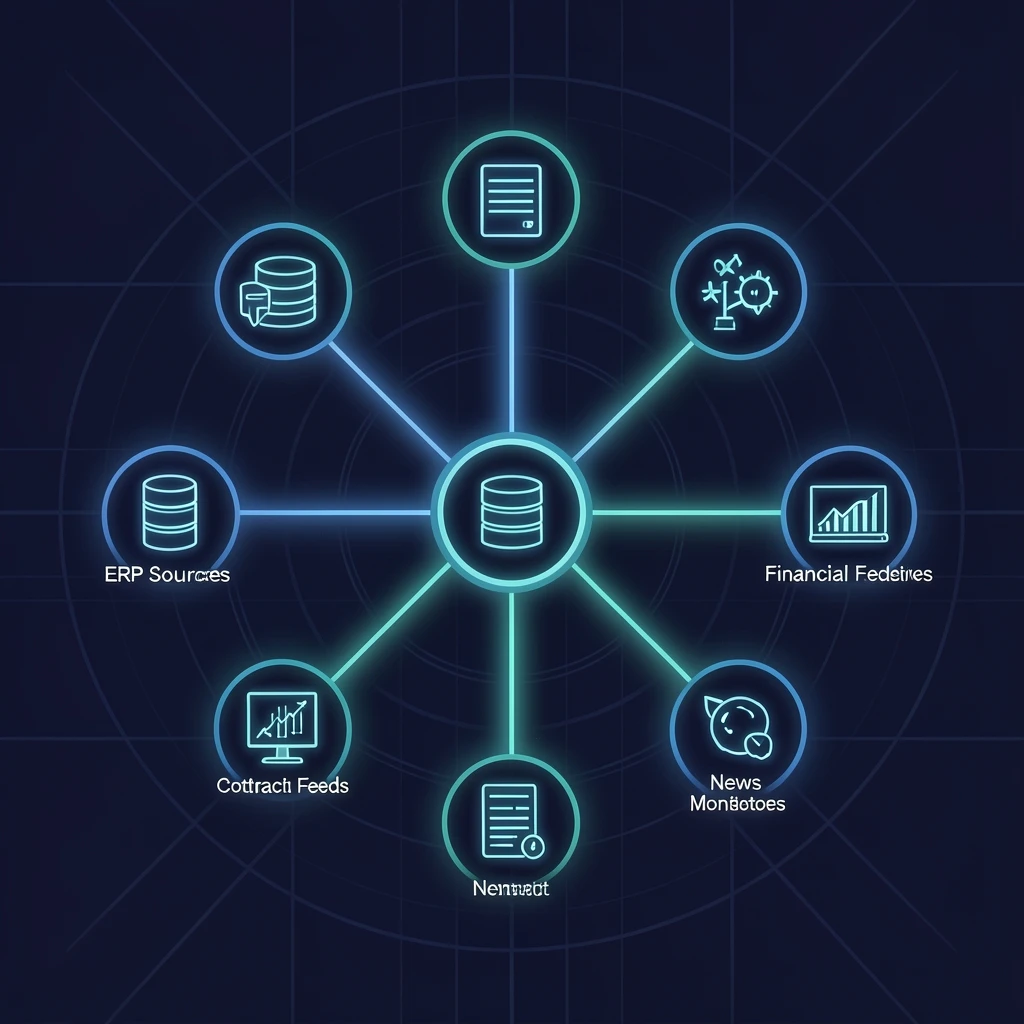
Datafi’s vertically integrated data and AI platform connects the full ecosystem of supplier-related data, from internal operational systems to external risk and financial intelligence sources, into a unified governed environment where AI has complete business context and the capacity to act.
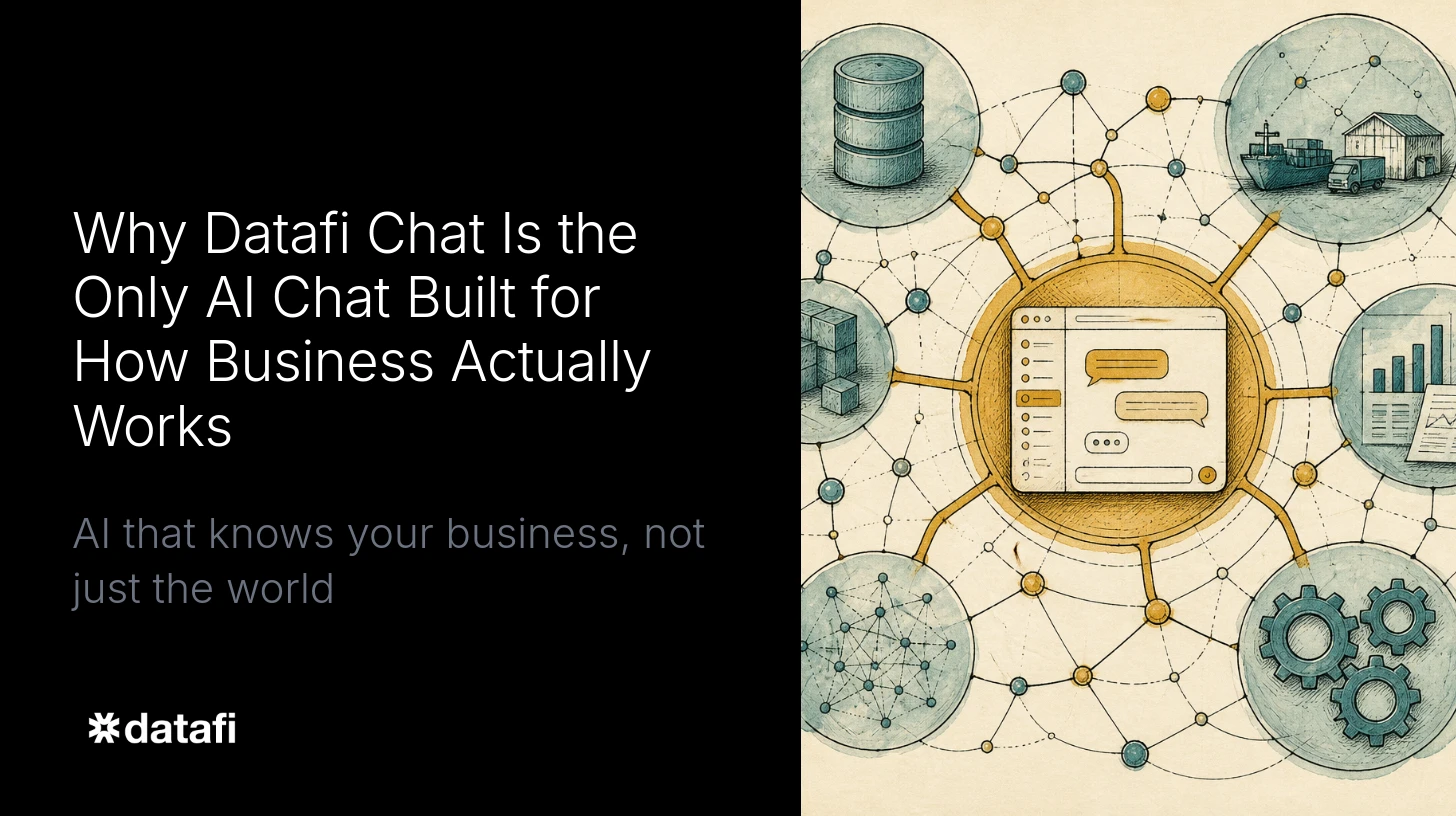
The Datafi Chat UI gives procurement professionals, supply chain managers, risk officers, and executives a natural language interface to every layer of supplier intelligence without requiring SQL skills, data science expertise, or navigation through a maze of disconnected dashboards. A category manager can ask a question as naturally as they would ask a colleague, and receive an answer that draws simultaneously from contract data, transactional history, quality records, external financial signals, and current news, synthesized in seconds and grounded in the specific business context that makes the answer meaningful.
What makes this possible is not just the AI layer. It is the architecture underneath it. Datafi’s platform is designed from the ground up to give the AI full visibility into the data ecosystem that defines your supplier relationships, and to do so with the governance and compliance controls that enterprise risk environments demand. Every query is governed. Every data access is permissioned. Every action taken by the AI is auditable. Risk intelligence at this level is not useful if it cannot be trusted, and trust in enterprise AI is built from governance, not just capability.
The Datafi Supplier Risk Intelligence Experience
Consider what this looks like in practice.
A procurement team at a mid-size manufacturer runs a significant portion of its component sourcing through a network of approximately 300 active suppliers across four continents. The team has an ERP system, a supplier portal, a contract management platform, and subscriptions to two third-party risk monitoring services. What they do not have is any way to easily correlate signals across all of these systems, and they certainly do not have an AI that understands the full operational and strategic context of each supplier relationship.
With Datafi, that changes fundamentally.
A supply chain analyst begins her morning by asking Datafi to surface any supplier risk signals that have emerged in the last 48 hours and to prioritize them based on current operational exposure. Datafi does not return a list of raw alerts. It returns a prioritized intelligence brief: three suppliers are flagged, with the highest priority being a Tier 1 component supplier in Southeast Asia where a combination of signals has emerged simultaneously, a 15-day delay in the most recent shipment, an adverse news item about labor regulatory action at one of its facilities, and a financial data indicator suggesting a tightening liquidity position.
Datafi has not just identified these signals. It has cross-referenced them against current inventory levels for the components this supplier provides, identified two product lines that are critically dependent on those components within the current production schedule, and surfaced the contractual force majeure and alternative sourcing clauses relevant to this supplier relationship.
The analyst does not need to go to four systems to understand what this means. She understands it immediately, in full context, with the relevant contract language and operational data already assembled.
She asks Datafi what her sourcing options are. Datafi queries the approved vendor list, identifies two pre-qualified alternative suppliers for the primary components at risk, surfaces the last qualification dates and capacity information available for each, and flags that one of them already has a pending quote on file from a sourcing event six months prior. It then drafts a preliminary outreach message to the alternative supplier contact and flags the situation for escalation to the VP of Supply Chain, with a risk summary prepared for that briefing.
What would have taken a team of analysts most of a working day to piece together was accomplished in a single conversation, with richer context than any manual process would have produced, and with the next steps already initiated.
Beyond Reactive Risk Management

The most transformative aspect of Datafi for supplier risk intelligence is not what it does when a crisis emerges. It is what it does between crises.
Traditional risk management is almost inherently reactive. Teams are stretched. Monitoring is periodic. Dashboards are reviewed when something goes wrong, not to prevent something from going wrong. The cadence of intelligence is driven by crises rather than by continuous vigilance.
Datafi shifts this dynamic by enabling always-on, contextual supplier intelligence. Risk signals are continuously correlated against live business context. Patterns that would never be visible in periodic reporting, a gradual drift in on-time delivery performance, a slow increase in invoice disputes, a correlation between quality issues and a specific production shift at a supplier facility, become visible when AI has access to the full data ecosystem and is continuously applying business context to what it observes.
Organizations that operate with this level of supplier intelligence do not eliminate supply chain disruptions. But they consistently convert what would have been crises into managed events, because they see the signal earlier, understand it more completely, and initiate action before the window for intervention closes.
This is the shift from AI that answers questions to AI that solves problems. And it is available now, not as a future capability, but as a deployable reality on the Datafi platform.
Governance, Compliance, and Control
Supplier risk intelligence at the enterprise level carries serious compliance and data governance obligations. Third-party data sharing agreements, procurement data sensitivity, and regulatory requirements around vendor due diligence all create constraints that AI platforms must be built to respect, not work around.
Datafi’s approach to governance is not a layer bolted on top of AI capability. It is foundational to the architecture. Role-based data access ensures that the AI surfaces only the information each user is authorized to see. Data lineage and audit trails provide the accountability that regulated industries require. Compliance-ready data handling means that supplier intelligence can flow across procurement, legal, finance, and executive teams without creating data governance gaps.
This is what makes Datafi the right platform for organizations where the stakes of getting supplier risk wrong extend beyond operational disruption to regulatory exposure, legal liability, and reputational consequence.
The Competitive Advantage of Unified Supplier Intelligence
Organizations that make the shift to AI-powered supplier risk intelligence on a platform like Datafi do not just manage risk more effectively. They build a structural competitive advantage.
When your AI has full context across your supplier ecosystem, you make better sourcing decisions. You negotiate from a position of greater intelligence. You identify concentration risks before they become vulnerabilities. You build supplier relationships grounded in objective performance data rather than relationship inertia. You move faster when disruption occurs because your response capacity is already organized around real-time intelligence rather than manual information gathering.
Supplier risk has always been one of the highest-stakes domains in enterprise operations. The organizations that will lead in the coming decade are those that treat their supplier intelligence not as a reporting function but as a strategic capability, one that is continuous, contextual, agentic, and deeply integrated with the full operational reality of the business.
That is the capability Datafi delivers. And the time to build it is before the next disruption, not after.
Ready to see how Datafi transforms supplier risk intelligence for your organization? Request a demo and see the platform working with your data ecosystem.