


There is a version of AI that answers questions. And there is a version of AI that solves problems. Most enterprises today have invested heavily in the first. The second is where competitive advantage will be determined for decades to come.
The distance between those two versions is not primarily a model problem. The best large language models in the world are capable of extraordinary reasoning. What they lack, in most enterprise deployments, is the context, the data access, the governance structure, and the operational autonomy they need to function as genuine business partners rather than sophisticated search engines. Closing that gap responsibly is the defining challenge of enterprise AI strategy today. It is the challenge Datafi was built to address.
Responsible AI in the enterprise must be accurate, accessible, governed, and genuinely useful at scale. Governance and performance are not in tension; in the right architecture, they reinforce each other.
Why Responsible AI Requires More Than a Policy
The conversation about responsible AI has too often centered on what AI should not do. Content filters, bias audits, model cards, ethics frameworks. These are necessary. But they are not sufficient. Responsible AI in the enterprise also has to be AI that actually works: that delivers accurate outputs grounded in real business data, that operates within governance structures that IT and legal can trust, and that extends capability to every employee, not just the technically fluent.
Irresponsible AI is AI that hallucinates because it lacks access to current, governed data. It is AI that creates shadow workflows because the sanctioned tools are too difficult for non-technical users. It is AI that concentrates analytical power in the hands of a few data specialists while leaving the rest of the organization making decisions on instinct. Responsible AI, properly understood, is AI that is accurate, accessible, governed, and genuinely useful at scale.
That is the lens through which Datafi designed its AI operating system. Not as a compliance exercise, but as a product philosophy.
The Vertically Integrated Stack: Why Integration Is a Responsibility Issue

Most enterprise AI deployments are assemblies. A data warehouse here. A governance layer there. A chat interface bolted on from a third party. An analytics tool that requires SQL skills to operate. These assemblies create seams, and seams are where responsible AI breaks down.
When the chat interface does not have access to governed, current data, the AI makes things up or becomes uselessly generic. When the governance layer is disconnected from the model’s operating context, policies cannot be enforced in real time. When the interface requires technical skill, the majority of employees are excluded, which means decisions get made without AI support, or employees find their own ungoverned workarounds.
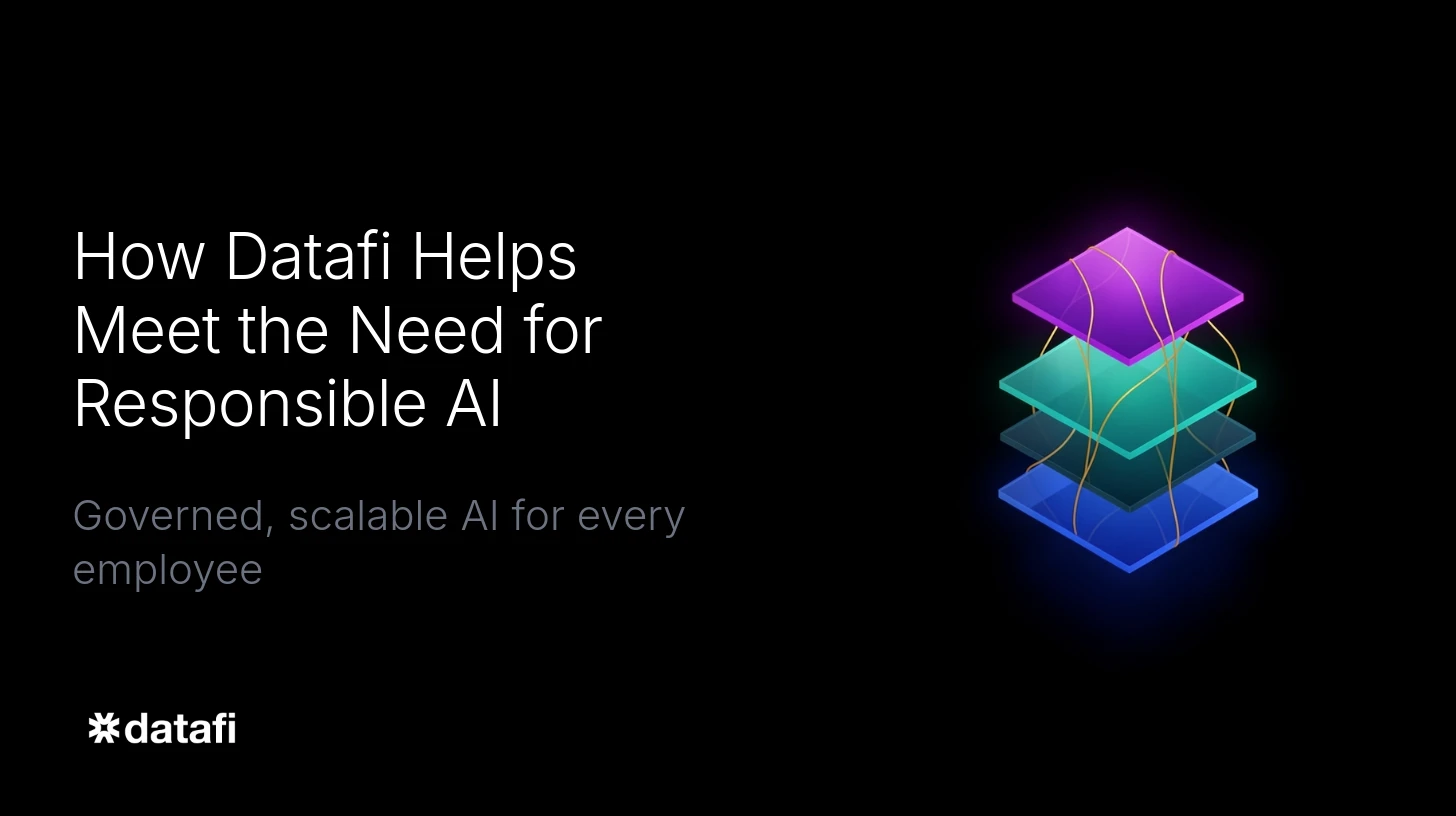
Datafi’s vertically integrated architecture eliminates those seams. The data ecosystem, the policy and governance framework, and the Chat UI designed for non-technical users exist as a unified system. The LLM operates with access to the full business context it needs, within a governed environment that organizations can trust, through an interface that any employee can use from day one.
This integration is not a feature set. It is the structural precondition for AI that is both powerful and responsible. You cannot have one without the other.
Full Business Context: The Foundation of Trustworthy AI Outputs
LLMs are only as trustworthy as the information they have access to. A model reasoning from incomplete data produces incomplete answers. A model reasoning from ungoverned, unverified data produces unreliable answers. Neither outcome is acceptable when AI is being used to inform decisions in maintenance operations, customer experience, strategic planning, or financial analysis.
Datafi gives LLMs access to the complete enterprise data ecosystem. That means structured and unstructured data, real-time operational data, historical records, and the semantic context required to understand what data means in a specific industry or business domain. When an AI agent in Datafi is asked to analyze equipment health across a maintenance fleet, it is not working from a sample or a cached summary. It is working from the complete, governed data picture that a human expert would use.
This is what makes autonomous AI workflows trustworthy rather than dangerous. The outputs are grounded. They can be audited. They can be explained. When a non-technical operations manager receives a recommendation from a Datafi workflow, they are receiving a conclusion that was reached through the same data sources, the same analytical logic, and the same governance controls that would have governed a human analyst doing the same work.
Full business context is not just a performance enhancement. It is a responsibility requirement.
Policies, Governance, and Control: Making AI an Institutional Actor
One of the most consequential decisions in enterprise AI strategy is whether the AI system behaves as an individual tool or as an institutional actor. Individual tools can be powerful, but they operate outside the governance structures that organizations depend on for compliance, security, and accountability. Institutional actors internalize those structures. They know what they are authorized to access. They know what they are not authorized to share. They operate within the boundaries that governance requires, automatically and consistently.
Datafi is built as an institutional actor. The policy and governance layer is not an add-on. It is foundational to the architecture. Data access controls, role-based permissions, audit trails, and compliance guardrails are enforced at the operating system level. This means that when a user interacts with a Datafi agent, they interact with an AI that already knows what it is authorized to do on their behalf.
For organizations operating in regulated industries, this is transformative. Compliance is not a constraint that slows AI adoption. It is a property of the system itself. AI agents can be deployed in pharmacovigilance, financial reporting, contract management, and ESG analysis because the governance infrastructure those functions require is already present in the platform.
For organizations of any size, it means that AI deployment does not require a new governance program built from scratch. Datafi’s operating system absorbs existing policies, reflects existing access controls, and extends them into the AI layer automatically.
A Chat UI Designed for Every Employee
The most dangerous form of AI inequality in the enterprise is not between companies. It is within them. Organizations that deploy AI capabilities exclusively to data scientists and engineers create a two-tier workforce where analytical power is concentrated rather than distributed. Decisions that should be informed by AI are made without it. Employees who should be empowered by AI are instead left behind it.
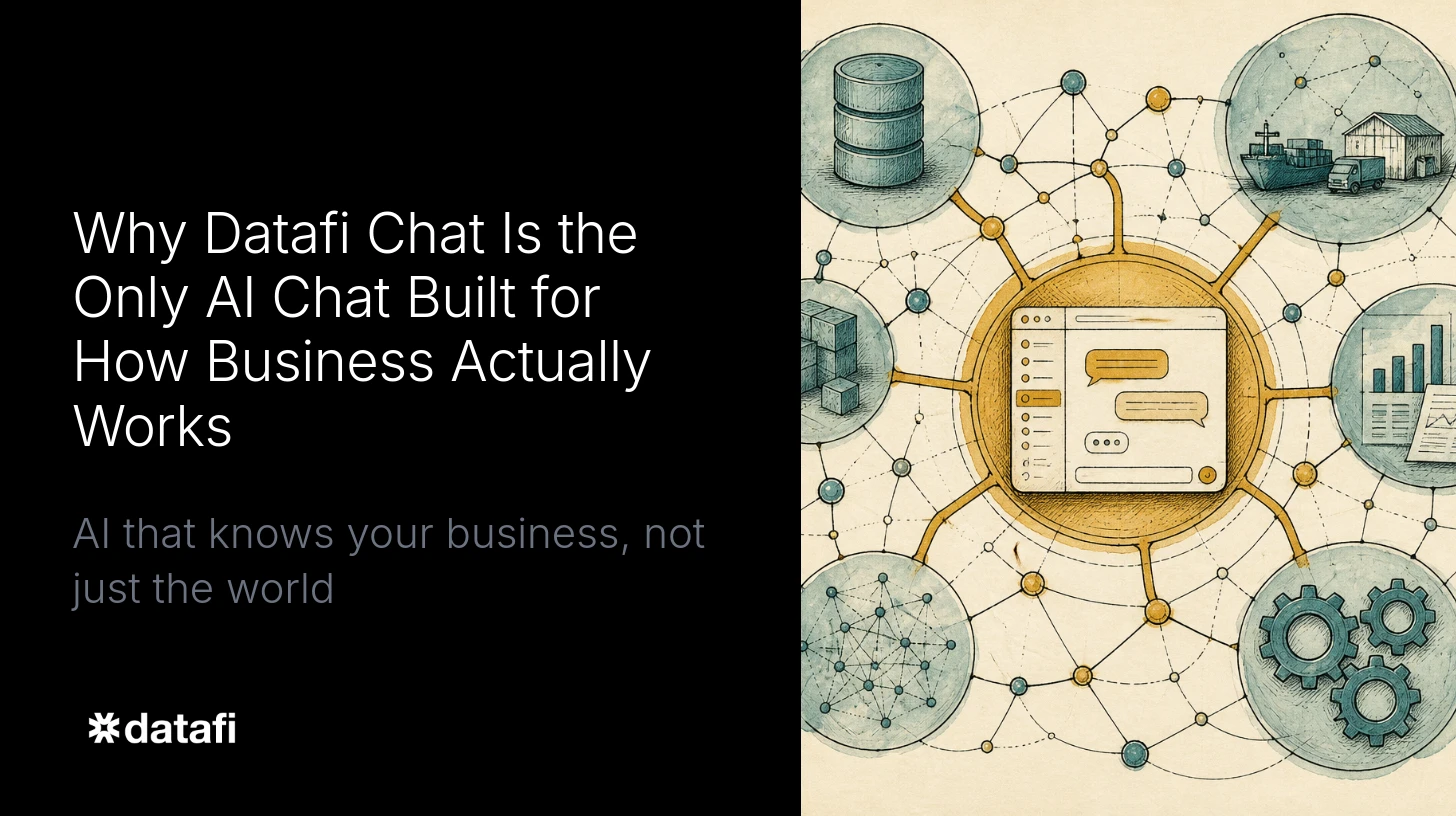
Datafi’s Chat UI was designed to eliminate that divide. The interface is built for non-technical users. It does not require knowledge of SQL, prompt engineering, or data modeling. An operations supervisor, a customer service manager, a procurement officer, or a logistics coordinator can ask a natural language question and receive a grounded, governed, actionable response.
When every employee can access the same AI-powered analytical depth that was previously available only to technical teams, the nature of decision-making in the organization changes entirely.
This is responsible AI in one of its most concrete forms: AI that serves every employee who needs it, not just the ones who know how to build a query. The Chat UI is the democratizing layer of the Datafi operating system, the interface through which AI capability becomes organizational capability rather than specialist capability.
When every employee can access the same AI-powered analytical depth that was previously available only to technical teams, the nature of decision-making in the organization changes. Frontline workers can identify anomalies before they escalate. Operations teams can respond to conditions in real time. Customer-facing staff can answer complex questions with confidence. AI becomes a tool of inclusion rather than exclusion.
Agentic AI: From Answering to Acting

The next evolution of enterprise AI is not better answers. It is autonomous action. AI agents and workflows that can identify a problem, reason through a solution, and execute that solution without requiring human intervention at each step. This is where the business case for AI shifts from productivity enhancement to operational transformation.
Datafi enables AI agents and autonomous workflows across the use cases where that transformation is most valuable. In predictive maintenance and asset management, agents continuously monitor equipment health data, identify degradation patterns, and initiate maintenance workflows before failures occur. The AI is not providing a report for a human to act on. It is identifying the problem, assessing urgency, routing the appropriate response, and documenting the outcome in a single governed workflow.
In operations optimization, Datafi agents analyze supply chain conditions, capacity constraints, and demand signals simultaneously, proposing and in appropriate contexts executing adjustments that keep operations running efficiently under dynamic conditions. In passenger experience, agents synthesize booking data, service history, and real-time conditions to personalize interventions at scale. In strategic planning, agents synthesize internal performance data, market intelligence, and competitive signals to surface the analytical foundations that executives need to make confident decisions.
What makes autonomous AI responsible rather than reckless is the governance architecture it operates within. In Datafi, every agentic workflow operates under the same policy and access controls as the rest of the system. Agents cannot access data they are not authorized to access. They cannot execute actions outside their defined scope. Their operations are logged, auditable, and explainable. The autonomy is real. The guardrails are real. They coexist because that coexistence was designed in from the beginning.
The Contextual Layer: Learning the Business, Not Just the Data
There is a distinction that matters enormously in enterprise AI: the difference between a model that has access to data and a model that understands a business. Data access is necessary. Business understanding is what makes AI genuinely useful in complex, high-stakes workflows.
Datafi’s architecture develops what we call the contextual layer, the accumulated semantic understanding of how a specific organization operates, what its data means in its particular industry context, how its processes work, and what outcomes its stakeholders care about. This contextual layer is what allows Datafi’s AI to function in roles that go beyond retrieval and into genuine reasoning.
When an AI agent in Datafi is helping to evaluate M&A due diligence risk, it is not keyword-matching against financial documents. It is reasoning about the relationships between entities, the implications of contract structures, the significance of operational data patterns, and the strategic context of the transaction. That reasoning is possible because the system has developed the business context to support it.
The contextual layer is also what makes AI learning in Datafi responsible. As agents operate in autonomous roles, they are not drifting outside governed parameters. They are developing deeper business context within the system’s governance structure. The learning makes the AI more useful. The governance makes the learning trustworthy.
Responsible AI as Competitive Strategy
It is worth stating plainly: responsible AI is not a tax on performance. In the Datafi operating system, it is a source of performance. The governance architecture that makes AI trustworthy is the same architecture that makes it scalable. Organizations can deploy AI agents in more sensitive roles precisely because the guardrails are built in. They can extend AI access to more employees precisely because the governance travels with the interface. They can invest in autonomous workflows with confidence precisely because the audit trail and accountability structures are foundational, not retrofitted.
For organizations evaluating how to accelerate AI adoption without incurring unacceptable operational or compliance risk, Datafi’s vertically integrated operating system is the answer. It is the architecture that makes the promise of enterprise AI, AI that solves problems rather than answers questions, achievable in practice rather than in theory.
The Organizations That Will Lead
The organizations that will lead their industries over the next decade are not necessarily the ones with the most data. They are the ones that can put their data to work, responsibly and at scale, through AI that is governed, contextual, autonomous where appropriate, and accessible to every employee who needs it.
Datafi was built to be the operating system for those organizations. The mission is not to make AI available to enterprises. It is to make AI genuinely operational across them: in the maintenance bay, the operations center, the customer experience team, the executive suite, and every decision-making context in between.
Responsible AI is not a destination. It is an operating principle. And with the right architecture, it is also a competitive advantage.
Datafi is an applied AI software company building the vertically integrated data and AI operating system for enterprise. To learn how Datafi can help your organization deploy responsible, scalable AI across every function and every employee, contact us today.