


A Datafi Potential Success Story
RK Industries has spent more than six decades building one of the Mountain West’s most capable integrated construction and industrial services enterprises. Seven business units. Four states. Thousands of employees spanning job sites, fabrication shops, service trucks, and corporate offices. From structural steel to mission-critical modular manufacturing, from water treatment to 24/7 electrical services, RK can take a client from concept to completion and keep their facilities running long after the project closes.
That operational breadth is also RK’s most complex data challenge. Project financials, equipment records, safety logs, labor data, subcontractor performance, and client histories are generated continuously across every corner of the business. Each data stream carries intelligence. But isolated by system and business unit, that intelligence never reaches the people or workflows where it could drive outcomes. Data exists. Value does not.
This is the problem Datafi was built to solve.
Across RK Industries’ seven business units and four states, fragmented data systems trap intelligence in silos, but a unified AI operating system can unlock $20 million or more in annual value through productivity recovery, predictive maintenance, and project optimization.
A Unified Intelligence Layer Across the Enterprise
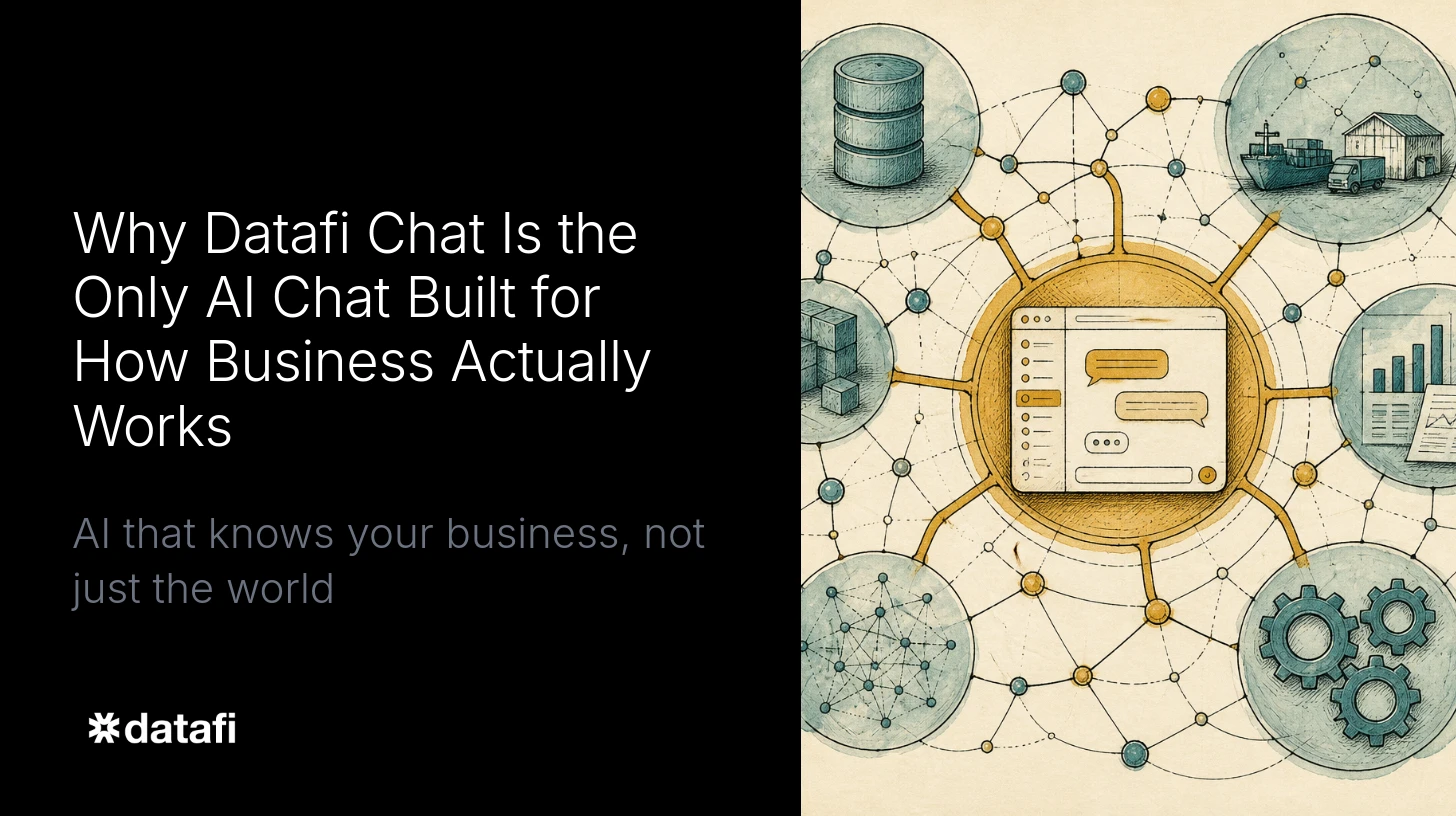
The Datafi AI Operating System gives every RK employee, regardless of role or technical capability, instant access to the information they need to do their job. Datafi’s Chat UI is designed for the non-technical user. A service technician in Colorado Springs should not need to navigate multiple systems to find the maintenance history of an asset, confirm warranty status, or pull the required inspection protocol. They should be able to ask a question in plain language and receive an accurate, grounded answer in seconds.
Scaled across RK’s workforce, the productivity math is significant. Knowledge workers consistently spend 15 to 25 percent of their time searching for information. A conservative 20 percent reduction in that friction, across thousands of employees, returns tens of thousands of hours annually to productive work. At RK’s scale, that represents $4 million to $7 million in recovered productivity every year, before a single AI agent touches a workflow.
Predictive Maintenance: Protecting Uptime and Margin
RK Service operates as a 24/7 commercial facility services provider, maintaining mechanical, electrical, and water systems across a significant client portfolio. RK also manages a substantial internal fleet of vehicles and fabrication equipment across its Henderson and Aurora facilities.
For both the client-facing service business and internal asset management, predictive maintenance is one of the highest-return AI applications available. The Datafi AI Operating System ingests equipment sensor data, service history, manufacturer specifications, and operational hours to identify failure risk before it becomes downtime. Reactive maintenance costs two to three times more than planned maintenance. Unplanned failures carry not only direct repair costs but emergency labor premiums, client relationship risk, and potential contractual penalties.
Predictive maintenance programs consistently reduce unplanned downtime by 30 to 50 percent and overall maintenance costs by 15 to 25 percent. Against RK’s service maintenance cost base, a Datafi-enabled program targeting a 20 percent cost reduction represents $6 million to $10 million in annual savings. The safety benefit compounds on top: for a company where safety is the first of its SMART core values, an AI system that identifies at-risk assets before they fail is also a workforce protection system.
Operations Optimization Across Construction Projects
RK’s construction divisions operate in an environment where margin is made or lost in the details of scheduling, labor allocation, materials procurement, and subcontractor coordination. The complexity multiplies on integrated multi-trade projects, which are increasingly RK’s competitive differentiator and its most operationally demanding work.
Datafi deploys AI agents that monitor project performance continuously, flag early schedule risk, model the downstream impact of disruptions, and surface optimization recommendations before a two-day slip becomes a two-week overrun. The same intelligence layer gives operations leadership a real-time, unified view of crew availability, certifications, and project demand across RK Mechanical, RK Electrical, and RK Steel simultaneously, turning what is today a human coordination challenge into a data-driven process.
Industry benchmarks suggest that 25 to 30 percent of construction costs are attributable to rework, scheduling inefficiency, and poor information flow. Even a conservative 5 to 8 percent margin recovery on complex multi-trade project volume translates to $10 million to $16 million in recovered margin annually at RK’s scale, dollars that go directly to the bottom line or to the competitive pricing that improves win rates.
Estimating Intelligence and Strategic Planning
RK competes for projects across a broad range of types and client sectors. Bid accuracy is a strategic capability: an estimate built on outdated productivity assumptions or missing market cost signals can win a project that loses money. Datafi’s AI agents synthesize historical project cost data, current market pricing, material escalation trends, and subcontractor performance history to build an estimating intelligence layer that makes every bid smarter and every go/no-go decision better informed.
A one to two percentage point improvement in margin capture across $200 million in annual project revenue equals $2 million to $4 million in additional gross profit annually. That is the compounding value of AI that operates not just as a reporting tool but as an autonomous analytical engine with full context of the business.
At the executive level, Datafi gives RK’s leadership a unified strategic intelligence layer. AI agents continuously synthesize business unit performance, pipeline health, workforce capacity, and market signals to inform capital allocation, geographic expansion decisions, and capability investments with the quality of analysis that previously required weeks of manual data assembly.
What separates Datafi from AI tools that have promised transformation and delivered novelty is an architectural commitment to context. LLMs cannot deliver enterprise value in isolation; they need access to the complete data ecosystem, embedded governance and policy controls, and the ability to function in fully autonomous roles.
The Datafi Difference
What separates Datafi from the AI tools that have promised transformation and delivered novelty is an architectural commitment to context. LLMs cannot deliver enterprise value in isolation. They need access to the complete data ecosystem, embedded governance and policy controls, and the ability to function in fully autonomous roles where they are not waiting to be prompted but are continuously learning and driving outcomes.
This is the Datafi AI Operating System: a vertically integrated data and AI technology stack that gives AI the full context of the business and deploys agents that solve hard problems rather than just answer questions.
For RK Industries, a company built on 60 years of innovation and a culture that puts people first, Datafi is the intelligence infrastructure that lets that culture scale. Every employee empowered with instant information. Every asset managed proactively. Every project optimized before problems compound. Every strategic decision informed by the full picture of the enterprise.
The future RK is building deserves AI capable of matching its ambition.
To learn how Datafi can deliver transformative outcomes for your organization, visit datafi.com.