


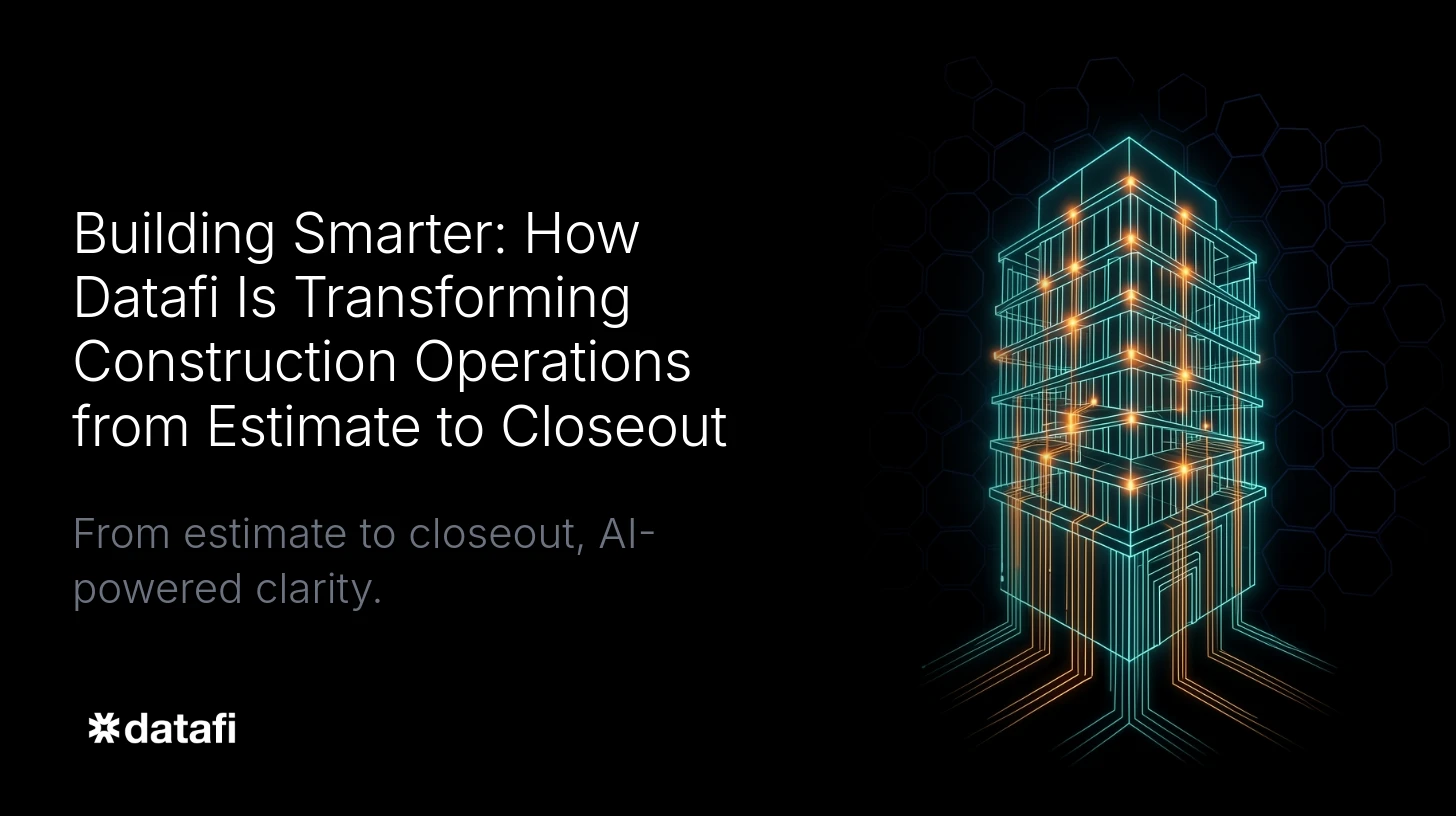
The construction industry has long operated at the intersection of complexity and consequence. A missed estimate throws a project into the red before the first shovel breaks ground. A miscommunication between the field and the office delays a subcontractor, which delays a pour, which delays a certificate of occupancy, which delays revenue. A cost overrun discovered in week ten should have been caught in week two. For decades, these challenges have been managed with spreadsheets, siloed software, and tribal knowledge, a patchwork of tools that generates data without generating clarity.
That era is ending.
Datafi is an applied AI platform purpose-built for organizations that need more than answers, they need action. For construction companies of any size, from regional general contractors to national ENR-ranked firms, Datafi delivers a unified data and AI experience that connects every phase of a project lifecycle: estimating, planning, field execution, cost tracking, and corrective action. The result is a workforce where every employee, from the estimator to the project executive to the foreman on site, operates from the same source of truth and is supported by AI that genuinely understands the business context behind every number.
The core transformation Datafi delivers is not better reporting; it is a shift from reactive, siloed data management to continuous, organization-wide operational intelligence that spans every phase from estimate to closeout.
The Real Cost of Disconnected Data in Construction

Before understanding what Datafi solves, it helps to name what it replaces. Most mid-to-large construction organizations operate with a technology ecosystem that looks roughly like this: an ERP or accounting system for financials, a standalone estimating platform, a scheduling tool, a document management system, a field productivity app, and some combination of spreadsheets that bridge the gaps between all of them. Data flows in one direction, into reports that arrive too late to change outcomes.
The estimating team builds a bid in one system. When that bid is awarded, a project manager manually re-enters scope into the scheduling and cost control system. Field supervisors log daily reports in a mobile app that syncs to a database no one reviews until month-end. Change orders get approved in email threads. RFIs sit unanswered because no one can quickly pull the original scope language. By the time a project controller identifies a cost deviation, the margin has already been spent.
This is not a technology problem. It is a data integration and intelligence problem. And it requires more than a new app, it requires a platform that understands the full operational context of how construction work actually gets done.
Datafi’s Approach: A Vertically Integrated Data and AI Stack
Datafi is built on a foundational belief: that to achieve transformative outcomes from AI, the AI must know the full context of the business. Not a slice of it. Not the clean, structured data that already lives in a warehouse. The full ecosystem, across systems, across phases, across roles, with the policies and governance controls that make it safe to act on at scale.
This is what separates Datafi from point solutions and generic AI tools layered on top of existing software. Datafi’s vertically integrated data and AI stack provides three essential capabilities working together.
First, access to the complete data ecosystem. Datafi connects to the operational systems construction companies already use, project management platforms, ERP and accounting systems, scheduling tools, field data applications, document repositories, and more. Rather than requiring companies to migrate away from existing investments, Datafi unifies the data layer, creating a live, governed view of every project across every system. This means the AI is not reasoning from a sample of the business. It is reasoning from the whole of it.
Second, governed, compliance-ready AI. Construction is a regulated industry. Data about subcontractor compliance, certified payroll, safety incidents, insurance certificates, and contract terms carries legal and financial weight. Datafi’s platform embeds policies and access controls directly into the data layer, ensuring that AI-driven decisions and recommendations are grounded in data the organization has explicitly authorized for use. Every insight is traceable. Every recommendation is auditable. This is not a feature, it is a prerequisite for deploying AI in critical business workflows.
Third, a Chat UI designed for non-technical users. The foreman tracking daily labor hours is not a data analyst. The project engineer managing submittals is not writing SQL queries. Datafi’s conversational interface gives every employee in the organization access to the intelligence embedded in their data, in the natural language they already use to do their jobs. When the platform is designed for the people who actually make operational decisions, AI stops being a back-office analytics tool and starts becoming a genuine operational capability.
Estimating: Winning Work at the Right Margin
Every project begins with a bid. And every bid is a forecast, of labor productivity, material costs, subcontractor performance, project duration, and risk. The quality of that forecast determines whether a project is won at a healthy margin or whether a company spends six months delivering a job it should have declined.
Datafi enables estimating teams to build bids with the full weight of historical project performance behind them. By connecting estimating workflows to actual cost data from completed and in-progress projects, Datafi’s AI agents can surface patterns that are invisible to a team working from memory and industry benchmarks alone. Which subcontractors have historically performed within budget on similar scope? What labor productivity assumptions proved accurate on the last five comparable projects? Where did the last three bids of this type lose margin, and why?
These are not questions that get answered in a traditional bid review. With Datafi, they become part of the estimating workflow, not after the bid is submitted, but before it is. The platform transforms historical operational data into forward-looking intelligence, allowing estimating teams to build more precise, more defensible bids with confidence rooted in evidence rather than intuition.
Planning: Connecting Scope to Execution Before Work Begins
The handoff from estimating to project management is where many projects begin to drift. Scope assumptions embedded in the estimate are not always fully transmitted to the team responsible for delivering the work. Schedule logic built in isolation from cost logic creates disconnects that compound over time.
Datafi closes this gap by maintaining a continuous data thread from bid to build. When a project is awarded, the structured data underlying the estimate becomes the foundation for the project plan, not through manual re-entry, but through an integrated data flow that preserves the intent and assumptions of the original scope. Project managers can interrogate the plan with natural language queries: which line items carry the highest cost risk based on historical variance? Which schedule milestones are most sensitive to procurement lead times? Where is the float in this schedule if a key subcontractor is delayed by two weeks?
AI agents within the Datafi platform can proactively identify planning assumptions that are inconsistent with historical performance, flagging potential problems before they become realized risks. This is the shift from reactive project management to anticipatory project management, and it begins before a single crew mobilizes.
Field Execution: Intelligence Where the Work Happens

The field is where projects are won or lost. It is also where data has traditionally been the weakest, collected inconsistently, transmitted with delay, and rarely connected to the financial and schedule systems that would make it actionable.
Datafi changes the operational dynamic in the field by making every frontline supervisor a participant in the project’s intelligence ecosystem. Through the conversational interface, a superintendent can ask whether today’s concrete pour is tracking to the productivity rate assumed in the estimate, what the current forecast to complete looks like for the framing package, or whether the safety observation logged this morning triggered any compliance requirements. The answers come from live project data, not from a report that will be generated at month-end.
This also means that when field conditions deviate from plan, the information required to make a corrective decision is immediately available. The superintendent does not need to call the project manager, who calls the project controller, who pulls a report from the ERP. The intelligence is at the point of decision, in the hands of the person with the authority and context to act on it. This is what it means to operationalize AI across the enterprise, not concentrating intelligence at the top of the organization, but distributing it to every role where operational decisions are made.
Cost Tracking: From Lagging Indicator to Leading Signal
Cost tracking in construction has historically been a reporting function, not a management function. By the time a cost report shows a variance, the underlying cause is often weeks old. The choices that drove the overrun have already been made. The corrective action is late.
Datafi transforms cost tracking from a lagging indicator into a leading signal. Because the platform maintains a live connection to field data, procurement activity, subcontractor invoicing, and schedule progress simultaneously, it can identify cost trends as they emerge rather than after they have materialized. An AI agent monitoring a mechanical package might detect that labor hours are running 12% above the estimated productivity rate in week three of a six-week duration, project the impact on the line item’s cost at completion, and surface that information to the project manager and project executive before the next pay application is processed.
This capability is not just about catching problems earlier. It is about changing the cadence of cost management from monthly reporting cycles to continuous operational awareness. For project executives managing multiple projects simultaneously, Datafi provides a unified view of portfolio cost performance that makes it possible to allocate attention where it is most needed, not across the entire portfolio equally, but precisely where the signals indicate risk.
Corrective Actions: Closing the Loop Between Decision and Outcome
The measure of any management system is not how well it identifies problems. It is how well it drives resolution. Corrective action in construction is often informal, a phone call, a directive in a meeting, a note in a daily report. The follow-through is rarely tracked. The outcome is rarely measured against the action taken.
Datafi brings structure and intelligence to the corrective action loop. When a cost variance or schedule deviation is identified, the platform can initiate a workflow that assigns ownership, defines the corrective action, establishes a resolution timeline, and tracks progress against it, all within the same unified data environment where the problem was first detected. AI agents can recommend corrective actions based on what has worked in similar situations on previous projects, drawing on the full breadth of the organization’s historical performance data.
Over time, this creates something more valuable than any individual corrective action: an organizational learning loop. Every deviation identified, every corrective action taken, and every outcome measured becomes part of the contextual intelligence the platform applies to future projects. The company does not just get better at managing this project. It gets better at building every project that follows.
The Datafi Difference: AI That Solves Problems, Not Just Answers Questions
There is a meaningful distinction between AI that answers questions and AI that solves problems. Most AI tools available to construction companies today do the former. They provide better search, faster report generation, and more accessible data visualization. These are valuable capabilities. But they are not transformative.
Transformation requires AI that can understand the full operational context of a construction business, the relationship between a bid assumption and a field outcome, between a subcontractor’s historical performance and their current contract, between a schedule milestone and the cost implications of missing it. It requires AI that can function in autonomous roles: monitoring, flagging, recommending, initiating workflows, and learning from outcomes without requiring a data scientist to configure every query.
This is the capability Datafi is building toward, and increasingly delivering. A vertically integrated data and AI stack, with access to the complete data ecosystem, embedded governance and policy controls, and a conversational interface that meets every employee where they are, is not just a better tool for construction operations. It is a new operational model, one where unified data experience and workflow intelligence become core competencies for every organization that chooses to embrace them.
Construction companies that implement Datafi are not just getting better software. They are building the organizational capability to use data and AI as genuine competitive advantages, in the bids they win, the projects they deliver, the margins they protect, and the decisions they make every day between estimate and closeout.
The most successful construction companies of the next decade will be the ones that treat information as a strategic asset. Datafi exists to make that possible.