




When Every Dollar Left on the Table Is a Decision That Was Never Made
Pricing is one of the highest-leverage levers in any product or retail business. It is also one of the most consistently mismanaged. Not because teams lack intelligence or effort, but because the information required to make a genuinely optimal pricing decision exists in fragments scattered across systems that were never designed to talk to each other. Inventory ages out in one platform. Sales velocity lives in another. Competitive signals arrive through manual monitoring or expensive third-party feeds. Customer segment sensitivity sits buried in a data warehouse that only analysts can access. By the time a pricing or merchandising team assembles all of that into a coherent picture, the window for action has often already closed.
The result is a familiar pattern: markdowns that come too late and go too deep, promotional pricing that leaves margin on the table, clearance cycles that still end with excess inventory, and replenishment decisions that contradict what the pricing team just did. None of these failures happen because the data did not exist. They happen because the data was never connected, never contextualized, and never delivered to a decision-maker in a form that made the right action obvious and immediate.
Datafi was built to close that gap.
Pricing failures rarely stem from bad judgment or missing data. They happen because the right data never reaches the right decision-maker at the right moment. Connecting your full data ecosystem to AI changes that completely.
The Problem With How Pricing Decisions Are Made Today
Most pricing and markdown processes rely on a combination of scheduled reporting, analyst support, and human intuition developed over years of experience. That combination is not without value. Experienced merchants and pricing managers carry institutional knowledge that no dashboard can replicate. But institutional knowledge applied against stale data and incomplete context produces decisions that are systematically late.
Consider a mid-size retailer managing several thousand SKUs across multiple channels. A markdown decision for a single category might require a pricing manager to consult a sell-through report, cross-reference it against on-hand inventory by location, check planned promotional activity in a campaign calendar, review recent competitive pricing from a monitoring tool, and factor in days-of-supply against seasonal deadlines. Each of those inputs lives in a different system. Some require analyst time to pull. Others require manual interpretation.
In practice, what happens is a compression of that process. Pricing managers develop heuristics. They make decisions based on the reports they have easy access to and apply judgment to fill the rest. The decisions are often good. But they are rarely optimal, and at scale, the gap between good and optimal compounds into meaningful margin loss.
For businesses with more dynamic inventory, like fashion, perishables, or consumer electronics with rapid obsolescence curves, the consequences of late or miscalibrated pricing are more severe. The problem is not analytical capability. The problem is that the data required to act at the right moment, with full context, is inaccessible to the people who need it most, without significant overhead.
What Datafi Makes Possible

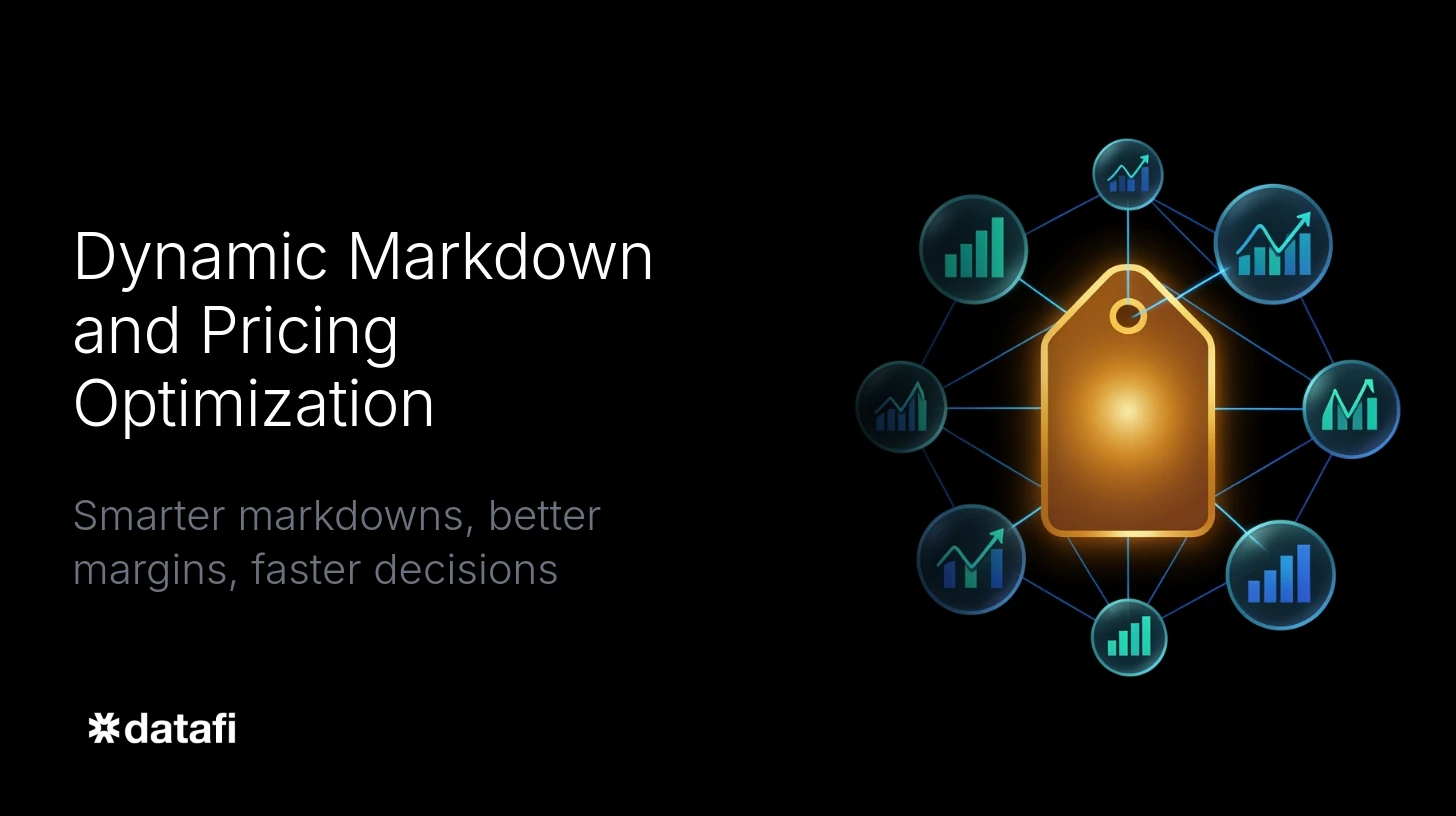
Datafi connects directly to the full data ecosystem of a business. Inventory management systems, point-of-sale platforms, e-commerce transaction data, ERP systems, promotional calendars, demand forecasting outputs, competitive price feeds, and customer segmentation models can all be surfaced through a single governed, context-aware interface. The LLM at the core of the Datafi platform does not work with summaries or exports. It works with live, connected data, carrying the full business context required to reason about pricing decisions the way an expert would.
This distinction matters enormously. A pricing tool that receives a feed of inventory and sales data can produce a recommendation within the logic it was designed to follow. But it cannot account for the fact that a major promotional event is scheduled in twelve days, that a key competitor just exited the market in a specific region, that a particular SKU has a high return rate that inflates its apparent sell-through, or that a customer segment that drives disproportionate margin is showing unusual purchasing patterns this week. Those factors exist in the data. They are just not in the pricing tool.
A Day in the Life: Pricing Decisions Transformed
A regional apparel brand running Datafi gives their pricing and merchandising team access to a governed AI workspace that connects to their retail operations platform, their e-commerce data, their promotional planning calendar, their competitive monitoring feed, and their demand forecasting models.
On a Tuesday morning, a pricing manager opens Datafi and asks a single question: which categories are at risk of missing sell-through targets for the current season, and what markdown timing would maximize margin recovery across those categories?
Datafi pulls current on-hand inventory and sell-through rates by SKU and category. It layers in the remaining days in the selling season. It checks the promotional calendar to identify windows where standalone markdown activity would not conflict with planned events. It reviews the competitive landscape to flag categories where aggressive markdown could be differentiated or where the brand is already priced below key competitors and markdown depth should be conservative. It surfaces patterns in historical markdown performance, identifying which SKU types respond well to early shallow markdowns versus late deep markdowns based on how similar products have performed in prior seasons.
The output is not a spreadsheet requiring further analysis. It is a prioritized action plan: the categories requiring immediate markdown attention, the recommended depth for an initial markdown, the timing for a secondary markdown if sell-through does not respond, and a margin impact model across scenarios. The pricing manager reviews it, exercises judgment on the recommendations, and initiates execution directly from the same interface.
What previously required an analyst request, a two-day turnaround, a cross-functional review meeting, and another day to prepare execution briefs now happens in a single session.
The decision is better because it was made with complete information. The margin outcome is better because the decision was made at the right moment.
Beyond Reactive Markdowns: Optimizing the Full Pricing Lifecycle

Dynamic markdown support is one dimension of what Datafi enables in pricing. The same connected, context-aware approach transforms the entire pricing lifecycle.
For initial pricing decisions on new products, Datafi can surface comparable SKU performance, analyze price elasticity patterns in adjacent categories, review competitive positioning, and factor in margin targets and cost inputs to recommend an opening price that balances competitiveness with margin integrity from the first day of availability.
For promotional pricing, Datafi can evaluate the full cost of a planned promotion against its forecasted lift, identifying where promotional spend is likely to generate genuine incremental revenue versus where it would cannibalize full-price sales from customers who would have purchased without the discount. This kind of promotional ROI analysis is theoretically possible with existing tools, but it requires a level of data assembly that most teams cannot operationalize at the speed promotions are planned.
For clearance and end-of-life pricing, Datafi can manage the full markdown cadence dynamically, adjusting recommendations as actual sell-through responses deviate from forecast. A SKU that responds faster than expected to an initial markdown can receive a signal to hold depth on the second markdown and preserve additional margin. A SKU that does not respond can be flagged for acceleration before it becomes a late-season clearance problem.
For competitive response pricing, Datafi can monitor competitor price changes and surface recommendations for selective response, distinguishing between competitor moves that warrant a response to protect volume in price-sensitive segments and those where holding price is the correct call to protect margin.
At each stage, the decisions are informed by the same complete data picture and the same business context. The AI does not treat each question in isolation. It reasons across the full pricing system.
Governance, Access, and Confidence at Scale
A persistent concern with AI-driven pricing is the question of control. Pricing decisions affect margin, competitive position, customer relationships, and brand perception. They cannot be delegated to a black box. Datafi is not a black box.
Every recommendation Datafi produces is traceable to the data and reasoning that produced it. Pricing managers can see what inventory data, competitive signals, historical patterns, and business context the system weighed in arriving at a recommendation. They can challenge the inputs, adjust the parameters, and override the recommendation. The AI is an extraordinarily capable analyst working with full information. The pricing manager remains the decision-maker.
Datafi also provides governance controls that ensure pricing teams are working with authorized data and that AI-generated recommendations are routed through the appropriate review and approval workflows before execution. For organizations with complex pricing governance requirements, including those in regulated categories or with franchise structures, this governance layer is essential.
Access controls ensure that different members of the pricing and merchandising team see the data and recommendations relevant to their scope. A category manager sees their categories. A regional pricing lead sees their geographies. A chief merchandising officer sees the full picture. The same AI capability is available across the organization, governed appropriately at every level.
The Compounding Advantage
The financial case for AI-driven pricing optimization is well-documented. Studies across retail and product categories consistently show that optimized markdown timing and depth can recover two to five percentage points of margin on clearance inventory alone. For a business doing significant volume through seasonal or trend-driven products, that is a material improvement in profitability.
But the more important advantage is one that compounds over time. A pricing team that operates with full information, acts at the right moment, and learns from the outcomes of every decision systematically improves the quality of its pricing instincts and the precision of its models. Datafi captures that learning, incorporating pricing outcomes back into the context that informs future recommendations. The system becomes more accurate. The team becomes more capable. The organization builds a pricing competency that is increasingly difficult for competitors operating on fragmented data and manual processes to match.
Datafi exists because the tools businesses use to manage data and AI were designed for a world where getting value from information required significant technical resources, long timelines, and specialist expertise. That world created a gap between the organizations with the resources to close it and those without. Datafi closes that gap for everyone.
Dynamic markdown and pricing optimization is one of the clearest expressions of what Datafi makes possible: a business decision that touches every part of the organization, made better, faster, and with more confidence, because the people responsible for it finally have everything they need to get it right.
Datafi connects your complete data ecosystem to AI that understands your business. Pricing decisions are just the beginning.