



The Store That Thinks It Knows You
Walk into a national retailer in Phoenix and you will find a sunscreen wall that stretches six feet high in January. Walk into a sister location in Minneapolis and you will find that same wall, occupying that same six feet, stocked with the same SKUs, in the same month, while winter boots sell out before noon.
This is not an inventory problem. It is an intelligence problem.
Assortment planning has always been one of the most consequential decisions in retail, grocery, and consumer products. Get it right and you maximize sell-through, minimize markdowns, reduce stockouts, and earn the kind of customer loyalty that compounds over time. Get it wrong and you are paying to carry dead inventory while your competitors earn the sale you missed. The margin between those two outcomes is increasingly razor-thin, and the organizations winning are not the ones with bigger buying teams. They are the ones whose planning decisions are grounded in real, local, contextual intelligence rather than category averages and historical baselines.
The organizations winning at assortment planning are not the ones with bigger buying teams. They are the ones whose decisions are grounded in real, local, contextual intelligence rather than category averages and historical baselines.
Most organizations today have more data than ever before and less clarity than they need. They have point-of-sale systems, loyalty card data, supplier forecasts, market trend reports, weather feeds, and regional demographic data. What they lack is a way to bring all of that together in one place, query it in plain language, and move from insight to action without a six-week analyst backlog standing in the way.
That is exactly what Datafi is built to solve.
Why Assortment Planning Is Hard
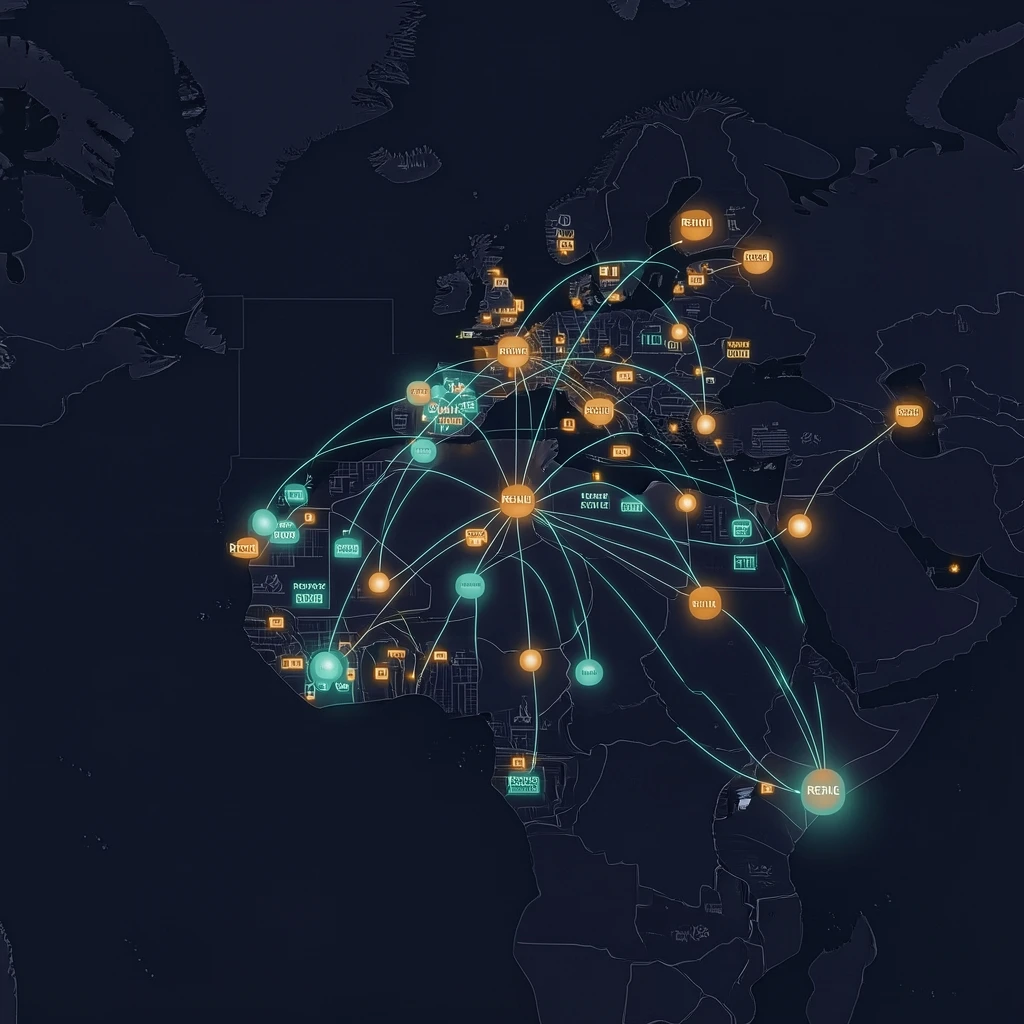
The challenge is not a shortage of data. It is a shortage of connected, contextualized data that the people making decisions can actually work with.
A regional buyer at a mid-sized grocery chain might have access to a category performance dashboard, a vendor portal, a demographic report from a third-party research firm, and a shared spreadsheet tracking store-level anomalies flagged by district managers. None of these talk to each other. Each tells a partial story. Synthesizing them into a coherent recommendation requires hours of manual cross-referencing, and by the time the analysis is complete, the season has moved.
The larger structural problem is that assortment planning decisions are made centrally for conditions that play out locally. National buying teams set category strategies based on aggregate data, but what sells in a downtown urban location is rarely what sells in a suburban family neighborhood twenty miles away, even within the same metro. Population density, household income distribution, cultural composition, proximity to competing formats, commuter patterns, and dozens of other local signals all drive demand variation that aggregate analysis systematically flattens.
The organizations that have historically compensated for this have done so by investing heavily in field intelligence, district manager observations, and manual overrides to central plans. That process is slow, subjective, inconsistent, and does not scale.
The future of assortment planning looks fundamentally different. It starts with giving AI systems full access to the data ecosystem that surrounds every planning decision, and it ends with the humans in that process making better decisions faster, without needing to be data scientists to do it.
How Datafi Approaches the Problem
Datafi is a vertically integrated data and AI platform designed to give enterprise organizations something that has historically required armies of engineers to build: a single, governed environment where business data from every relevant source can be accessed, queried, and acted upon by the people who need it, in the language they already speak.
For assortment planning, that means connecting the full data ecosystem that informs buying decisions. Transaction data from point-of-sale systems. Customer behavior signals from loyalty programs. Market trend data from external providers. Weather and seasonal patterns. Competitor pricing and promotional intelligence. Regional demographic and economic data. Supplier performance history and lead time variability. Local event calendars. All of it becomes available to the Datafi platform as a coherent, governed data environment.
The critical distinction is what happens next. Most analytics platforms stop at visibility. They surface the data, render it in dashboards, and leave the synthesis to the analyst. Datafi goes further. Because the platform provides the AI with full business context, not just raw data access, the intelligence it generates is grounded in the actual conditions of your business. The AI is not answering abstract questions about retail trends. It is answering specific questions about what your customers in your stores in your markets are buying, why the pattern is shifting, and what the right response is.
This is the difference between an AI that answers questions and an AI that solves problems.
The Datafi Experience for Assortment Planning

Consider a regional grocery buyer managing a category across forty store locations in a metro area that spans urban, suburban, and rural sub-markets. The buying cycle requires quarterly assortment reviews, and the buyer needs to understand which SKUs are overperforming, which are underperforming, and where local demand divergence justifies a departure from the national category template.
In a traditional workflow, this analysis would require pulling reports from multiple systems, exporting to spreadsheets, manually tagging stores by market type, and comparing performance indices against category benchmarks. That process takes days. It also depends entirely on the buyer knowing which questions to ask and which comparisons to make, which means patterns that fall outside standard reporting views are routinely missed.
With Datafi, the buyer opens the platform’s Chat UI and starts asking questions the same way they would ask a knowledgeable colleague. “Which SKUs in the beverage category are showing the highest velocity variance between my urban and suburban stores over the last ninety days?” The platform does not return a table of raw data. It returns a synthesized answer grounded in the connected data ecosystem, surfacing the specific items, the stores driving the divergence, and the likely demand signals behind the pattern.
The buyer follows up. “Is the pattern consistent with what we saw in the same period last year, or is this new?” “Are the items gaining share in urban locations currently on the national assortment, or are they local additions?” “What would happen to gross margin per linear foot if I replaced the two lowest-velocity national SKUs in that cluster with the two highest-velocity regional items?”
Each question builds on the last. The platform maintains context across the conversation, the same way a knowledgeable analyst would, rather than treating each query as an isolated request. The buyer is not writing SQL. They are not navigating a dashboard hierarchy. They are having a productive dialogue with a system that actually understands what they are trying to accomplish because it has access to everything that matters.
When the analysis surfaces a clear recommendation, the platform does not stop at the insight. Datafi’s agentic capacity means the system can initiate the downstream workflow: flagging the SKU substitution for review, generating the category change documentation, alerting the supplier, and updating the forecast model. The buyer reviews and approves. The action moves.
That is not reporting. That is operational AI.
Local Demand Intelligence at Scale
The power of this approach compounds at scale. A national retailer with thousands of store locations faces a version of the assortment planning problem that has historically been simply unsolvable with manual methods. The data surface is too large, the local variation too granular, and the planning cycles too compressed for human analysis to keep pace.
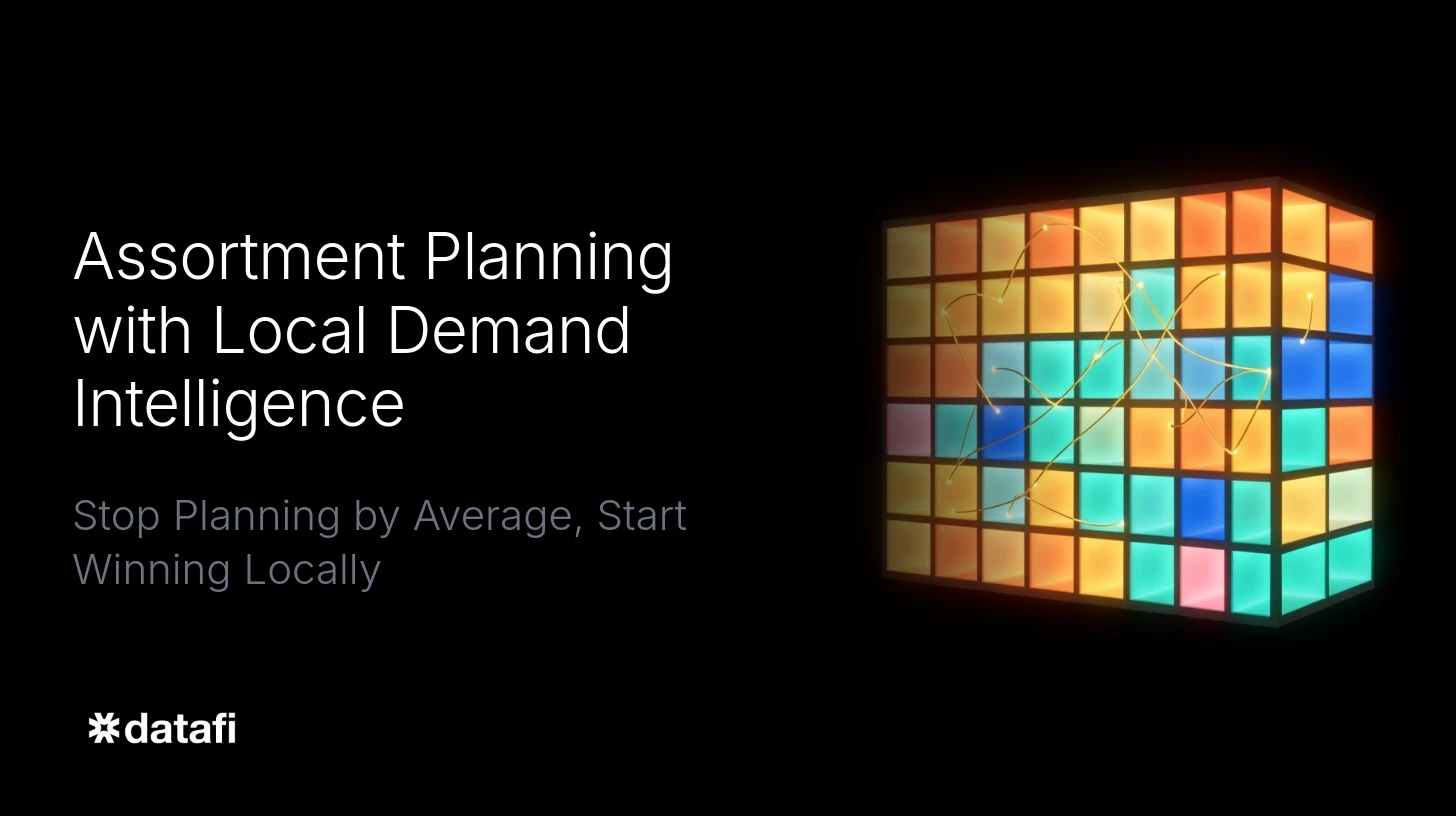
Datafi changes that equation. When the platform has full access to the data ecosystem across the entire store network, it can surface local demand patterns that aggregate analysis would never reveal. It can identify clusters of stores that share demand characteristics regardless of geographic proximity, and treat those clusters as planning units rather than defaulting to regional hierarchies that were drawn for logistics reasons rather than demand reasons.
It can correlate local event calendars with demand spikes at specific SKU levels, and build that signal into the planning model so that the buyer for a store located near a major sports venue is working from a baseline that already reflects the demand uplift on game weekends. It can track the diffusion of emerging product trends from early-adopter urban markets into suburban adoption curves, giving buyers a forward signal rather than a historical one.
Crucially, it can surface all of this to non-technical users. The district manager who notices something unusual about their store cluster does not need to file a data request. They can ask Datafi directly. “Why are sales of plant-based refrigerated items down fifteen percent in my north district stores when category trend data shows national growth?” The platform can cross-reference inventory availability, price shelf data, competitive openings in the area, and loyalty card demographic shifts to provide an answer grounded in what is actually happening rather than a generic category trend statement.
This democratization of intelligence is not a secondary feature of the Datafi platform. It is the whole point. The assumption that only large enterprises with dedicated data science teams can operate with real analytical sophistication is a legacy constraint, not a permanent condition. Datafi is built to make the analytical capability that has historically required millions of dollars of infrastructure and dozens of data engineers available to any organization willing to connect their data and ask good questions.
The Governance Dimension
Enterprise assortment planning decisions carry real business consequences and real compliance obligations. Pricing decisions, promotional structures, supplier agreements, and inventory commitments all operate within legal and contractual frameworks that cannot be violated because an AI made a recommendation without understanding the constraints.
Datafi is built from the ground up as a governed platform. Data access is role-based and auditable. The AI operates within the permissions and constraints defined by the organization, not around them. When a buyer is working in a market where promotional restrictions apply to certain product categories, the platform operates within those restrictions. When a planning recommendation touches a supplier contract with minimum volume commitments, the platform surfaces that constraint as part of the analysis rather than generating a recommendation that would inadvertently violate it.
Governance is not a feature bolted onto Datafi. It is embedded in the architecture. That distinction matters enormously for enterprise buyers who have learned from experience that deploying AI without adequate data governance is not an efficiency gain. It is a liability exposure.
From Planning Cycle to Continuous Intelligence
The traditional assortment planning process is structured around discrete planning cycles: quarterly reviews, annual resets, promotional planning windows. That cadence was designed around the limitations of manual analysis. When analysis takes weeks, you plan in cycles because that is all you can afford to do.
When analysis happens in real time, the planning process changes fundamentally. Datafi enables organizations to shift from a cycle-based planning model to a continuous intelligence model, where demand signals are monitored continuously, deviations are surfaced as they emerge, and the planning team is in a position to respond in days rather than months.
A category that was correctly assorted for the prior quarter may be misaligned with shifting demand by the time the next quarterly review arrives. With Datafi, that misalignment is visible the week it begins to materialize. The buyer can investigate, decide, and act before the miss compounds. The markdown that would have been unavoidable becomes preventable. The stockout that would have cost the category three weeks of lost velocity gets resolved before it fully develops.
That is what it means to solve the problem rather than report on it.
Starting the Conversation
Assortment planning with local demand intelligence is one of the most direct paths to tangible financial return that the Datafi platform enables. The opportunity to recover margin from better SKU decisions, reduce markdowns through more accurate local alignment, and improve sell-through by matching supply to real demand rather than average demand is available to any organization that is willing to stop accepting aggregate intelligence as a substitute for local truth.
The data is already there. The buying talent is already there. What has been missing is the platform that brings them together and makes the intelligence genuinely accessible, genuinely comprehensive, and genuinely actionable.
Datafi is that platform. And the conversation starts with a question.
Datafi is an applied AI software company building the vertically integrated data and AI platform that makes enterprise-grade intelligence accessible to every organization. To learn how Datafi can transform your assortment planning process, request a demo.