

Series: Property & Casualty Insurance | Part 1 of 3
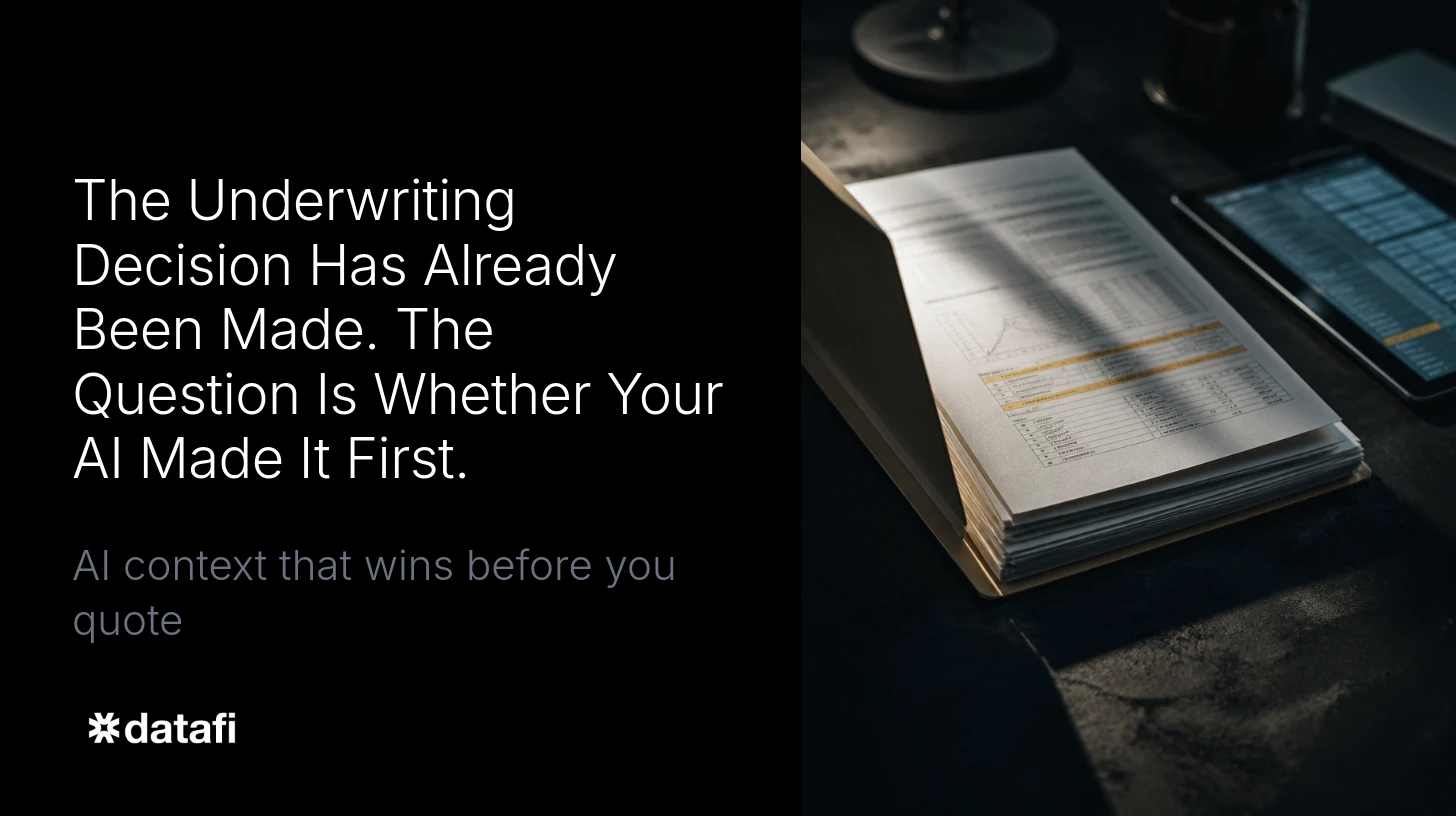
The Decision Moment Is Shrinking
In specialty, excess, surplus insurance, the competitive advantage goes to whoever quotes best, fastest, and with the most confidence. Binding authority windows close in hours. Brokers reward responsiveness. And in a hardening market, the organizations that can evaluate complex risk thoroughly and still move at speed are the ones writing the business.
The pressure is not new. What is new is the gap that has opened between organizations that have given their underwriters complete, synthesized context at the moment of decision and those still relying on manual data assembly.
One of the largest specialty wholesale insurance organizations in North America was facing exactly this problem. Underwriters were sharp. Their appetite was well defined. But the information required to make a high-quality risk decision was scattered across policy administration systems, third-party enrichment feeds, historical loss databases, and submission documents that arrived in dozens of formats. Before an underwriter could evaluate a risk, someone had to find all of it, assemble it, and trust that nothing was missing.
That process took hours. Hours that, in competitive specialty lines, often meant the opportunity was already gone.
The underwriting decision is only as good as the context available when it is made. Organizations that deliver complete, synthesized context at the moment of decision are writing the business; those relying on manual data assembly are falling further behind every quarter.
What Complete Context Actually Means
It is worth being precise about what the problem is, because the insurance industry has spent considerable money on tools that address adjacent problems without solving the core one.
Submission intake tools extract fields from documents. Data enrichment feeds add third-party risk signals. Underwriting workbenches organize the workflow. Each of these has value. None of them solves the fundamental issue, which is that the underwriter still has to move across multiple systems, mentally synthesize information from different sources, and make a judgment call with an incomplete picture.
What complete context means in practice is this: when an underwriter opens a submission, the system should already know the account history, the prior loss experience for comparable risks, the third-party signals relevant to that class of business, the completeness of the submission relative to appetite requirements, and the open questions that need answers before the file is bindable. All of it. Assembled automatically. Present at the moment it is needed.
This is not a document management problem. It is not an automation problem in the narrow sense of extracting fields from PDFs. It is an intelligence problem. It requires an operating system that connects every relevant data source, understands the underwriting context, and delivers a complete decision packet rather than a pile of component parts.
The Operating System Difference
The specialty wholesale organization addressed this by deploying the Datafi Business AI Operating System across its underwriting operation. The architecture was straightforward in design, though nontrivial in execution: connect every relevant data source into a single governed environment, build agentic workflows that run automatically when a submission arrives, and surface the output through a Chat UI that underwriters actually use.
When a new submission enters the system, an AI agent begins working immediately. It parses the submission documents, extracts and normalizes the key fields, checks completeness against appetite criteria, pulls the account’s historical relationship data, runs the exposure details against the loss history for comparable risks, and surfaces any signals that warrant attention before the file reaches the underwriter’s desk.
The output is not a summary. It is a decision packet. A structured, auditable document that contains everything the underwriter needs to evaluate the risk, ask informed follow-up questions, and arrive at a view on pricing and terms, without spending the first two hours of the process hunting for information.
The time required to reach that point dropped from an average of three and a half hours to under a few minutes per submission. That is not an incremental improvement. That is a structural change in how many risks a single underwriter can evaluate with full confidence in a given week.
Under a few minutes to a complete decision packet. Three and a half hours was the old baseline.
What Changes When Underwriters Have Full Context
The immediate operational impact is capacity. Underwriters who previously could evaluate a limited number of submissions per day with complete context can now evaluate significantly more. That matters most when submission volume spikes, when market conditions create a surge in new business opportunities, or when appetite expands into new classes and the team needs to move quickly.
But the deeper impact is quality. When an underwriter sees a complete picture at the outset, their judgment is better informed. They ask better questions. They identify risk concentrations earlier. They price with more confidence. They decline faster on risks that fall outside appetite, which is itself a form of value because it preserves underwriting capacity for the risks worth writing.
There is also a learning effect that compounds over time. When every decision packet is generated from the same connected data environment, the organization builds a structured record of how it has evaluated risk across its book. That record becomes a training signal. It informs appetite refinement. It surfaces patterns in loss development that might not appear in any single underwriter’s experience.
The underwriting decision, in other words, is not just better at the individual level. It improves at the organizational level as well, because the operating system learns from every decision made on its foundation.
The Competitive Stakes
Specialty insurance is a relationship business, but relationships alone do not win submissions in a competitive E&S market. Speed and accuracy do. Brokers learn quickly which carriers and wholesalers return high-quality indications fast. They route their best submissions accordingly.
Organizations that have invested in the infrastructure to give their underwriters complete context at the decision moment are not just operationally more efficient. They are competitively better positioned to write the business that matters most, because they can respond to it before the window closes.
The organizations that have not made that investment are not standing still. They are falling further behind every quarter, because the gap between context-enabled underwriting and manual assembly is not static. It widens as submission volume grows, as risk complexity increases, and as competitors continue to build on a foundation that compounds.
Datafi is the Business AI Operating System purpose-built for specialty insurance organizations. Learn more at datafi.co
Next in this series: Submission Triage Is Killing Your Underwriting Capacity.