


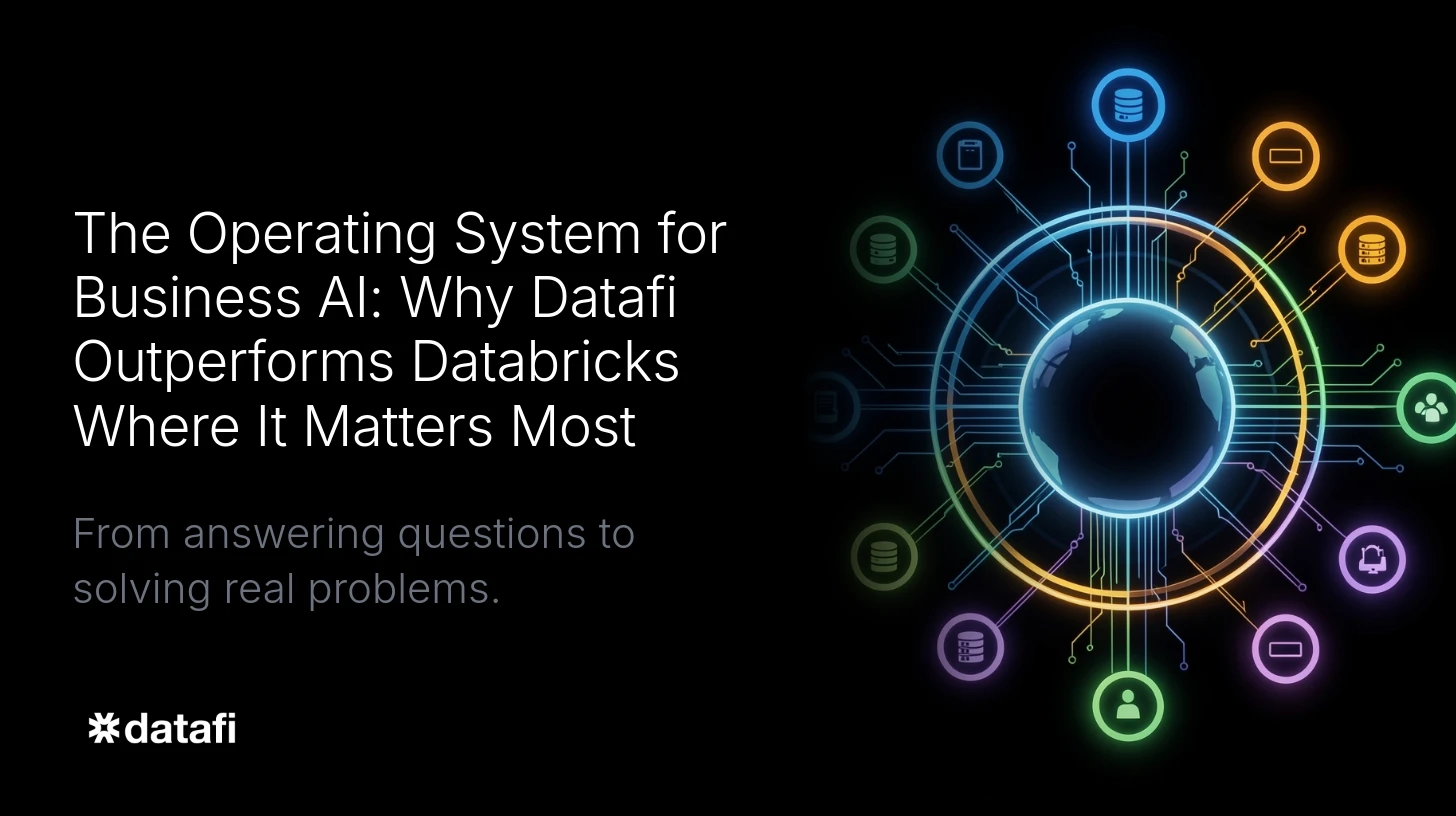
There is a question every enterprise technology leader eventually has to answer honestly: is the AI platform we have built around actually solving our business problems, or is it just helping us answer questions faster? It is a sharper distinction than it sounds, and the gap between those two outcomes is precisely where Databricks and Datafi part ways.
Datafi is purpose-built as an operating system for business AI, combining data ecosystem, governance, AI orchestration, and user interface into a single vertically integrated platform, enabling every employee to benefit from autonomous, governed AI, not just data engineers.
Databricks is a powerful, well-engineered platform. Its origins in Apache Spark, its lakehouse architecture, and its MLflow ecosystem have made it a legitimate workhorse for data engineering teams and machine learning practitioners. But practitioner-grade power is not the same as enterprise-wide transformation. When organizations begin to ask AI to take on genuinely critical roles across the business, to reason about operational complexity, to orchestrate workflows autonomously, to put insight in the hands of every employee rather than a handful of analysts, the architectural assumptions underneath Databricks begin to show their limits. Those limits are not incidental. They are structural.
Datafi was built from a different premise entirely.
Built for the Whole Enterprise, Not Just the Data Team

Databricks was designed for data engineers and data scientists. Its notebooks, its SQL warehouses, its Delta tables and Unity Catalog governance layer are all refined tools for technical users who know how to use them. That is genuinely valuable. But the workforce of a modern enterprise is not composed primarily of data engineers. It is composed of operations managers, maintenance technicians, customer experience leads, strategic planners, finance directors, and frontline employees who need AI to work for them without requiring them to become data practitioners first.
Datafi’s Chat UI is purpose-built for that reality. It is a natural language interface that allows any employee, regardless of technical background, to interrogate data, trigger workflows, and engage AI agents in the context of their actual job. There is no SQL to write, no notebook to configure, no dashboard to navigate. The intelligence comes to the user, and it comes in a language they already speak.
This is not a cosmetic difference. It is the difference between an AI investment that serves a small technical population and one that creates unified data experience and workflow efficiency across every function, every team, and every role in the organization. For enterprises of any size, including those without large data engineering organizations, that distinction is the entire ballgame.
The Vertical Integration Advantage
To understand why Datafi’s architecture matters, it helps to understand what AI actually needs to do difficult work. Large language models are not limited primarily by their reasoning capability. They are limited by context. An LLM that can only see a narrow slice of a business, a single data source, a disconnected tool, or a sanitized summary cannot reason about that business the way a domain expert would. It can answer questions about what it can see. It cannot solve problems that require understanding the full picture.
Databricks approaches this challenge as a data infrastructure provider. It offers connectors, catalogs, and APIs that developers can use to build context into AI applications. That is a valid approach for engineering teams with the resources to build and maintain those integrations. But it places the burden of creating a coherent, context-rich AI environment squarely on the customer’s technical organization, and it does so for each use case, each workflow, each department, in a largely disconnected way.
Datafi takes a vertically integrated approach. The data ecosystem, governance and policy layer, AI orchestration, and the user interface are not separate products assembled by the customer. They are designed together, as a single operating system for business AI. The result is that LLMs operating within Datafi have access to the full context of the business: its data, its rules, its processes, and its organizational relationships. That full-context access is not a feature to be configured. It is a foundational property of the architecture.
This matters enormously for what AI can actually accomplish. An LLM that knows your asset maintenance history, your procurement records, your operational schedules, your regulatory constraints, and your historical failure patterns is not just answering questions about equipment health. It is doing the kind of integrative reasoning that a seasoned operations engineer does. It is solving problems.
Governance as an Enabler, Not a Constraint
One of the most persistent anxieties in enterprise AI adoption is the tension between capability and control. Leaders want AI that can act autonomously and at scale, but they are rightly cautious about deploying systems that operate outside the boundaries of policy, compliance, and organizational accountability.
Databricks has invested significantly in its Unity Catalog governance layer, and for data management purposes it is a capable system. But governance in Databricks is primarily a data access control mechanism. It governs who can see what data. It does not govern how AI behaves, what actions agents are permitted to take, how decisions are logged and audited, or how organizational policies are expressed as AI-legible constraints.
Datafi’s governance layer is built specifically for AI operation. Policies are not just access rules; they are behavioral constraints that shape how AI agents reason and act. This means an organization can deploy autonomous agents in high-stakes operational roles, not in spite of its compliance requirements, but because of them. The governance layer is what makes broad autonomous deployment safe. It is what lets a regulated industry trust AI with consequential decisions. Far from being a limitation on what Datafi can do, it is what unlocks the most valuable applications of the platform.
Agentic AI for Critical Operational Roles

The most significant architectural distinction between Datafi and Databricks becomes visible when you examine what each platform enables AI to actually do in the enterprise.
Databricks, even with its recent investments in AI and generative capabilities, remains primarily an analytical and engineering platform. It is excellent at processing data, training models, and surfacing insights. Translating those insights into action requires additional development, additional tooling, and additional integration work by the customer’s technical team.
Datafi is designed for AI that acts. Its agentic layer allows organizations to deploy AI in operational roles that go far beyond analysis. Consider some of the domains where this distinction produces measurable outcomes.
In predictive maintenance and asset management, the difference between an AI that tells you a piece of equipment is likely to fail and an AI that autonomously schedules inspection, initiates procurement of a replacement part, updates the maintenance log, and notifies the relevant supervisor is the difference between a dashboard and an autonomous workflow. Datafi enables the latter. The agent does not just surface the prediction; it acts on it, within the governance constraints defined by the organization, without requiring human intervention at every step.
In operations optimization, Datafi’s agents can monitor real-time operational data, identify inefficiency patterns, and autonomously adjust resource allocation or trigger corrective workflows. This is not batch analysis delivered to an analyst who then decides what to do. It is continuous, autonomous optimization operating at the speed the business actually moves.
In passenger and customer experience, organizations can deploy agents that synthesize data from across the customer lifecycle, dynamically adapt service delivery, and surface personalized interventions to frontline staff in real time. The context those agents carry is not limited to a single system of record. It spans the full data ecosystem the organization has built.
In strategic planning, the value of a vertically integrated AI operating system is perhaps most profound. Strategic decisions require synthesizing information across departments, time horizons, market signals, and internal capabilities simultaneously. Datafi’s architecture makes that synthesis possible, giving decision-makers AI that has read the whole book, not just a chapter.
Accessible at Every Scale
One of the most important and often overlooked distinctions between Datafi and Databricks is scale accessibility, not in the technical sense, but in the organizational sense.
Databricks is fundamentally an enterprise-tier platform. Its complexity, its cost structure, and its requirement for skilled technical teams to operate effectively make it an aspirational investment for large organizations with established data engineering functions. Smaller and mid-sized organizations, or those without mature data teams, find themselves unable to capture its value even when they have licensed it.
Datafi’s vertically integrated approach removes that barrier. Because the platform handles the integration, governance, and AI orchestration as a unified system, organizations do not need to build and maintain the scaffolding themselves. The sophistication is in the product, not in the team required to configure it. This means a regional transportation authority, a mid-sized manufacturer, or a growing financial services firm can deploy the same quality of AI operating system that a Fortune 100 company can, without building a data engineering organization to match.
This is a genuine democratization of enterprise AI capability, and it is one of Datafi’s most consequential differentiators.
The Architecture of Problem-Solving AI
The way to understand the difference between Datafi and Databricks is to understand the difference between AI that answers questions and AI that solves problems.
Answering questions is valuable. It is where most enterprise AI deployments live today. An analyst asks a question, the AI returns an answer, and the analyst decides what to do. This is better than not having AI. But it is not transformation. The analyst is still the bottleneck. The organization is still limited by the capacity of its human decision-makers to consume AI output and translate it into action.
Solving problems requires something more. It requires AI that has the full context of the business, that can reason across the entire data ecosystem, that operates within defined governance boundaries, that can act autonomously when appropriate, and that is accessible to every employee who could benefit from its capability, not just those who know how to query a data warehouse.
Datafi is not a collection of tools assembled around a data engineering platform. It is a purpose-built operating system for business AI, designed from the ground up to enable contextual, autonomous, governed, and broadly accessible AI that enterprises actually need to transform how they operate.
That architecture is what Datafi has built. It is not a collection of tools assembled around a data engineering platform. It is a purpose-built operating system for business AI, designed from the ground up to enable the kind of contextual, autonomous, governed, and broadly accessible AI that enterprises actually need to transform how they operate.
For organizations ready to move beyond answering questions and into genuinely solving their hardest business problems, that is the platform worth building on.