


Post 3 of 3 in the series “The Limits of AI Point Solutions”
Every enterprise AI conversation I have been in eventually arrives at the same fork, and it is a false one.
On one side, keep buying tools. Stay flexible, move fast, accept the sprawl. On the other, commit to a platform, consolidate onto one vendor’s view of the world, and spend the next two years migrating into it. One path costs you coherence. The other costs you control. Most organizations, sensibly, choose neither and drift.
The reason the fork feels inescapable is that both options assume the same thing: that to unify how AI works across your business, you must first unify where your business runs. That assumption is wrong, and dismantling it is the point of this post.
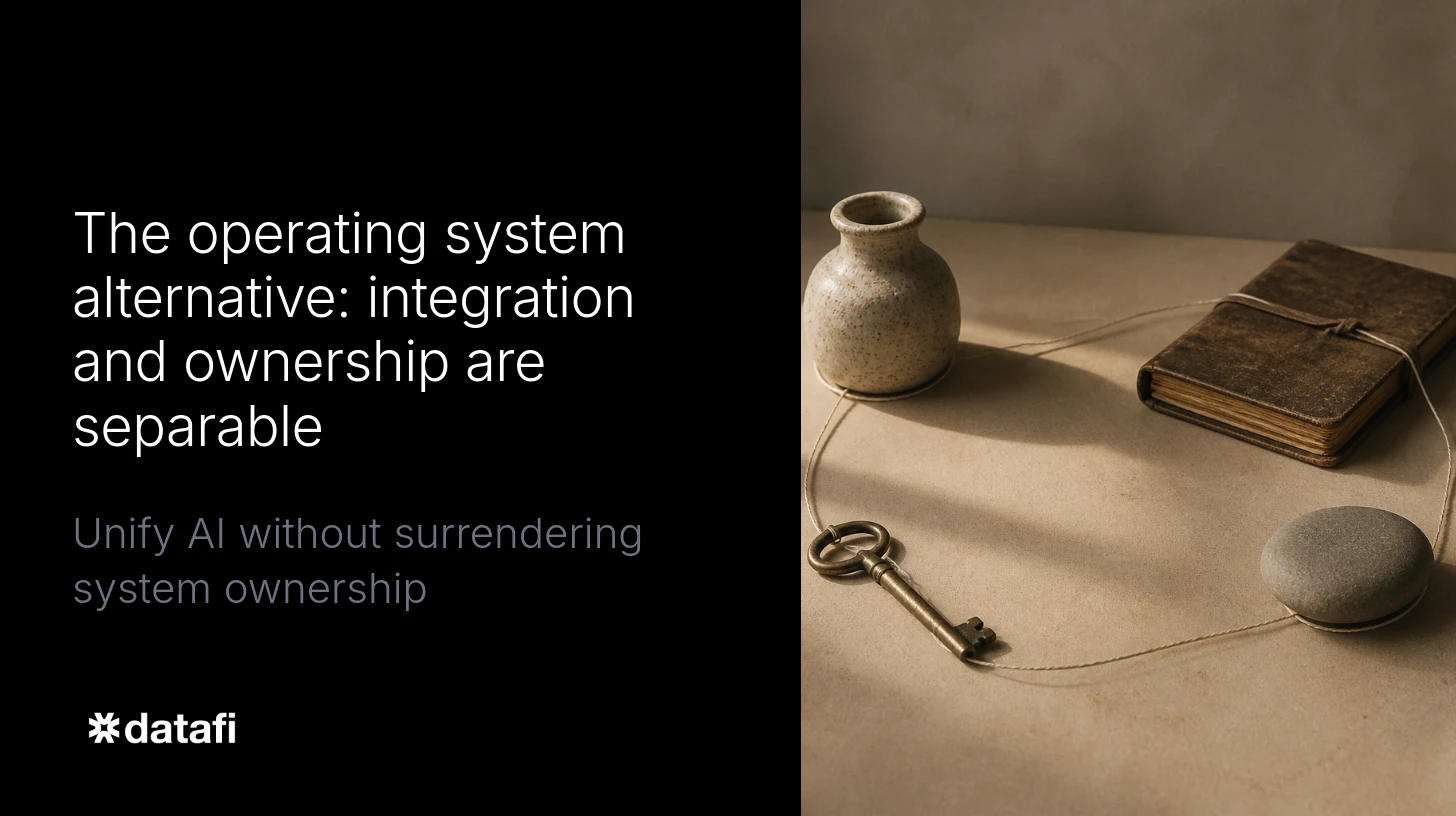
Integration and ownership are separable. You can have the first without surrendering the second. That separation is not a marketing distinction. It is an architectural one, and it is the entire premise of a Business AI Operating System.
The old bargain was: consolidate your systems to unify your intelligence, and accept dependence on whoever owns the destination. That bargain is obsolete. Agents need meaning, permission, and the ability to act across your systems. They do not need your systems to become one system. Integration and ownership are separable.
The premise worth questioning
The premise is inherited from an older era of enterprise software, and it was true then.
To get a single view of the customer, you consolidated into one CRM. To get a single financial close, you consolidated into one ERP. To get a single source of truth, you moved the data into one warehouse. Integration meant relocation. It meant that whoever owned the destination owned the truth, and everyone else’s system became a source to be drained.
That model produced two decades of migration projects and one durable lesson, which most leaders learned the hard way: the vendor who holds your context holds you. Not through the contract. Through the gravity.
The instinct to resist that, to keep systems distributed, to avoid the big consolidation, is not stubbornness. It is scar tissue, and it is earned. The mistake is assuming the old bargain still applies.
What changed
What changed is that AI does not need your data to be in one place. It needs your data to be understandable from one place. Those are different requirements, and conflating them is the source of most of the bad architecture in this market.
An agent trying to resolve an underwriting exception does not need the claims history to have been migrated into the policy system. It needs to know that claims history exists, where it is authoritative, what a claim means in your business, whether this particular user is permitted to see it, and how to retrieve it under that permission. All of that is metadata, governance, and semantics. None of it is a migration.
This is the difference between a data problem and a context problem, and the industry has spent three years solving the wrong one. Warehouses solved location. What agents actually need is meaning, permission, and the ability to act, and you can supply all three across systems that stay exactly where they are.
McKinsey’s architectural argument lands in the same place, though they arrive from a different direction. Their prescription is a composable, distributed, vendor-agnostic architecture in which any agent, tool, or model can be introduced without system rework, in which logic, memory, orchestration, and interface are decoupled, and in which components can be independently replaced as the technology advances. They favor open standards such as the Model Context Protocol over proprietary protocols precisely because the alternative is lock-in. And they name governed autonomy as a design principle: agent behavior controlled through embedded policy, permission, and escalation rather than trusted to good intentions.
Read that list again and notice what is absent. Nothing in it requires you to move anything.
What the layer actually does
This is what Datafi builds, and I want to be concrete about it rather than architectural, because the abstraction is easy and the substance is what matters.
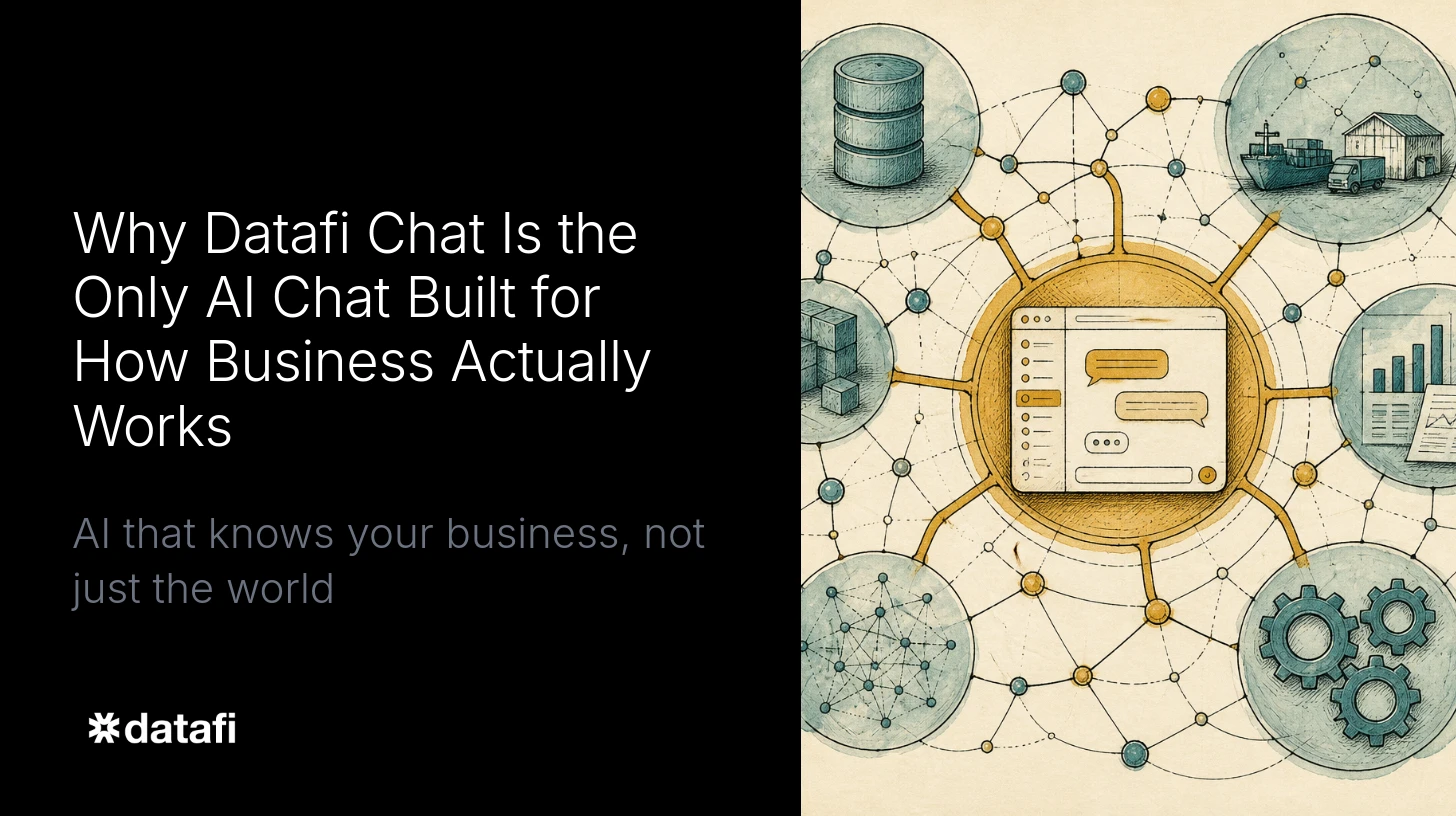
The global business contextual layer holds the authoritative answer to what things mean in your business. Not eleven vendors’ private guesses at what a customer is, but one governed definition, mapped to the systems that are actually authoritative for each fact. Your CRM stays your CRM. Your claims system stays your claims system. The layer knows which is true for what, and it is the only thing in your estate that does.
Sentinel enforces governance once, at that layer, rather than eleven times in eleven dialects. Permission is expressed against the business, not against each application’s private role model, which means the question of who can see what has a single answer that stays correct when someone adds a twelfth tool on Tuesday.
Orchestrate is where agents run, against that governed context, spanning the four systems the workflow actually touches because the layer beneath them spans those systems. This is the mechanism by which the unit of work stops being the task and becomes the process, which is the shift that separates a five percent improvement from a sixty percent one.
Control Tower makes what the agents did visible. Not what one tool did inside its own boundary, but what the workflow did end to end, across boundaries, in a form you can audit. Autonomy without observability is not automation. It is exposure with a nicer interface.
And it is model agnostic, deliberately. The reasoning engine is a component, not a commitment. The frontier moves every few months; your architecture should be able to move with it without a migration, and it can only do that if the intelligence sits above the model rather than inside it.
The chat interface is not a feature
One thing gets underweighted in these conversations, and I want to name it because it is where the theory meets the person doing the work.
The purpose of putting a chat interface over a governed contextual layer is not convenience. It is enfranchisement. The underwriter, the claims manager, the operations lead, the CFO’s analyst: these are the people who know what the problem is and have historically been three tickets and six weeks away from being able to act on it. Every one of those tickets was a translation step between someone who understood the business and someone who understood the systems.
Collapse that, and the constraint on transformation stops being engineering capacity and starts being imagination. That is a different company.
But it only works if the layer underneath is governed. A chat interface over an ungoverned estate is a data breach with good UX. The interface is the visible half of the argument; Sentinel is the half that makes it responsible.
What this looks like in practice
The organizations getting this right are not the ones with the most agents. They are the ones who picked a process that mattered, one that was cross-functional, exception-heavy, and tied to actual economics, and rebuilt it rather than accelerating it.
One of the largest specialty wholesale insurance organizations in North America is a case I keep returning to. The work that mattered was never inside one system. It spanned submissions, policy, claims, and a body of institutional judgment that lived in documents and in people’s heads. No point solution could have touched it, because no point solution could see across it. What made the difference was not a better model. It was a layer that could hold the whole problem at once, with governance that made it safe to let agents act on it.
That is what McKinsey means when they say the unit of transformation must move from the use case to the business process, and that the question is no longer where can I use AI in this function, but what would this function look like if agents ran sixty percent of it. You cannot ask that question of a tool. You can only ask it of an architecture.
The end of the false choice
So return to the fork, and notice that it dissolves.
You do not have to choose between sprawl and surrender. You do not have to migrate to unify. You do not have to hand your context to a vendor to get an agent that works across your business, and you do not have to accept eleven partial pictures to keep your systems where they are. The layer gives you coherence without relocation, governance without a chokepoint, and orchestration without lock-in, because it was designed on the assumption that you would want to keep what you have.
This is what we mean by an operating system. Not an application you use, but the thing your applications and your agents run on. It owns the context, the governance, the orchestration, and the observability. It does not own your business.
The gen AI paradox, widespread deployment with minimal impact, was never a technology failure. It was an architecture failure, purchased one reasonable decision at a time.
The organizations that break out of it will not be the ones who bought the most AI. They will be the ones who built the layer that let AI stop answering questions and start solving problems.
The time for exploration is ending. What comes next has to be built on something.
Datafi is a Business AI Operating System for mid-enterprise organizations, built to activate the systems you already own so AI can solve business problems rather than simply answer questions about them. Learn more at datafi.co.
Series: The Limits of AI Point Solutions
Post 1: The activity trap: why your AI pilots feel productive and change nothing
Post 2: The compounding cost of a fragmented stack
Post 3: The operating system alternative: integration and ownership are separable