


There is a moment every technology leader eventually faces. The whiteboard diagrams look clean, the vendor pitch was compelling, and the vision of a unified data platform sounds exactly like what the organization needs. Then reality sets in: your data lives across dozens of systems, your teams span departments with radically different technical fluency levels, and the AI tools being offered still require your people to know exactly what question to ask before they can get any value.
Microsoft Fabric is an ambitious platform. But ambition and fit are different things. For organizations navigating a broad, heterogeneous data landscape with serious ambitions for AI-driven transformation, a different kind of operating system is required. One built not just for managing data, but for putting AI to work across every corner of the enterprise.
That operating system is Datafi.
Most enterprise AI deployments underdeliver not because of weak models, but because they lack the full business context layer that transforms raw data into intelligence an AI agent can actually reason with. Datafi is built from the ground up to solve this problem at enterprise scale.
The Lock-In Problem Nobody Talks About Enough
Microsoft Fabric is architecturally elegant if your organization is already deeply committed to the Microsoft ecosystem. Azure, Teams, Power BI, OneLake, Copilot Studio — these integrations create a coherent picture when your world is already Microsoft-shaped.
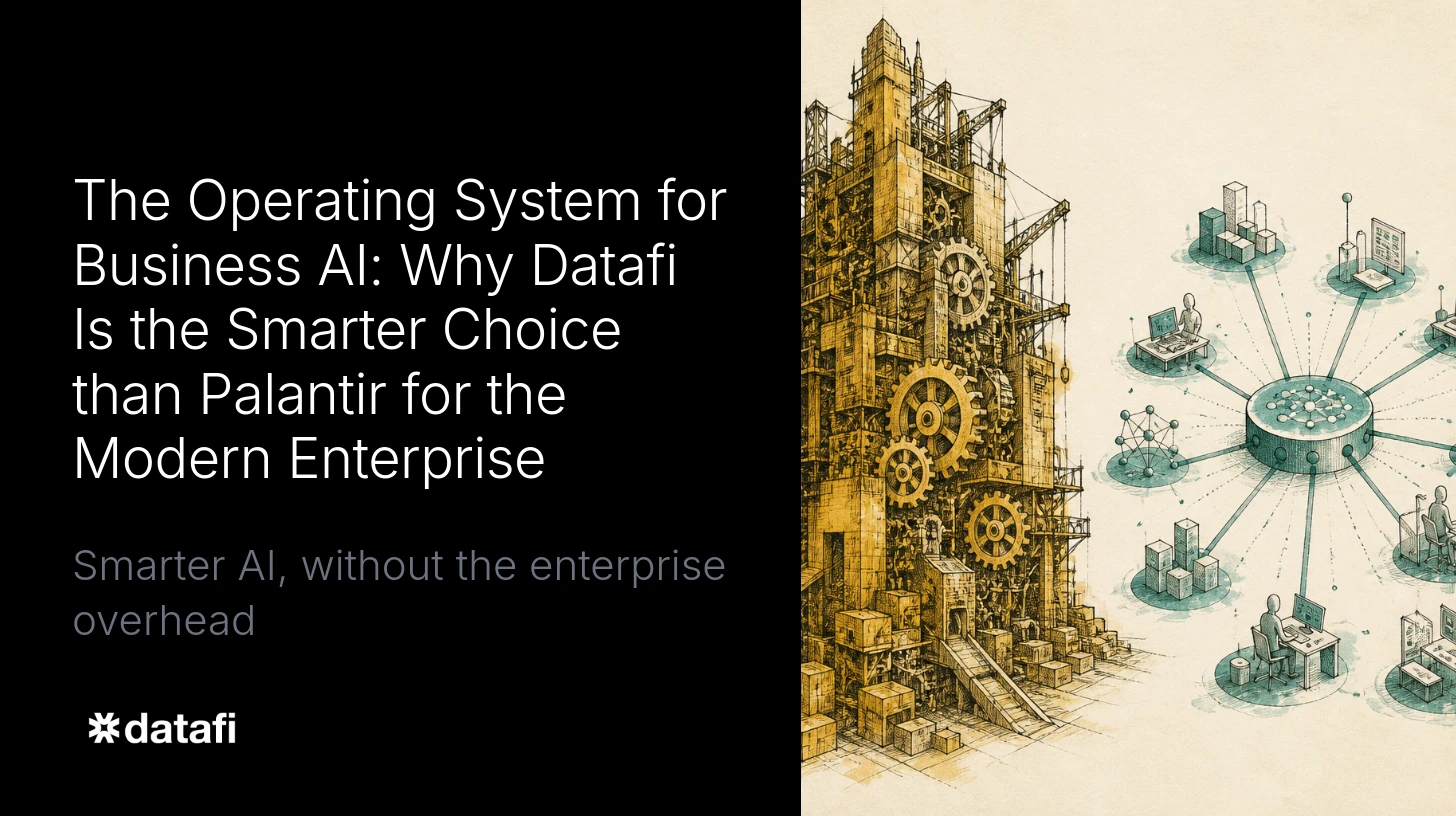
Most enterprise organizations are not Microsoft-shaped. They are Snowflake-shaped and Databricks-shaped and Salesforce-shaped and Oracle-shaped and SAP-shaped simultaneously. Their data sits in legacy ERP systems, operational databases, third-party SaaS platforms, proprietary historian tools, and industry-specific data stores that Microsoft has no native understanding of. Forcing all of that into a Microsoft-first architecture is not modernization — it is a migration project disguised as an AI strategy, one that can consume years of engineering capacity and millions in services spend before a single business outcome is delivered.
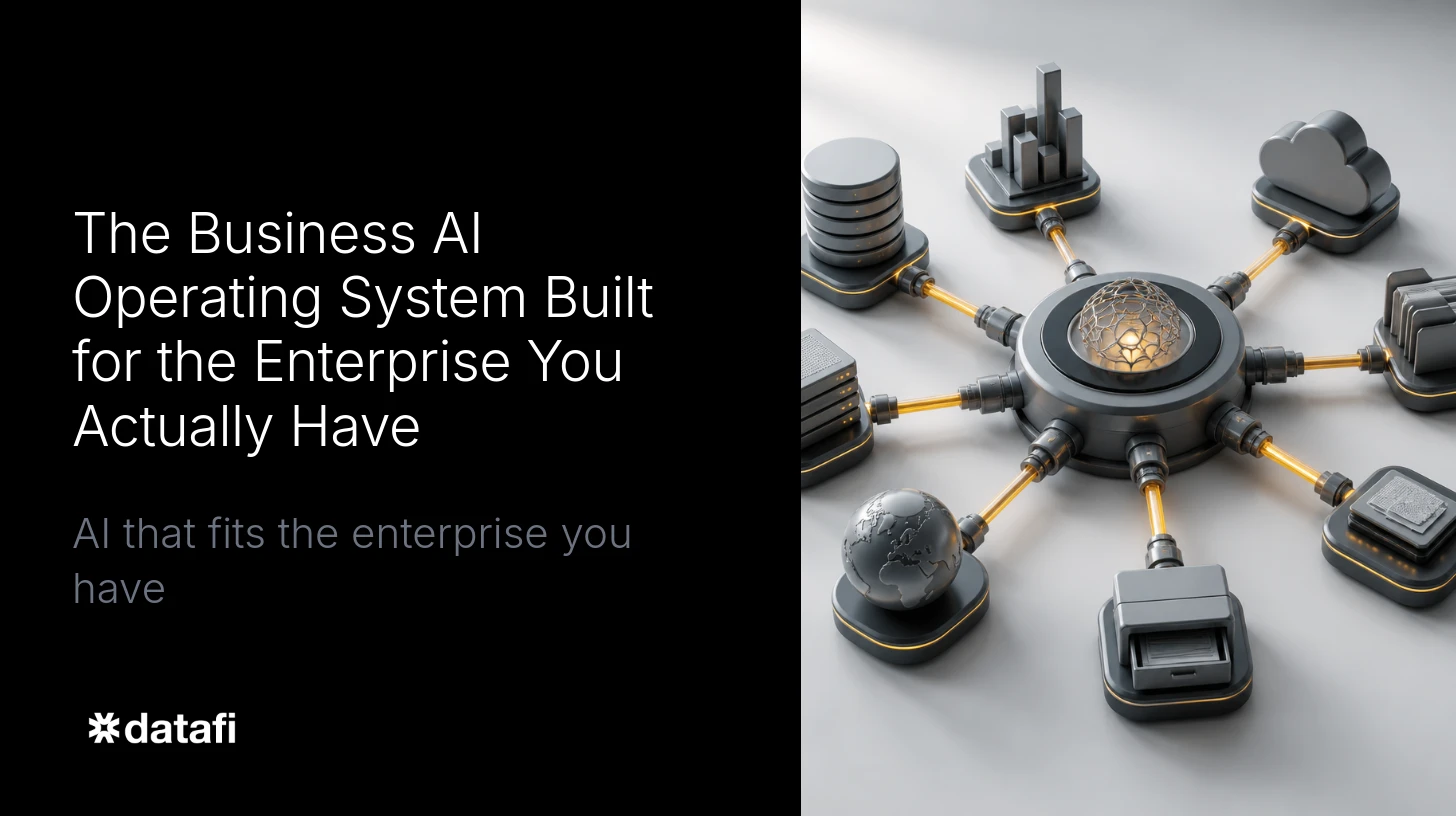
Datafi takes a fundamentally different position. Rather than requiring the enterprise to reshape itself around a vendor’s ecosystem, Datafi connects to the data landscape the organization already has. Snowflake, Databricks, Azure, AWS, Google Cloud, on-premise databases, industry APIs, and proprietary data sources — Datafi builds a unified semantic and governance layer across all of it. You retain the flexibility to evolve your technology stack without rebuilding your AI foundation every time a better tool emerges.
This is not just an architectural preference. It is a business risk decision. Organizations that consolidate around a single vendor for their AI operating layer expose themselves to pricing leverage, roadmap dependency, and the compounding cost of migration when strategy shifts. Datafi is built on the conviction that the companies who will win the AI era are the ones who maintain control of their data strategy, not the ones who hand it to a hyperscaler.
The Context Problem: Why Most AI Deployments Underdeliver
Here is the core challenge that most enterprise AI deployments are quietly struggling with. Large language models are extraordinarily capable reasoning engines. But reasoning requires context. An LLM asked to analyze customer churn, flag operational anomalies, or draft a strategic recommendation needs to understand not just the data it is querying, but the business context that makes that data meaningful.
What does this customer segment actually represent in commercial terms? What constitutes an anomaly in this operational context versus normal variance? What strategic constraints shape what is actually actionable versus theoretically optimal?
Microsoft Fabric, like most data platforms, provides a foundation for organizing and querying data. It does not provide the contextual layer that transforms raw data into business intelligence an AI agent can act on with confidence.
Datafi is built around this problem. The platform is designed from the ground up to develop and maintain a full business context layer — semantic definitions, business rules, organizational hierarchies, domain-specific logic, and governance policies — that travels with the data regardless of where it lives. This context is not a documentation artifact. It is a live, queryable layer that AI agents and workflows access in real time as they reason through complex problems.
This is the difference between an AI that answers questions and an AI that solves problems. The first retrieves. The second reasons. And reasoning at enterprise scale requires the full picture of the business, not just the data in a query result.
Datafi Chat: Designed for the People Who Actually Run the Business
One of the most telling distinctions between Datafi and Microsoft Fabric is what each platform looks like to the non-technical user.
Microsoft’s Copilot experiences are genuinely useful for knowledge workers already embedded in Microsoft tools. But they are designed for the Microsoft interface paradigm — surfaced through Teams, Excel, and Power BI for users who already live in those tools. The agent-building capabilities in Copilot Studio require technical configuration and governance oversight that puts meaningful AI automation out of reach for most business teams.
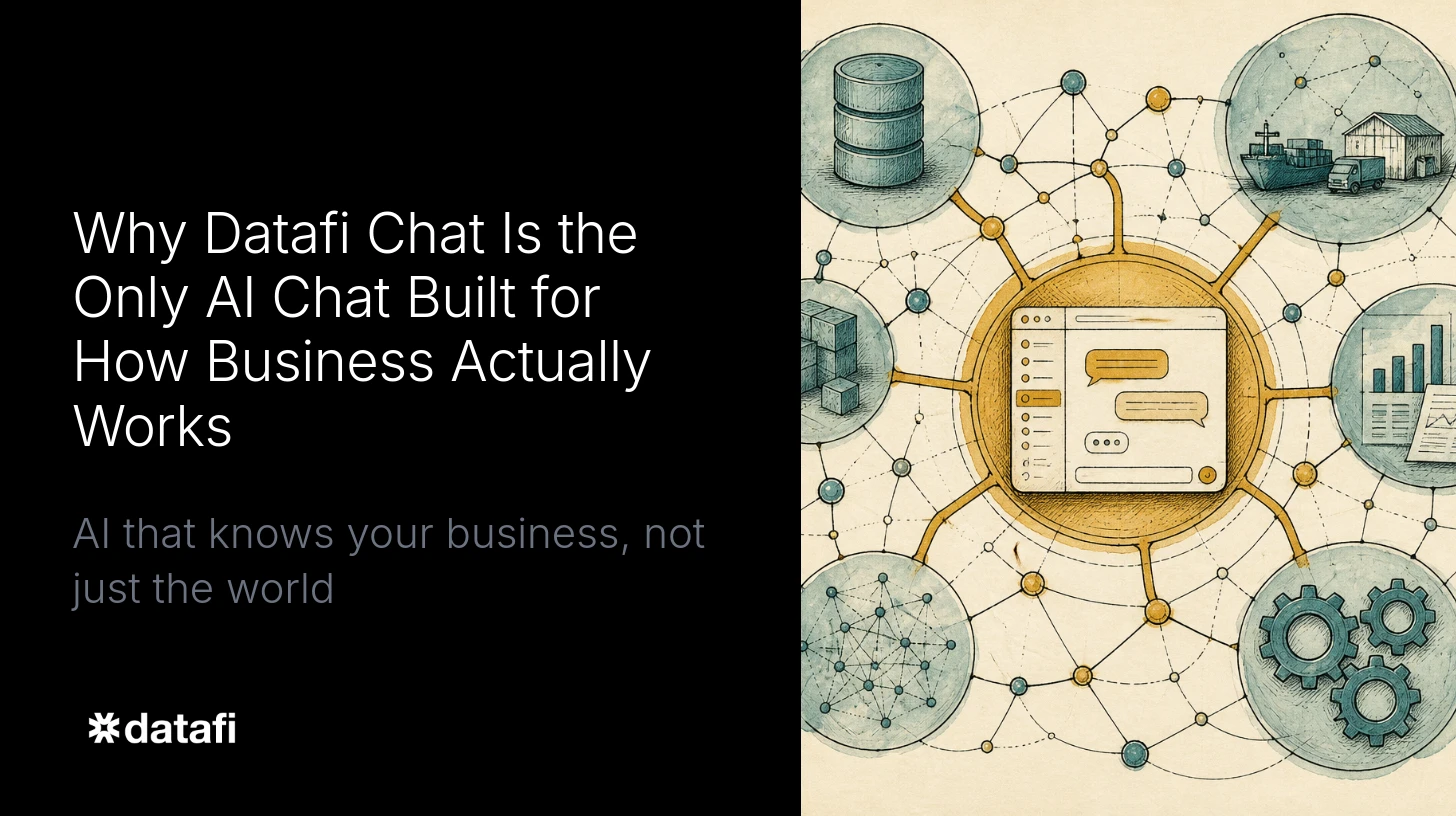
Datafi Chat is built for a different user. It is designed for the operations manager, the logistics coordinator, the financial analyst, the customer service leader, and the plant supervisor — the people who carry the deepest domain knowledge in the organization and currently have the least access to AI tools that can genuinely help them.
Datafi Chat provides a natural language interface that connects directly to the full Datafi data and governance layer. Business users can ask complex, context-rich questions and receive answers that are grounded in real business data, governed by organizational policies, and traceable to source. More importantly, Datafi Chat is the same interface through which AI agents and automated workflows surface their outputs, request human input, and escalate decisions that require human judgment.
This seamless integration between the conversational interface and the agentic layer is not a feature. It is an architectural commitment. Datafi believes that the path to broad AI adoption across the enterprise runs through a single interface that every employee can use, not a fragmented collection of purpose-built tools that require specialized training for each use case.
From Answering Questions to Solving Problems: The Agentic Enterprise

The organizations that will capture the most value from AI in the coming decade are not the ones that deploy the most chatbots. They are the ones that deploy AI in roles that were previously only possible with skilled human labor — critical thinking, pattern recognition across complex systems, proactive problem identification, and autonomous decision execution within defined parameters.
This is the vision that Datafi is built to realize.
Consider predictive maintenance and asset management. Today, most organizations rely on scheduled maintenance intervals, reactive repair cycles, and human pattern recognition to manage physical assets. An AI agent with full access to sensor historian data, maintenance records, parts inventory, procurement lead times, and operational schedules can do something qualitatively different. It can identify failure signatures before they manifest, model the cost tradeoffs of early intervention versus run-to-failure, coordinate the parts and labor scheduling required for optimal intervention, and do all of this continuously across thousands of assets simultaneously.
Microsoft Fabric can help an organization query the data that supports this use case. Datafi can deploy the agent that runs it.
Or consider operations optimization in a manufacturing or logistics environment. The variables are enormous: demand signals, supplier reliability, capacity constraints, labor availability, transportation networks, regulatory requirements, and margin targets interact in ways that exceed human cognitive capacity to continuously optimize. An AI agent operating within a properly contextualized Datafi environment can monitor these variables in real time, model scenario outcomes, recommend interventions, and in mature deployments execute within approved decision boundaries autonomously.
The passenger experience use case in transportation and hospitality follows the same pattern. Guest history, service preferences, operational capacity, real-time demand, staffing levels, and inventory data are all available, but synthesizing them into personalized, proactive service decisions at scale has historically required either large service teams or the sacrifice of personalization for standardization. AI agents operating on a complete business context layer can close that gap in ways that neither a data platform nor a chatbot alone can achieve.
Strategic planning deserves particular attention. AI agents with access to financial data, market intelligence, operational performance metrics, competitive signals, and the organization’s own historical decision record can serve as a genuine thought partner for leadership teams. Not by generating generic strategic frameworks, but by reasoning through the specific strategic context of the organization with the full weight of its proprietary data. This is not possible without the contextual layer. It is not possible with a system that only knows what you explicitly asked it to query.
The Vertically Integrated Advantage
There is a reason Datafi describes itself as a Business AI Operating System rather than a data platform or an AI tool. The term is deliberate.
An operating system provides a stable, unified foundation on which applications can be built and run. It handles the complexity of the underlying hardware so that the applications can focus on delivering value. It governs access, manages resources, and maintains the integrity of the environment regardless of what is running on top of it.
Datafi is vertically integrated across the layers that matter for enterprise AI deployment: connectivity to the full data ecosystem, a semantic and governance layer that maintains business context, an AI orchestration layer that coordinates agents and workflows, and a user interface designed for every employee from technical to non-technical. These layers are not assembled from separate vendor products and stitched together with integration work. They are built as a coherent whole.
Microsoft Fabric is a powerful data engineering and analytics platform. But deploying it as an enterprise AI operating system requires assembling Fabric with Azure OpenAI, Copilot Studio, Power Platform, and a collection of integration layers that are maintained separately, upgraded separately, and governed separately. The total cost of ownership, the integration complexity, and the governance overhead of that assembled stack is substantially higher than it appears in the initial evaluation.
Datafi’s vertical integration means a faster path to production, a more coherent governance posture, and a lower ongoing cost of maintaining the AI foundation as the organization’s needs evolve.
Built for the Enterprise You Have, Ready for the Enterprise You Are Building
Mid-market and enterprise organizations are not homogeneous. They do not all run the same data stack, serve the same industries, employ the same ratio of technical to non-technical workers, or face the same competitive dynamics. The AI operating system that serves them needs to be flexible enough to meet them where they are and powerful enough to carry them where they need to go.
Datafi is built on this premise. Whether an organization is beginning its AI journey with a focused agent deployment in one operational area, or scaling toward a fully autonomous AI-enabled enterprise, the Datafi platform provides a consistent foundation that grows with the ambition.
The organizations that will look back five years from now with confidence in their AI strategy are the ones that made an architectural commitment early — not to a vendor, not to a technology stack, but to a set of principles about what enterprise AI actually requires to deliver transformative outcomes. Full business context. Governed access across the complete data landscape. A user interface that every employee can use. Agents that solve problems rather than answer questions.
That is what Datafi is built to provide. Not a point solution. Not a platform that requires the enterprise to become someone else’s reference architecture. A Business AI Operating System for the organization you have, and the one you are becoming.
To learn more about how Datafi can accelerate your organization’s AI transformation, visit datafi.co.