


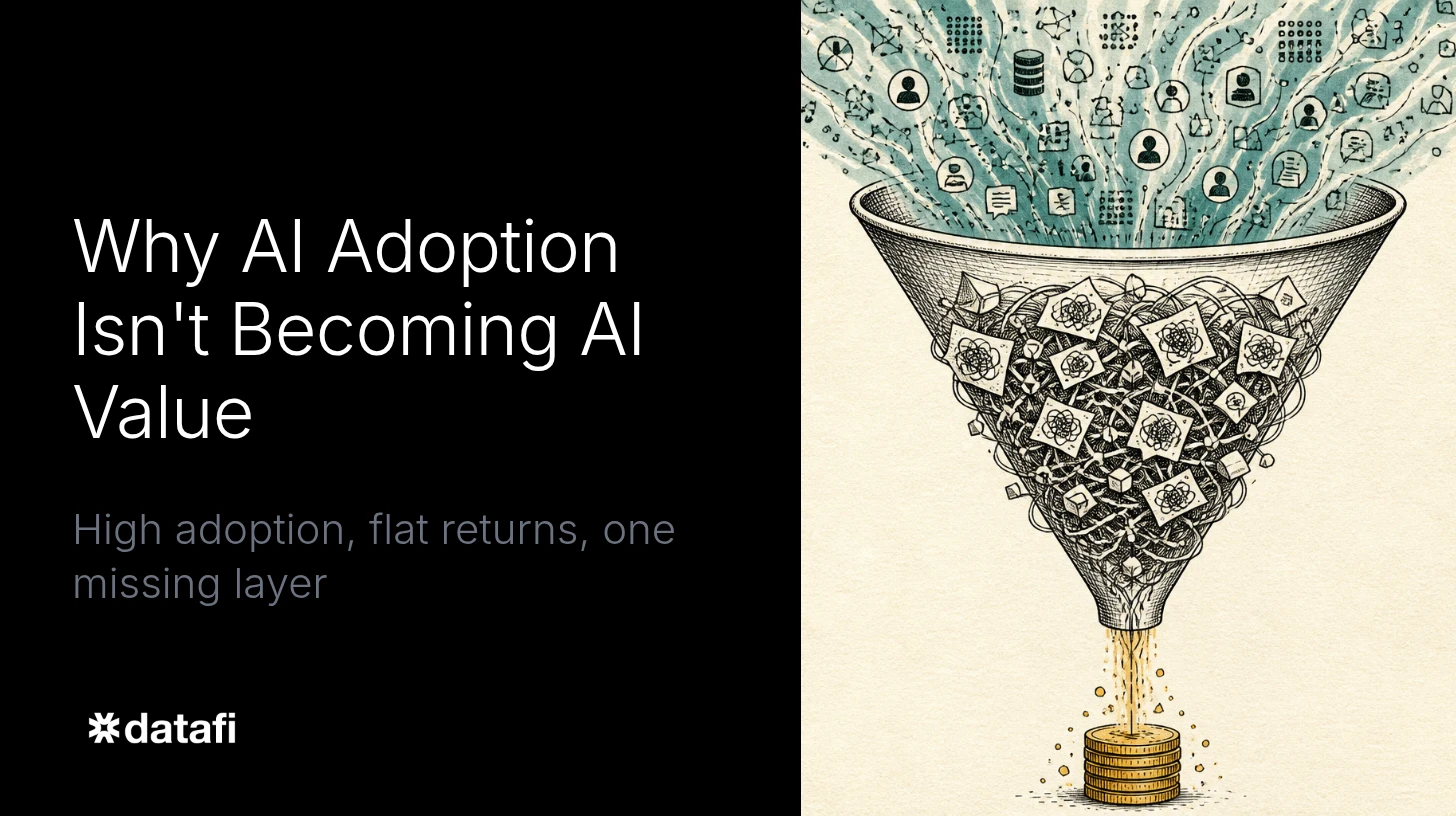
Forty percent of large companies now say they have scaled AI agents into at least one business function. Six percent say AI contributes at least 5 percent of their EBIT.
Those two numbers come from McKinsey’s 2026 State of AI survey, and they anchor a new report from QuantumBlack, AI by McKinsey, on what the authors call the AI operating system. The gap between them is striking, but the gap is not the most important part. The most important part is that the 6 percent figure barely moved from the year before.
Think about what happened in that year. Agent frameworks matured. Every major software vendor shipped a copilot. Model prices collapsed. Enterprises bought seats by the thousands and stood up AI councils and centers of excellence. Adoption climbed. And the share of companies that can point to AI on the income statement stayed essentially flat.
McKinsey’s reading of this is direct: the hard part is no longer getting people to use AI. The hard part is changing how the enterprise itself works. Their proposed answer is a management layer that functions as a “second brain” for the business, an AI operating system that holds what the company knows and puts it to work from the CEO to the front line.
I agree with the diagnosis. I want to be more specific about the cause, because the cause tells you what to build.
The adoption-to-value gap is a context gap. Agents that can reach your data but do not understand what it means will answer questions all day and solve almost nothing. McKinsey’s second brain is a name for the missing layer: the definitions, relationships, rules, and history that turn data into business meaning, available to every agent and every person at the same time.
The premise worth questioning
The premise underneath most enterprise AI strategy is that value follows adoption. Get the tools into enough hands, connect them to enough data, give people time to learn, and the returns will arrive.
It is a reasonable premise, and it has history on its side. Before taking it apart, it deserves a fair hearing.
The case for patience
Every general purpose technology has looked disappointing in its early years. Economists spent the late 1980s puzzling over why computers showed up everywhere except in the productivity statistics. ERP programs in the 1990s routinely ran over budget and under delivered before they became the backbone of modern operations. Cloud migration looked like a cost exercise until it became the platform for nearly everything that followed.
Research on this pattern has a name for it: the productivity J-curve. New technologies require complementary investments in process, skills, and organization, and those investments depress measured returns before they lift them. On that reading, a flat 6 percent is not a failure signal. It is the bottom of the curve.
There is also a measurement argument. EBIT attribution is hard. When a customer service team handles more volume with the same headcount, or an analyst produces in an hour what used to take a week, the gains are real but diffuse. They show up as avoided hiring, faster decisions, and better margins in a dozen places, and few finance teams can cleanly assign any of it to AI.
Both arguments are true. Patience is warranted, and measurement is genuinely difficult.
But the J-curve argument contains its own warning. The value in that curve does not come from time passing. It comes from the complementary investments. Organizations that wait without making them do not ride the curve upward. They stay at the bottom while their competitors climb.
So the useful question is not whether to be patient. It is which complementary investment AI actually requires. McKinsey’s report answers that question, and the answer is not more models, more seats, or more data platforms.
Why access is not understanding
Consider a question that sounds simple: which of our customer lanes are losing money?
Picture a regional freight carrier asking it. An agent with database access can find the revenue and cost tables and return a number. But what is margin on a lane? Does linehaul cost get allocated by miles, by weight, or by revenue? Do accessorial charges count, and when do they post? How is the fuel surcharge treated when it lags the fuel price by two weeks? Finance answers those questions one way in its spreadsheets. Operations answers them another way in its daily dashboard. The pricing team has a third version that lives mostly in the head of a director who has been there eighteen years.
The agent will return a confident answer. It will not know which definition it used, and it will not know that the three definitions disagree.
McKinsey’s opening scenario turns on exactly this problem. An insurer’s AI operating system assesses exposure to new margin rules across seven countries and immediately flags something it cannot resolve on its own: each regulator defines margin differently. The work that follows is reconciliation, mapping each regulator’s definition to how the company measures margin across its pricing, finance, and commission systems. Only after that work does the analysis become something leaders can act on.
That reconciliation is the second brain. It is not glamorous, and it is not the part of AI that makes headlines. It is the part that decides whether an agent’s output can be trusted with a decision.
The report’s retail example makes the same point from a different angle. District managers at a large US retailer already had extensive dashboards covering more than 7,000 stores. They were not short on data or on answers. What changed outcomes was a layer that synthesized everything into a single view, diagnosed likely causes of performance gaps, recommended actions, and helped managers decide which stores to visit.
Dashboards answer questions. The second brain solves problems.
That distinction has been the organizing idea of every system we have built at Datafi, and it is the clearest explanation I know for why adoption keeps rising while value stays flat.
What the second brain actually is
McKinsey defines the AI operating system as a continuously running layer that maintains enterprise context, reasons across functions, recommends or executes decisions, and learns from outcomes. The report is careful to separate it from what already exists.
The existing estate stays where it is. Infrastructure, data platforms, and legacy systems are not replaced. Models are sourced from multiple providers to avoid dependence on any single one. On top of that estate sit four layers: a semantic layer that gives AI a consistent understanding of the business, analytics and deterministic models that agents can call as tools, agent definition and orchestration, and an experience layer that delivers intelligence where people already work.
The report’s most important line about the semantic layer is its measure of value. The layer earns its place by extending what agents understand so they can operate like experienced employees. Not like a search engine with good recall, but like someone who has been in the business long enough to know what the numbers mean and which ones to distrust.
The second idea worth underlining is reuse. McKinsey illustrates how each new business problem adds a few new ontology components while reusing a growing share of existing ones. The first problem is expensive because the context does not exist yet. The fourth problem is cheap because most of it does.
This explains the flat line better than any measurement argument. Most enterprise AI spending over the past two years went to the top of the stack, into models, chat seats, and copilots, or to the bottom, into data platforms and pipelines. Very little went to the middle, where meaning lives. Every new use case was built from scratch against raw data, so every use case cost about the same as the last one, and none of them made the next one smarter. That is how you get high adoption and low returns at the same time.
The mid-enterprise version of the problem
McKinsey’s survey defines large companies as those with more than $1 billion in revenue, and the report’s case studies reflect that scale. One manufacturer connected roughly 100 data sources, used AI to accelerate building its ontology, and had its first phase running in about 16 weeks. That is fast for an organization of that size, and it still assumes a dedicated team with the time and skill to do it.
A $400 million carrier, a regional insurer, or a family-owned grocery chain faces the same context gap with a fraction of the people. In some ways the gap is sharper. Institutional knowledge in a mid-enterprise company is concentrated in fewer heads, which makes it easier to capture and more dangerous to lose. Leadership is closer to operations, which makes McKinsey’s vision of direct, delayered management more achievable. But there is rarely a data science organization standing by to build an ontology from scratch.
For these companies, the second brain cannot be a program they staff. It has to be something they deploy.
What this requires architecturally
At Datafi, this is the layer we built the platform around. The business context layer federates to the systems a company already runs, including ERP, TMS, policy administration, point of sale, on-premises databases, and file shares, without migrating or copying data. Definitions, relationships, and business rules accumulate in that layer as teams solve real problems, which is the reuse pattern McKinsey describes.
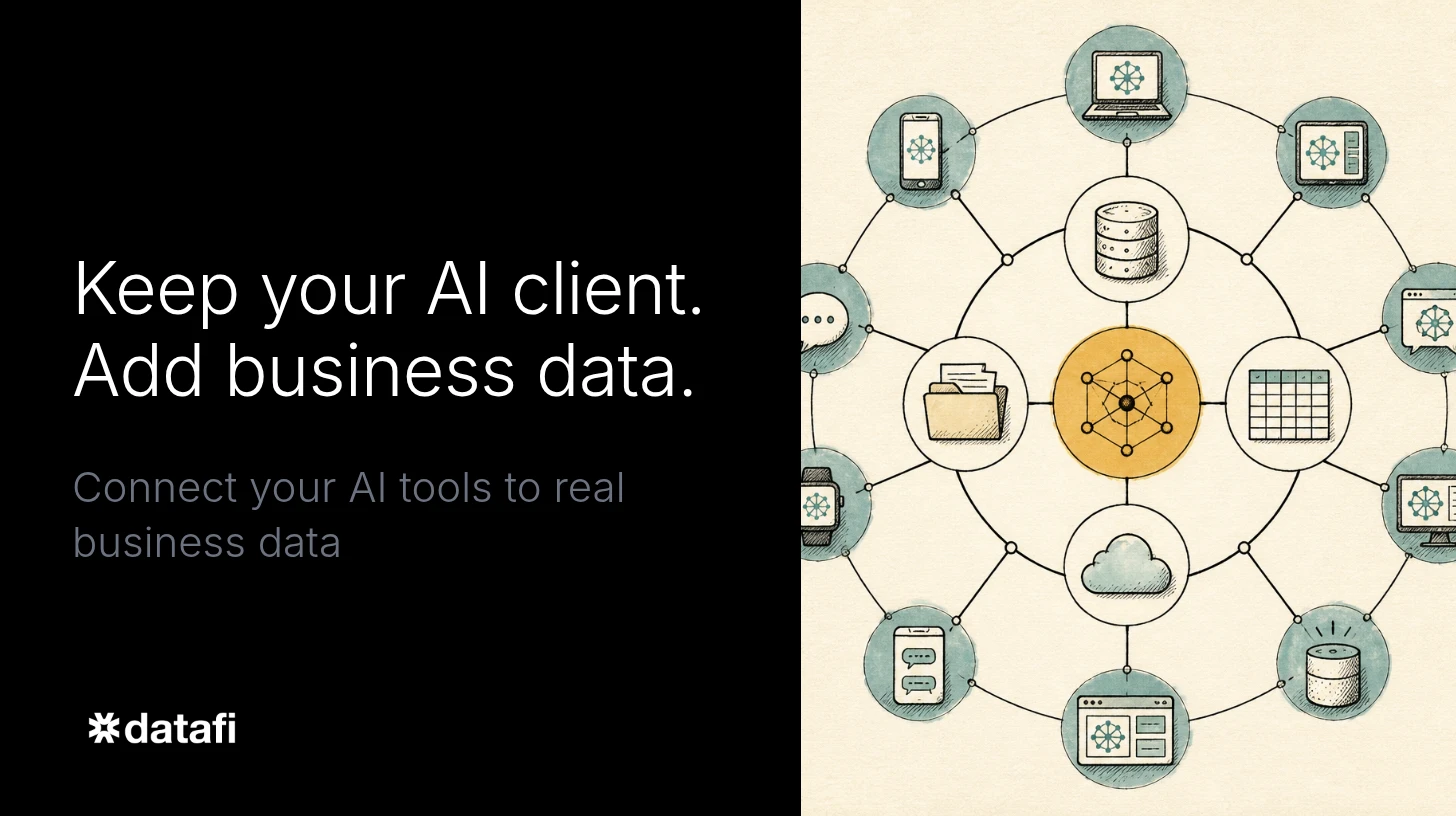
The experience layer starts with the tools people already use. Finance can work in Copilot while sales uses ChatGPT and engineering uses Claude. Datafi connects each of them to the same live business context and applies the same per-user access rules to every request, so the company keeps one second brain instead of a separate, partial one inside each vendor’s product. That is also how we read McKinsey’s advice to source models from multiple providers: the intelligence that matters should belong to the enterprise, not to whichever model happens to be in front of it this year.
From there, organizations choose how far to take it. Converse lets people talk to their data, ask complex questions, and generate reports and documents through their preferred AI client. Activate puts AI to work, with Studio for building apps and agents without an engineering queue, and Runtime for coordinating multi-step work across systems. Control Tower and Cyber make the whole thing governable, with access, policy, and audit built into the architecture rather than added after the fact.
For a mid-enterprise organization, the timeline matters as much as the architecture. A first use case in production in days, on live data, with nothing migrated, is what makes the second brain achievable for companies without a 16-week program team.
The question that has to change
If the gap is a context gap, then most of what organizations currently measure about AI is beside the point. Seats deployed, agents launched, and pilots completed are all adoption metrics. They are the 40 percent number. They say nothing about whether the organization is building toward the 6 percent.
The better questions are about accumulation. Does the second use case cost less than the first? When an agent reports margin, does it know which definition it used? When a long-tenured director retires, does what she knew stay in the business? Is each decision the system helps make captured so that the next recommendation is better?
Those are the leading indicators of value. Companies that can answer yes are building the second brain McKinsey describes. Companies that cannot are adding users to a system that does not yet understand the business it is meant to run.
In the next post in this series, I look at McKinsey’s most important architectural rule: own the context, rent or replace the technology. I examine what that rule means for mid-enterprise organizations that cannot assemble a custom AI operating system from parts, why integration and ownership are separable, and how AI economics belong inside the operating system rather than outside it.
Datafi is the operating system for business AI. We help mid-enterprise organizations unify their data, deploy governed AI agents, and deliver measurable outcomes in weeks rather than years, without migrating off the systems that already run the business.
The Second Brain: Bringing the AI Operating System to the Mid-Enterprise
Part 1: Why AI Adoption Isn’t Becoming AI Value
Part 2: Own the Context, Rent the Stack
Part 3: You Can’t Delayer What You Can’t Govern
Written by Vaughan Emery, Co-Founder & Chief Product Officer at Datafi
Sources: “The AI operating system: A new way for CEOs to run the enterprise,” QuantumBlack, AI by McKinsey, October 2026. “The state of AI in 2026: On the road to ROI,” McKinsey, August 25, 2026.