



From Reactive Repairs to Intelligent Prevention
Every manufacturer, utility provider, and asset-intensive organization shares the same costly problem: equipment fails at the worst possible time. A compressor goes offline mid-shift. A turbine bearing degrades faster than the scheduled inspection cycle anticipated. A conveyor belt tears on the floor of a fulfillment center during peak season. These failures are not random events. In most cases, the data that could have predicted them existed in the organization’s systems for days, weeks, or even months before the breakdown occurred. The problem was never a lack of data. The problem was that no one, and no system, was connecting the signals fast enough or completely enough to act.
This is the gap that Datafi was built to close.
The root cause of costly equipment failures is not a lack of sensor data; it is a lack of orchestration. Predicting a failure is only valuable when AI can simultaneously assess parts availability, technician scheduling, production impact, and compliance requirements, then deliver a decision-ready action plan to the right person in minutes.
The Hidden Cost of Disconnected Maintenance Data

Industrial organizations generate enormous volumes of asset data. Sensor telemetry streams in from IoT-connected equipment. SCADA systems log operational parameters by the second. CMMS platforms hold years of work order history, parts consumption records, and technician notes. ERP systems track procurement lead times and inventory levels for critical spare parts. Environmental monitoring systems capture temperature, humidity, and vibration baselines. And somewhere in a shared drive, an experienced maintenance engineer has a spreadsheet that correlates three specific sensor readings with a failure mode that has cost the organization two unplanned outages in the last eighteen months.
None of these systems talk to each other in any meaningful way. Maintenance teams operate in a perpetual state of information fragmentation. They are not unintelligent or unmotivated. They are simply working without the full picture.
The downstream costs are significant and well-documented: unplanned downtime averages three to five percent of production capacity in manufacturing environments, with each hour of critical equipment downtime often costing tens of thousands of dollars. Reactive maintenance labor runs two to three times more expensive than planned maintenance. Emergency parts procurement destroys procurement economics. And the organizational knowledge embedded in the minds of experienced maintenance engineers walks out the door with every retirement.
The industry’s response has largely been to deploy point solutions: a predictive analytics module bolted onto a sensor platform, a machine learning model trained on one data source, a digital twin for a handful of critical assets. These investments have delivered value in isolation. But they have not solved the fundamental problem, because the fundamental problem is not a lack of prediction. It is a lack of orchestration.
What Orchestrated Predictive Maintenance Actually Looks Like
Predicting that a pump bearing will fail in fourteen days is only useful if the organization can act on that prediction with precision and speed. Acting with precision requires knowing the current inventory status of the replacement bearing, the lead time to procure it if stock is insufficient, the scheduled production runs that will be impacted by a planned shutdown, the availability of the qualified technician who services that equipment class, and the compliance documentation requirements that govern maintenance on that asset type.
Each of those data points lives in a different system. Answering all of those questions simultaneously, automatically, and in time to schedule a maintenance window before the failure occurs is what separates AI that solves a problem from AI that merely answers a question.
This is the architecture Datafi makes possible.
The Datafi platform connects across an organization’s full data ecosystem, spanning IoT telemetry, CMMS, ERP, inventory management, workforce scheduling, and compliance systems, providing the AI layer with complete operational context. When the Datafi intelligence layer detects an anomaly pattern in sensor data that correlates with a known failure signature, it does not simply generate an alert. It initiates a coordinated orchestration sequence that assesses the full operational picture, determines the optimal maintenance response, and surfaces a recommended action plan to the maintenance team, complete with parts availability, scheduling options, compliance checklists, and cost impact analysis.
The maintenance engineer receives not a raw alert but a decision-ready briefing. The AI has already done the work of pulling the relevant history, cross-referencing inventory, checking technician certifications, identifying the production impact window, and drafting the work order. The human’s job is to review and approve, or to override with judgment that the AI cannot possess: the knowledge that the production manager flagged this line as untouchable for the next seventy-two hours, or that a newer technician needs to be assigned to build experience on this asset class.
Human judgment remains in the loop. The AI amplifies it rather than replacing it.
The Datafi Architecture Enabling This
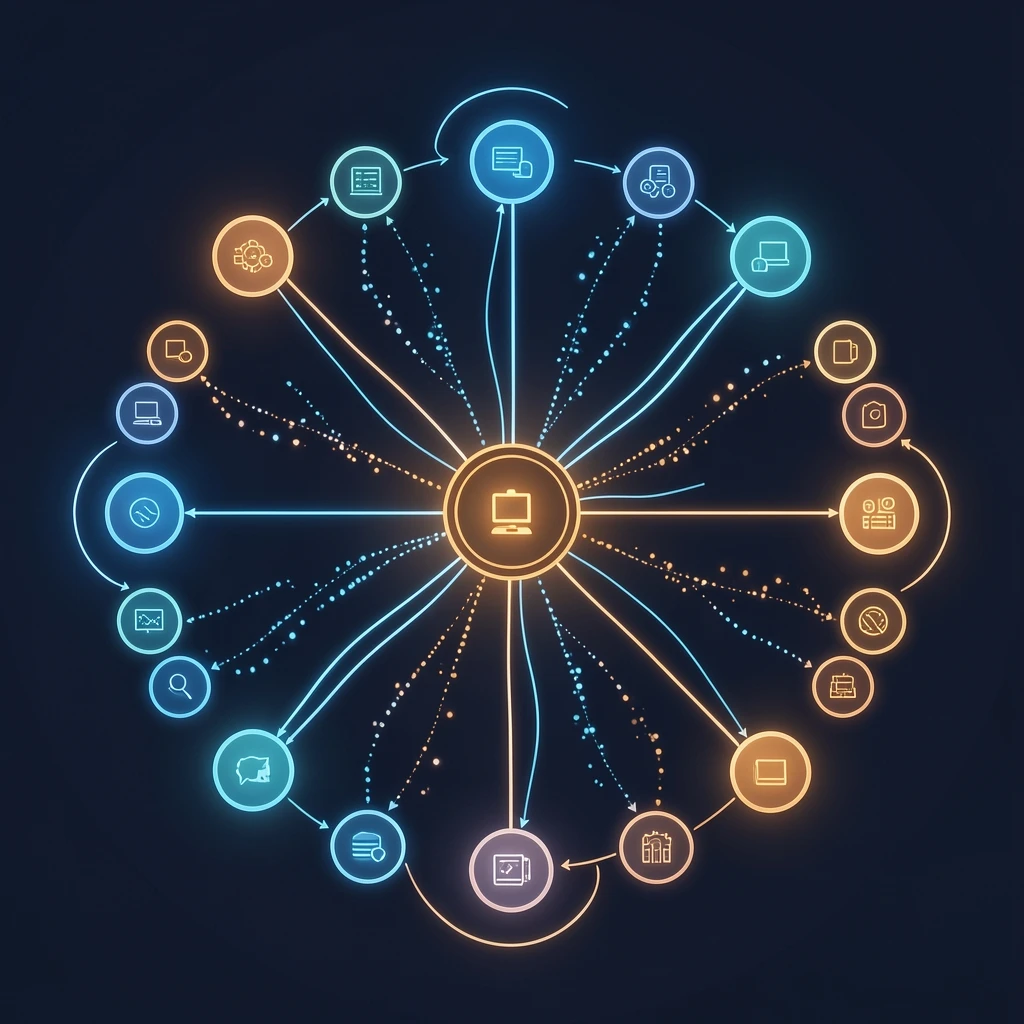
Several specific elements of the Datafi platform make predictive maintenance orchestration achievable in ways that point solutions cannot replicate.
Unified Data Access Across the Full Ecosystem
Datafi’s vertically integrated stack establishes governed connections to every relevant data source without requiring organizations to consolidate those sources into a new centralized repository. Sensor telemetry, CMMS records, ERP inventory data, and scheduling systems all remain in place. Datafi provides the AI layer with real-time access to all of them, with permissions and governance controls that ensure the right people have access to the right data and that every query and action is logged for audit purposes.
This is critical in maintenance contexts where regulatory compliance governs maintenance records, spare parts traceability, and equipment certification histories. The Datafi platform does not create a compliance liability. It inherits and enforces the governance model the organization already operates under.
Full Business Context for the AI Layer
Predictive maintenance AI that operates only on sensor data is fundamentally limited. It can identify anomalies. It cannot assess their business significance. A bearing degradation signal on a non-critical auxiliary pump has a completely different response profile than the same signal on a primary production asset running at capacity during a peak order period.
Datafi provides the AI with the business context required to make that distinction. The platform understands which assets are critical, what production schedules are in play, what the cost of downtime is for each asset class, and what the organization’s maintenance prioritization rules are. This context is not hardcoded. It is drawn live from the operational systems where it actually lives, so it reflects reality rather than a static configuration that was accurate six months ago.
Agentic Workflow Orchestration
The most significant capability Datafi provides in a predictive maintenance context is agentic orchestration: the ability to execute multi-step workflows autonomously, under human governance, across multiple systems.
When a predictive signal crosses a defined threshold, the Datafi agent does not wait for a human to begin asking questions. It begins working through the response workflow: pulling relevant maintenance history for the asset, checking parts inventory, querying technician availability, assessing production schedule impacts, drafting the work order with pre-populated compliance documentation, and presenting the completed package to the maintenance supervisor for review and approval.
The time from signal to decision-ready recommendation collapses from hours to minutes. And because the agent’s work is visible, auditable, and governed, organizations do not have to choose between speed and control.
Natural Language Access for Non-Technical Users
Datafi’s Chat UI democratizes access to maintenance intelligence across the organization. A plant manager can ask, in plain language, “What is the current health status of our rotating equipment fleet and are there any maintenance windows I should know about in the next thirty days?” and receive a synthesized, context-aware answer that draws on sensor data, CMMS history, and scheduling systems simultaneously.
This is not a dashboard report. It is a conversation with an AI that understands the full operational picture. The plant manager can follow up with “What would the production impact be if we scheduled the compressor maintenance for next Tuesday?” and receive an immediate impact assessment based on live scheduling data.
The intelligence is accessible to everyone who needs it, not only to the data engineers who know how to write queries.
Real-World Impact
Organizations deploying Datafi in predictive maintenance orchestration contexts are measuring impact across several dimensions.
Unplanned downtime reduction is the most immediate and significant metric. When the AI layer has full ecosystem access and can detect failure signatures across multiple correlated data sources, rather than a single sensor stream in isolation, the predictability of equipment behavior improves substantially. Maintenance windows get scheduled before failures occur. Production continues.
Planned maintenance efficiency improves because work orders arrive to technicians pre-populated with asset history, parts lists, compliance documentation, and job plans. Time spent preparing for a maintenance task decreases. Time spent executing it increases.
Parts inventory optimization follows naturally from the AI having visibility into both predictive maintenance schedules and current inventory levels. Organizations reduce emergency procurement events, right-size safety stock levels, and improve spare parts forecasting accuracy.
And perhaps most significantly in the current workforce environment: the operational knowledge embedded in experienced maintenance engineers becomes codified and accessible. When a veteran maintenance supervisor articulates the three-sensor correlation pattern that predicts a specific failure mode, Datafi captures that logic, applies it at scale, and makes it available to every shift, every technician, and every future hire. Institutional knowledge stops being at risk of retirement.
Why This Requires a Platform, Not a Point Solution
The predictive maintenance use case illustrates a broader truth about enterprise AI deployment. The value of AI is not in the prediction. Predictions are cheap. The value is in what happens after the prediction: the orchestrated response, the cross-system workflow, the decision-ready synthesis that reaches the right person at the right time with the right context to act.
Achieving that requires an AI layer that has genuine access to the full data ecosystem, not just the sensor platform or the CMMS or the ERP in isolation. It requires agentic capability that can execute multi-step workflows rather than simply answering questions. It requires governance that organizations in regulated industries can actually operate under. And it requires an experience layer that makes the intelligence accessible to the maintenance supervisor, the plant manager, and the operations director, not only to the data science team.
This is precisely what Datafi was designed to deliver. Not AI that answers questions about equipment health. AI that orchestrates the response to a predicted failure before the failure happens.
The era of reactive maintenance was defined by the limitations of disconnected data. The era of predictive maintenance orchestration is defined by what becomes possible when AI operates with the full picture.
Datafi provides the full picture.
Ready to explore what predictive maintenance orchestration could mean for your operations? Connect with the Datafi team to discuss your asset environment and learn how the platform connects to your existing data ecosystem.