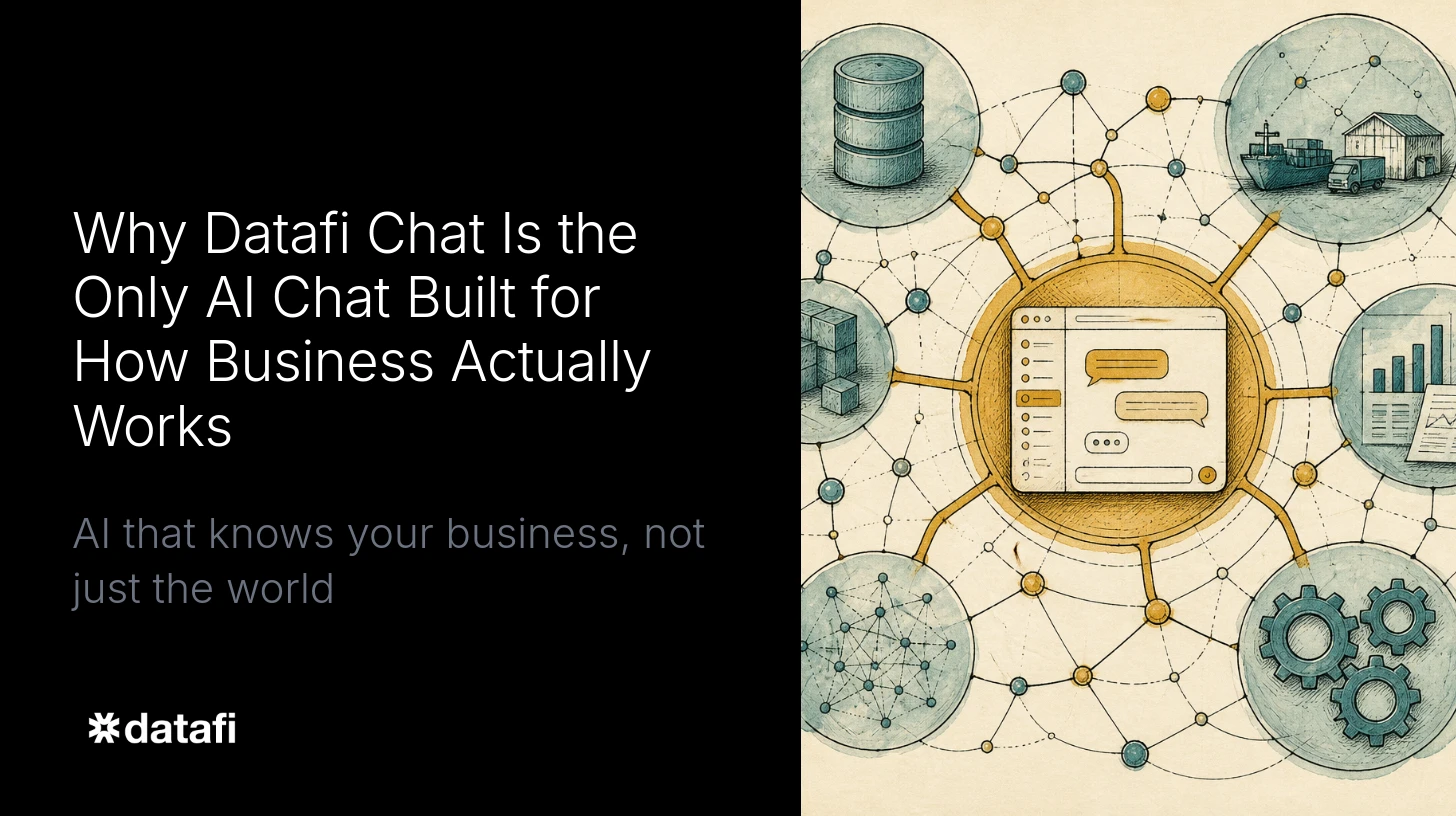



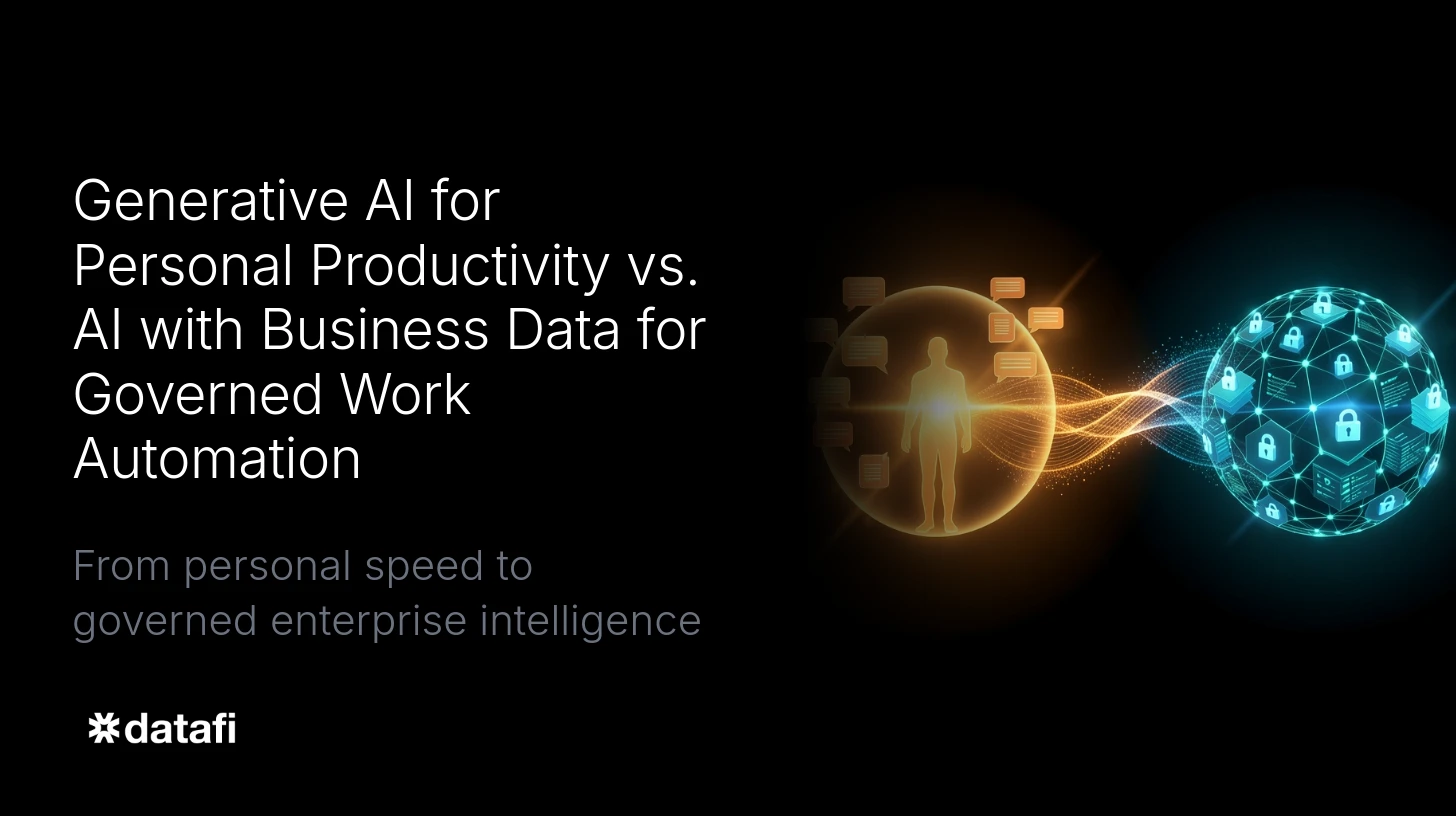
We’re living through two very different waves of AI adoption. The first wave is visible to everyone: using generative AI to draft emails, summarize articles, brainstorm outlines, schedule meetings, and speed up general research. It’s fast, delightful, and personal. The second wave is quieter but far more transformative: using AI and LLMs with enterprise data, securely and governably, to automate work, enable true self-service data access for non-technical users, and rewire how decisions and processes happen. This article compares the two, outlines the unique needs of the enterprise, and shares a perspective shaped by years of making business data truly usable.
Personal productivity AI speeds up individuals, but the transformative enterprise opportunity lies in governed, context-rich AI that spans your entire data estate and converts intent into compliant, auditable action.
The Personal Productivity Wave

Personal productivity tools showcase what LLMs do best out of the box: synthesize natural language, pattern-match across broad public knowledge, and act as tireless assistants. They:
- Draft and edit: Turn bullet points into prose, improve tone, or translate language.
- Summarize and search: Condense long documents or web pages and answer general questions.
- Schedule and coordinate: Propose meeting times, polish agendas, and generate follow-ups.
The common thread is that these tasks don’t demand deep, proprietary context or strict control. They’re “good enough” with public knowledge and lightweight preferences. Risk is low. Governance is minimal. If the model makes a mistake, you simply edit the draft. If it fabricates a citation, you can catch it before sending. The unit of value is individual speed.
The Enterprise Wave: Governed Work Automation and Self-Service Data
Enterprises operate under very different constraints. AI must be trustworthy, secure, and auditable, while delivering real, compounding productivity across teams and processes. When you connect LLMs to business data and systems, the objective shifts from “answer my question” to “get work done reliably”. That raises the bar in five ways:
-
Identity and Policy Enforcement: Who is asking? What are they allowed to see or do? Row-level and column-level security, data masking, and policy inheritance must be enforced consistently, across SQL warehouses, SaaS apps, and unstructured stores.
-
Lineage and Auditability: Where did this answer come from? What queries, tables, and documents were touched? Can we reproduce the result next week? The system must track lineage and provide an audit trail for compliance and trust.
-
Quality and Freshness: Are we using the authoritative source? Is the metric certified, and is the data up to date? Enterprises need governance around semantic definitions (e.g., what “Active Customer” means), along with SLAs on data freshness.
-
Determinism and Guardrails: It’s not enough to be eloquent; the AI must be correct within policy. Natural-language-to-SQL requires schema awareness, constraint validation, and safe execution plans. For workflow automation, every action should pass approval gates and rollback paths.
-
Observability and Evaluation: AI in production is software. You need evaluation suites, regression tests, prompt/version management, failure modes, monitoring, and incident response to sustain reliability at scale.
The Real-World Enterprise Data Landscape
Most organizations already have a sprawling data estate:
- Structured systems: CRM (accounts, opportunities), ERP (orders, invoices, inventory), HRIS (headcount, roles), data warehouses and lakes (fact/dimension tables, curated marts).
- Unstructured knowledge: Email, chat, wikis, PDFs, contracts, tickets, call transcripts, presentations.
Information is duplicated, partially correct, locked in silos, or trapped behind application APIs. The semantics differ across teams (“MRR” vs. “ARR,” “lead” vs. “contact”), and the authoritative source may vary by region or product line. AI that only sees one system produces narrow, often misleading answers. AI that sees everything without governance becomes a liability.
The practical requirement is an identity-aware, policy-enforcing knowledge fabric that spans both structured and unstructured data. Think: a semantic layer that encodes business definitions and access rules, a retrieval layer that respects identity and freshness, and an orchestration layer that composes the right tools (query engines, vector search, app connectors) at runtime.
Full Enterprise Knowledge Context, User by User
Context is not just “all the docs.” It’s the right subset, for the right person, for the right task:
- Persona and role: A sales manager needs pipeline health and renewal risk; finance needs deferred revenue and cash collection; support needs SLA breaches and sentiment.
- Scope and geography: Policies may differ by EMEA vs. US; products have different SKUs and pricing plans; metrics have regional cut-offs and fiscal calendars.
- Tooling and workflow: The same insight should generate different actions: open a CRM task, post to a channel, update a ticket, or schedule a follow-up.
LLMs thrive when fed with structured context (semantic definitions, metrics catalogs, policy rules) combined with retrieved evidence (contracts, emails, cases). The fusion lets AI ground its reasoning: not just “what is churn risk?” but “show me accounts at risk this quarter, why they’re at risk, and draft recovery actions, within my permission scope.”
From Q&A to Agentic Workflows
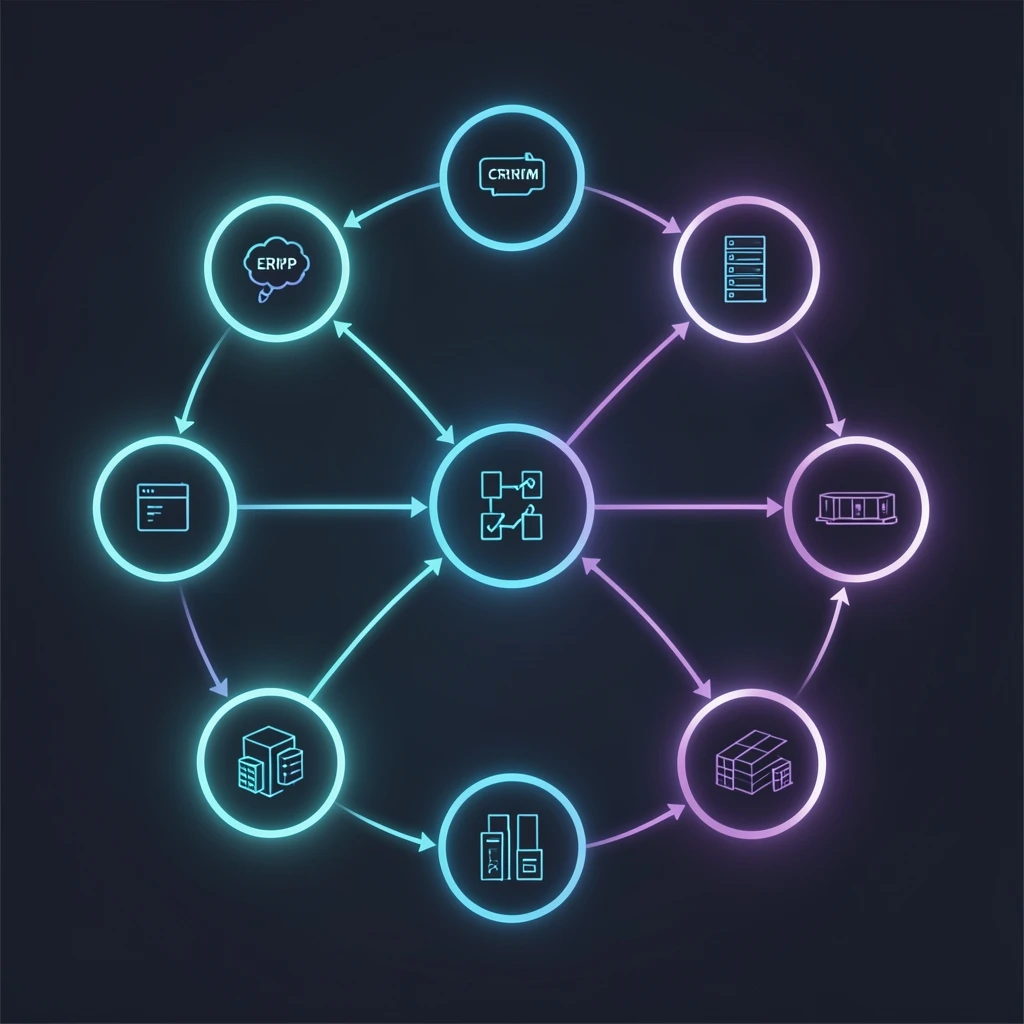
The shift from answers to outcomes comes from agentic patterns: multi-step plans, tool use, and feedback loops. A governed enterprise agent should be able to:
- Understand the goal (“recover at-risk renewals over $50k in Q4”).
- Assemble context (query warehouse for usage declines, retrieve support escalations, pull contract terms).
- Apply policy (respect data permissions, avoid PII leakage, seek approval for sensitive actions).
- Act (open CRM tasks, draft outreach, schedule meetings, update a forecast).
- Explain and log (show lineage, decisions, and outcomes).
Examples:
- Revenue operations: Detect renewal risk from product usage dips, support sentiment, and contract terms; create playbooks and assign owners, then track outcomes.
- Supply chain: Identify late POs, simulate ETA impacts, and trigger vendor escalations; reconcile ERP records and generate exception reports.
- Financial close: Flag anomalies, draft reconciliations with citations, route to controllers for approval, and file workpapers with full lineage.
Making Self-Service Real for Non-Technical Users
Self-service has historically meant dashboards someone else built. AI changes the interface: ask in natural language, get governed results, and, crucially, take the next step. To make this safe and satisfying:
- Semantic layer: Business terms mapped to sources, certified metrics, and calculation rules.
- Policy engine: Centralized authorization and masking, enforced everywhere.
- Query planning: NL → SQL with schema awareness, cost control, and safe execution.
- Grounded answers: Each result with citations, confidence signals, and quick pivots (“break down by region,” “show the outliers”).
- Action connectors: CRM/ERP/ticketing integrations so insights flow straight into the work.
When these pieces exist, non-technical users don’t just consume data, they operate the business with it.
What It Takes (A Practitioner’s View)
My experience working hands-on with enterprise data shapes a simple principle: AI succeeds when the data product is real. That means:
- Start from decisions and processes, not models. Identify the moments where better context or faster action changes outcomes.
- Treat semantics and policy as first-class assets. If definitions and permissions aren’t encoded, you will drift into inconsistency or risk.
- Design for the change management. New workflows need training, approvals, and accountability; measure cycle-time reduction and error rate improvements.
- Observe the agents. Build evaluation harnesses, capture failure cases, and iterate prompts/tools like you would any critical service.
- Meet users where they work. Embed in CRM, ERP, email, and messaging so the “last mile” is as smooth as the insight.
Conclusion: Beyond Answers, Toward Outcomes
Personal productivity AI is a force multiplier for individuals. But the bigger prize is enterprise AI that is context-rich, governed, and agentic, one that sees across CRM, ERP, email, and messaging, understands the business through a semantic lens, and converts intent into compliant action. That’s how we move from “answering questions” to solving problems, from static reports to living workflows, and from isolated efficiency gains to system-level transformation.
Build the knowledge fabric, encode your business language, wire in policy, and equip agents with tools and oversight. Do that well, and you don’t just make people faster, you change how work gets done.