


When the Answer Isn’t Enough
There is a moment every credit analyst knows well. The data is in front of them. The borrower’s financials are pulled. The bureau scores are loaded. The sector risk model has run. And yet the decision still requires a dozen more steps: cross-referencing covenant structures, checking portfolio concentration limits, validating against current macro overlays, pulling the relationship history, and then writing it all up in a format the credit committee will actually read.
The data answered the question. But the problem is still unsolved.
This is the central tension in credit risk today. Organizations have invested heavily in data infrastructure, risk models, and bureau integrations. They have dashboards. They have scores. They have signals. What they lack is the connective tissue that turns all of that information into a decision, and the ability to do it at a speed and consistency that modern lending volumes demand.
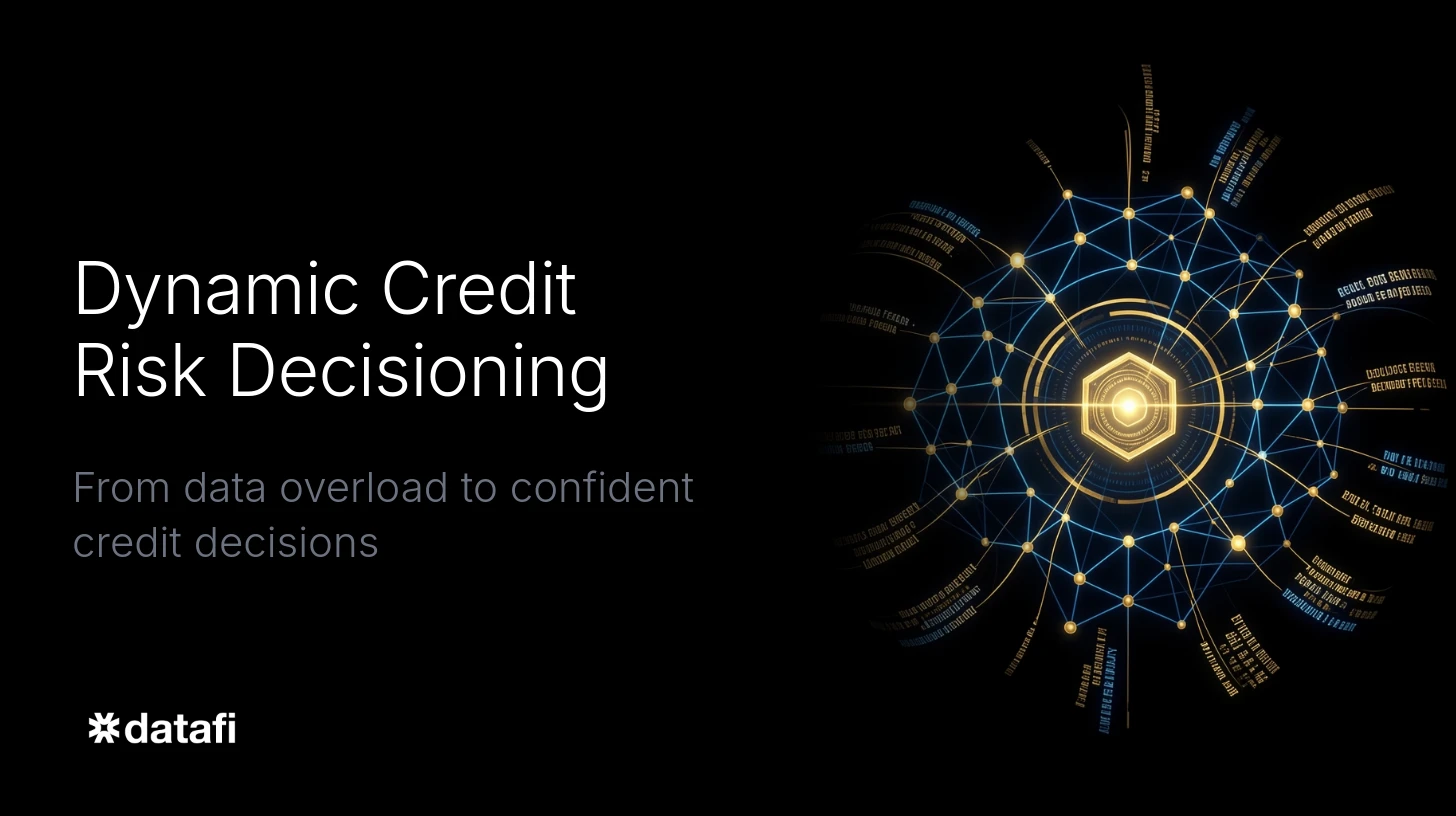
Dynamic credit risk decisioning on the Datafi platform is built around a different starting point. Not “how do we present more data to analysts?” but “how do we give AI the full context it needs to actually solve the credit problem?”
The bottleneck in modern credit decisioning is not data availability, it is context. AI can only produce defensible credit decisions when it has simultaneous access to bureau data, internal relationship history, current policy, portfolio concentration, and macroeconomic overlays. Datafi is built to provide exactly that complete picture.
The Problem With Point-in-Time Thinking
Traditional credit decisioning is fundamentally episodic. A borrower applies. A snapshot is taken. A model scores. A human reviews. A decision is made.
That episodic structure made sense when data was scarce and models were static. But credit risk is not a snapshot problem. It is a continuous signal problem. A commercial borrower’s risk profile shifts every time a payment is late, a supplier relationship changes, a sector headwind emerges, or a covenant is tested. Consumer credit risk moves with employment trends, interest rate cycles, and spending behavior patterns that play out across weeks and months, not moments.
Organizations that still decision on point-in-time snapshots are not wrong, they are simply operating with an architecture that was never designed to do what they now need it to do. The gap between when risk changes and when a decision reflects that change is where losses accumulate, where pricing errors compound, and where portfolio quality quietly erodes.
Datafi closes that gap by treating credit risk as a continuous reasoning problem rather than a periodic reporting exercise.

Full Context Is the Prerequisite
The reason AI has not yet transformed credit decisioning in most organizations is not a model problem. It is a context problem.
A language model handed a credit bureau score and a financial summary will produce a reasonable-sounding analysis. It will not produce a good credit decision. A good credit decision requires the borrower’s payment history with your institution specifically, the current exposure across related entities, the applicable credit policy and its recent amendments, the portfolio’s current concentration in this sector, the covenant structure on any existing facilities, the relationship manager’s notes, and the macroeconomic overlays the risk team published last week.
None of that lives in a single system. It lives across your core banking platform, your CRM, your document repository, your risk policy database, your market data feeds, and your internal analytics environment. An AI that can only see part of that picture will produce partial answers. Partial answers require humans to fill the gaps, which returns you exactly to where you started.
Datafi’s vertically integrated data and AI stack is built to eliminate that gap. By connecting across the full data ecosystem, not just the systems that happen to have APIs, Datafi gives the AI the complete business context required to reason about credit the way your best analysts do. Every relevant signal. Every applicable policy. Every piece of relationship history. All of it available to the AI at the moment of decisioning.
This is not about building a better dashboard. It is about giving intelligence everything it needs to act.
What Dynamic Decisioning Actually Looks Like
On the Datafi platform, credit risk decisioning is not a workflow that starts when an application arrives. It is a continuously running analytical process that flags, reasons, and recommends across the entire portfolio in real time.
Portfolio Monitoring That Thinks
Rather than waiting for a quarterly review or a covenant breach alert, Datafi continuously monitors the signals that precede deterioration: payment behavior shifts, utilization pattern changes, sector news correlated to specific exposures, bureau refresh data, and relationship manager activity. When a pattern emerges, the platform does not simply surface a number. It synthesizes the signals, cross-references them against current policy, assesses portfolio impact, and delivers a recommendation with the reasoning visible.
An analyst reviewing that recommendation is not starting from scratch. They are reviewing a structured argument built from complete context, with every supporting data point traceable and every policy reference cited. The human role shifts from data gathering to judgment, which is where human expertise actually belongs.
Application Decisioning With Real-Time Context
For new credit applications, Datafi compresses the time from submission to decision without compressing the quality of analysis. The platform simultaneously pulls bureau data, internal relationship history, financial statement analysis, sector risk profiles, and applicable credit policy, then reasons across all of it to produce a structured credit assessment.
Because the AI has access to both external data and internal context, it can identify nuances that point-in-time models miss. A borrower with a moderate bureau score but a ten-year payment history with your institution, operating in a sector your portfolio is currently underweight in, should be treated differently than a borrower with the same bureau score and none of that context. Datafi makes that distinction not by building more rigid rules, but by giving the AI the context to reason about it the way a seasoned underwriter would.
Covenant and Condition Monitoring
Commercial credit portfolios carry complex ongoing obligations: financial covenants, reporting requirements, concentration conditions, and trigger events that require action when crossed. Monitoring these manually at portfolio scale is a resource problem that most institutions manage by doing it partially.
Datafi automates continuous covenant surveillance across the entire commercial portfolio, flagging conditions, modeling headroom, and escalating exceptions with full analytical context already prepared. When a covenant is tested, the relationship manager and credit team do not receive an alert. They receive a complete situation briefing: current status, trend, comparable borrower history, policy implications, and recommended next steps.
Stress Testing and What-If Reasoning
Credit risk management is not only about current conditions. It is about understanding how portfolios behave under conditions that have not arrived yet. Datafi’s agentic capabilities allow risk teams to run natural language stress scenarios against live portfolio data, asking questions like “what does our commercial real estate exposure look like if rates stay elevated for another eighteen months and vacancy rates in secondary markets increase by fifteen percent?” and receiving structured analytical responses grounded in actual portfolio composition.
This is qualitatively different from running a pre-built stress model. It is dynamic, responsive reasoning applied to the specific shape of your portfolio at a specific moment in time.
Compliance and Governance Built In

Credit decisions carry regulatory obligations that cannot be treated as an afterthought. Fair lending requirements, adverse action notice standards, model risk management expectations, and audit trail requirements are not features you add to an AI decisioning system. They are foundational constraints that shape how the system must operate.
Datafi is built with governance at the architecture level, not the integration layer. Every decision the platform supports is logged with full context: what data was used, what policy was applied, what the AI’s reasoning was, and what the human’s final determination was. That audit trail is not a report that someone generates after the fact. It is a continuous record maintained automatically as a byproduct of how the platform operates.
For regulated financial institutions, this matters enormously. The ability to demonstrate not just what decision was made, but why, on the basis of what information, against what policy standard, is increasingly what examiners expect. Datafi provides that defensibility without requiring risk teams to build a separate compliance documentation process alongside their decisioning process.
Access controls ensure that sensitive borrower data, credit policy details, and portfolio analytics are available only to the roles and individuals with appropriate permissions. The Datafi platform’s governance framework means that AI-assisted decisioning does not create new data exposure risks, it operates within the same controlled environment as every other sensitive credit process.
The Role of the Analyst Changes, Not Disappears
A common anxiety about AI in credit decisioning is that it displaces the judgment that makes credit risk a profession rather than a calculation. That anxiety is understandable and, on the Datafi platform, unnecessary.
The goal of dynamic credit risk decisioning is not to remove humans from the loop. It is to ensure that when humans are in the loop, they are doing the work that actually requires human judgment rather than the work that should have been automated years ago.
An analyst spending three hours gathering data for a credit memo is not exercising judgment. They are executing a data assembly task. An analyst reviewing a complete, well-reasoned AI-generated credit assessment and applying their relationship knowledge, their sector expertise, and their institutional experience to a final recommendation is doing exactly what credit professionals are trained to do.
AI that answers questions leaves the analyst doing the same work they always did, just with a slightly better search tool. AI that solves problems gives the analyst a reasoning partner that has already done the information work, so the analyst can focus on the decision itself.
Datafi shifts the analyst from data assembly to decision quality. The result is faster decisions, more consistent application of policy, better use of experienced talent, and credit outcomes grounded in more complete information than any individual analyst could realistically compile on their own.
What Organizations Actually Gain
The value of dynamic credit risk decisioning on the Datafi platform is measurable in several dimensions that matter to different stakeholders.
Credit teams gain speed without sacrificing depth. Decisions that previously required days of data gathering and memo preparation can be completed in hours, with analysis that is more comprehensive than what the manual process typically produced.
Risk functions gain consistency. When every decision is made against the same complete data context and the same current policy, the variance that comes from individual analysts having different access to information or different interpretations of policy begins to close.
Compliance and audit functions gain defensibility. The automatic documentation of every decisioning event, with complete context and reasoning, transforms audit preparation from a reconstruction exercise into a retrieval exercise.
Portfolio management gains visibility. When monitoring is continuous rather than periodic, deterioration is visible earlier, and the time available to act before a situation becomes a loss is meaningfully longer.
And the institution as a whole gains the ability to scale credit operations without scaling headcount proportionally, because the work that scales with volume, which is data gathering, policy checking, and memo preparation, is handled by AI while the work that requires judgment scales with the quality of the people doing it.
Built for the Complexity You Actually Face
Credit risk is not a simple domain. It involves regulatory constraints, institutional relationships, proprietary models, complex data ecosystems, and high-stakes decisions where errors have real consequences. Any platform claiming to transform credit decisioning needs to be evaluated against that actual complexity, not against a simplified version of it.
Datafi is designed for organizations that operate in that complexity every day. The platform’s ability to connect across heterogeneous data sources, apply governance at the architecture level, and give AI the full business context it needs to reason rather than just retrieve is precisely what makes dynamic credit risk decisioning possible rather than aspirational.
The organizations that will lead in credit over the next decade will not be those with the best models. Models are increasingly commoditized. They will be the organizations whose AI has the best context, the most complete picture, and the deepest integration with the institutional knowledge that defines how credit decisions should actually be made.
That is what Datafi is built to deliver.
Not answers. Solutions.
Ready to see how Datafi transforms credit risk decisioning for your organization? Connect with our team to explore what dynamic, context-aware AI can do for your portfolio.