


From Periodic Reviews to Perpetual Intelligence
There is a moment that every wealth manager and financial advisor knows well. A client calls, upset, because the market moved significantly three weeks ago and their portfolio drifted well outside its target allocation. The conversation is awkward not because the advisor made a wrong decision, but because nobody was watching at the right time. The data existed. The signals were there. The logic for action was well understood. But no system connected those three things into a timely, governed, client-specific response.
That gap, between data that exists and intelligence that acts, is exactly the problem Datafi was built to close.
Portfolio rebalancing is analytically well-defined, yet most firms still execute it reactively and manually. Datafi closes the gap by giving AI full access to a firm’s entire data ecosystem, combined with client-level context and agentic capacity to act the moment conditions demand it.
Portfolio rebalancing is one of the most analytically well-defined disciplines in financial services. The rules are knowable. The thresholds are configurable. The data is available. And yet, for most firms, the rebalancing process remains reactive, manual, and inconsistent, executed during scheduled review cycles rather than when conditions actually demand it. The result is client exposure, missed opportunity, and an advisor experience that relies more on institutional memory than institutional intelligence.
Datafi changes that. Not by adding another dashboard. Not by surfacing another report. But by giving the AI full access to the data ecosystem that matters, combined with the context to understand what each client’s situation actually means, and the agentic capacity to act on it.
The Problem With How Rebalancing Triggers Work Today

Most portfolio management platforms surface alerts reactively. An advisor logs in, runs a report, and sees which accounts have drifted beyond tolerance. Or they receive a batch notification at the end of the day that lists accounts requiring attention.
This is not intelligence. It is a delayed echo of conditions that already existed.
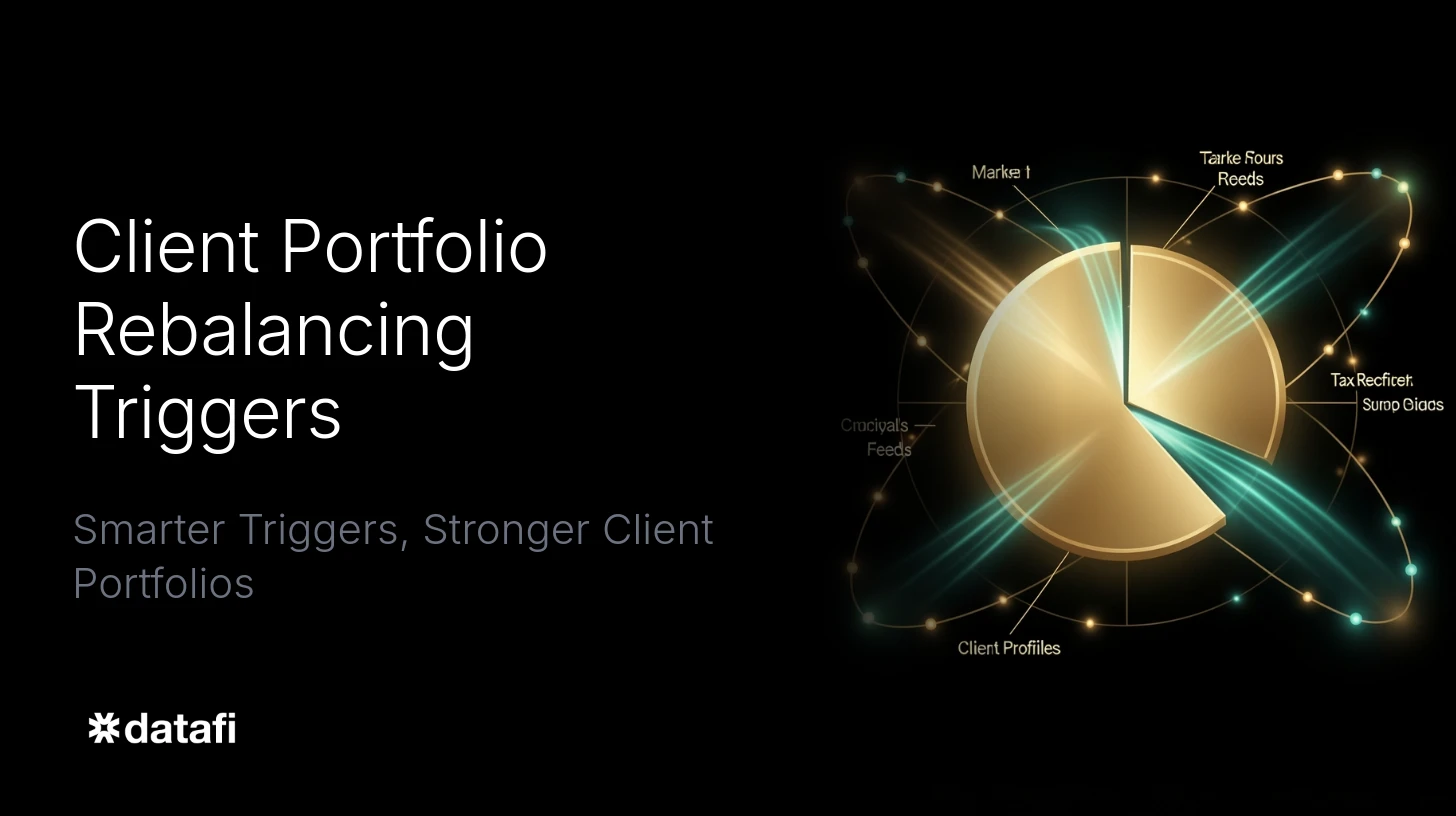
The deeper problem is fragmentation. The data that matters for a rebalancing decision rarely lives in one place. Target allocation models sit in the portfolio management system. Market data flows through a separate feed. Client tax status and cost basis live in a tax optimization module. CRM notes contain context about a client’s upcoming liquidity event or their anxiety about volatility. Compliance rules define what is permissible given a client’s mandate. Life event data, investment policy statements, and risk tolerance profiles may be stored in yet another system entirely.
No advisor can synthesize all of that in real time across hundreds of clients. No traditional alert engine has the contextual awareness to weigh all of those factors together. And no rules-based system can understand that a drift trigger for one client means something entirely different than the same drift trigger for another.
This is where most technology in the space stops. Datafi starts here.
What Datafi Brings to Portfolio Rebalancing
Datafi is a vertically integrated data and AI platform designed for exactly this kind of problem. It provides governed, contextual AI that connects to an organization’s full data ecosystem, reasons across all of it simultaneously, and operates with the agentic capacity to move from signal to action.
For portfolio rebalancing, that means the AI is not just monitoring allocation drift. It is understanding drift in the context of who the client is, what they care about, what their current life circumstances are, what the tax implications of rebalancing would be, whether the timing aligns with compliance restrictions, and what the appropriate next action is for that specific client at this specific moment.
This is the difference between AI that answers questions and AI that solves problems.
Unified Data Access Without Disruption
Datafi connects to the existing data infrastructure of a financial firm without requiring a rip-and-replace of the systems already in place. Portfolio management platforms, CRM systems, market data feeds, tax optimization tools, document repositories, and compliance systems are all brought into a unified AI context layer. The data stays where it lives. Datafi provides the intelligence layer on top.
This means the rebalancing AI has access to everything that a senior advisor would want to know before making a recommendation. It is not working from a slice of the picture. It is working from the whole picture.
Client-Level Context, Not Just Portfolio-Level Data
A 5% allocation drift in equities means something different for a 34-year-old client in the accumulation phase of a growth-oriented portfolio than it does for a 67-year-old client drawing down from a balanced portfolio three years into retirement. A rules-based alert engine treats them identically. Datafi treats them as the distinct individuals they are.
Because the AI has access to investment policy statements, risk profiles, CRM notes, life event data, and behavioral history, it can assess whether a trigger warrants immediate action, requires advisor review, or should be deferred given the client’s stated preferences and current circumstances. That judgment is embedded in every analysis.
Tax-Aware Rebalancing Intelligence
Rebalancing creates taxable events. Clients in taxable accounts have cost basis, holding periods, and tax lot considerations that directly affect the cost-benefit calculus of any rebalancing action. Datafi integrates that data into the trigger analysis, so the output is not simply “this account is out of tolerance” but rather “this account is out of tolerance, the estimated tax cost of rebalancing is X, and here are three potential approaches ranked by after-tax efficiency.”
This level of analysis used to require a combination of advisor judgment, manual spreadsheet work, and a separate tax optimization consultation. Datafi delivers it as part of the initial signal, before any human time is spent.
Compliance and Mandate Awareness
Every client relationship exists within a compliance context. Some clients have restrictions on specific securities or sectors. Some are subject to regulatory constraints based on their classification. Some accounts are governed by investment policy statements that define permissible deviations and required response windows.
Datafi maintains awareness of these constraints as part of the AI context. A rebalancing trigger is not surfaced to an advisor unless the proposed response is already compliant with the client’s mandate. The AI does the compliance pre-screening, so advisors are reviewing actionable recommendations, not raw alerts that may or may not be permissible to act on.
Agentic Capacity for Workflow Initiation
Identifying a trigger is only the beginning. Acting on it requires workflow. In most firms, converting a rebalancing signal into an executed trade involves a sequence of steps: advisor review, client communication, proposal generation, compliance sign-off, and order entry. Each step is a handoff point where time is lost and context can be dropped.
Datafi’s agentic capacity means the platform can initiate workflow steps autonomously within defined governance boundaries. It can draft a client communication explaining the proposed rebalancing action in language appropriate for that client’s financial sophistication. It can generate a rebalancing proposal document pre-populated with the relevant portfolio data, tax analysis, and recommended trades. It can route the proposal to the appropriate compliance review queue. It can flag the advisor’s calendar with a suggested outreach window based on the client’s communication preferences.
The advisor’s role becomes one of review and approval rather than construction and coordination. Their time is spent on judgment and relationship, which is where their expertise creates the most value.
A Day in the Life With Datafi

Consider what the experience looks like in practice for an advisor managing 150 client relationships.
Without Datafi, the advisor’s morning begins with a manual review of yesterday’s market movements against their memory of which clients are near their tolerance thresholds. They run a report that surfaces drifted accounts but provides no context about tax implications, upcoming client events, or mandate restrictions. They spend two hours triaging the list, calling up multiple systems to understand each situation before they can decide what to do.
With Datafi, the advisor opens their AI-powered workspace and finds a prioritized list of clients requiring attention, already filtered for compliance and ranked by urgency. Each client entry includes a plain-language summary of the drift condition, the recommended action, the estimated tax impact, relevant context from recent CRM notes, and a pre-drafted client communication ready for review and personalization. Workflow initiation is one step away.
The 150-client book of business does not get harder to manage as markets move. It becomes more manageable, because the intelligence is always on, always contextual, and always ready to act within the boundaries the firm has defined.
Governance and the Human in the Loop
Datafi is designed with the understanding that financial services is a trust industry. Every piece of AI output in a client-facing context carries reputational and regulatory weight. The platform’s architecture reflects this.
The governance model is configurable at the firm level. Advisors can define which types of rebalancing actions the AI can initiate autonomously, which require advisor review before workflow proceeds, and which require supervisor or compliance approval. Nothing goes to a client without passing through the right human checkpoint. Nothing is executed without meeting the firm’s audit trail requirements.
The AI operates as a highly capable, always-available member of the team that works within the rules the firm has established, not around them. That is not a constraint on capability. It is what makes the capability trustworthy enough to deploy at scale.
The Broader Opportunity
Portfolio rebalancing is one use case on a much larger map. The same capabilities that make Datafi powerful for rebalancing triggers, unified data access, deep client context, tax and compliance awareness, and agentic workflow capacity, apply across the full lifecycle of client relationship management in financial services.
Tax-loss harvesting identification. Annual review preparation. Estate planning trigger detection. Client risk profile drift analysis. New product suitability matching. Regulatory reporting preparation. Each of these is a problem that sits at the intersection of structured data, contextual intelligence, and workflow action. Each of them benefits from the same foundational architecture that Datafi provides.
Firms that deploy Datafi for rebalancing triggers are not buying a point solution. They are deploying an AI infrastructure that grows more capable with each use case it touches, because the data context deepens, the workflow patterns compound, and the organizational confidence in AI-assisted decision making builds over time.
From Reactive to Perpetual
The question financial services firms should be asking is not whether to automate rebalancing triggers. The question is whether they want AI that merely alerts them to conditions after the fact, or AI that understands those conditions in the full context of each client relationship and is ready to act the moment the situation calls for it.
The first kind of AI answers questions. The second kind solves problems.
Datafi is built for the second kind. Because in a relationship business where trust is the ultimate differentiator, the firms that deliver consistent, intelligent, proactive service at scale are the ones that earn the right to manage wealth across generations. Not the ones with the most data. The ones who can actually use it.
Datafi is an applied AI platform that connects to your full data ecosystem, provides LLMs with complete business context, and delivers agentic AI capacity designed for the way your organization actually works. Learn more about how Datafi is transforming the use of information in financial services and beyond.