


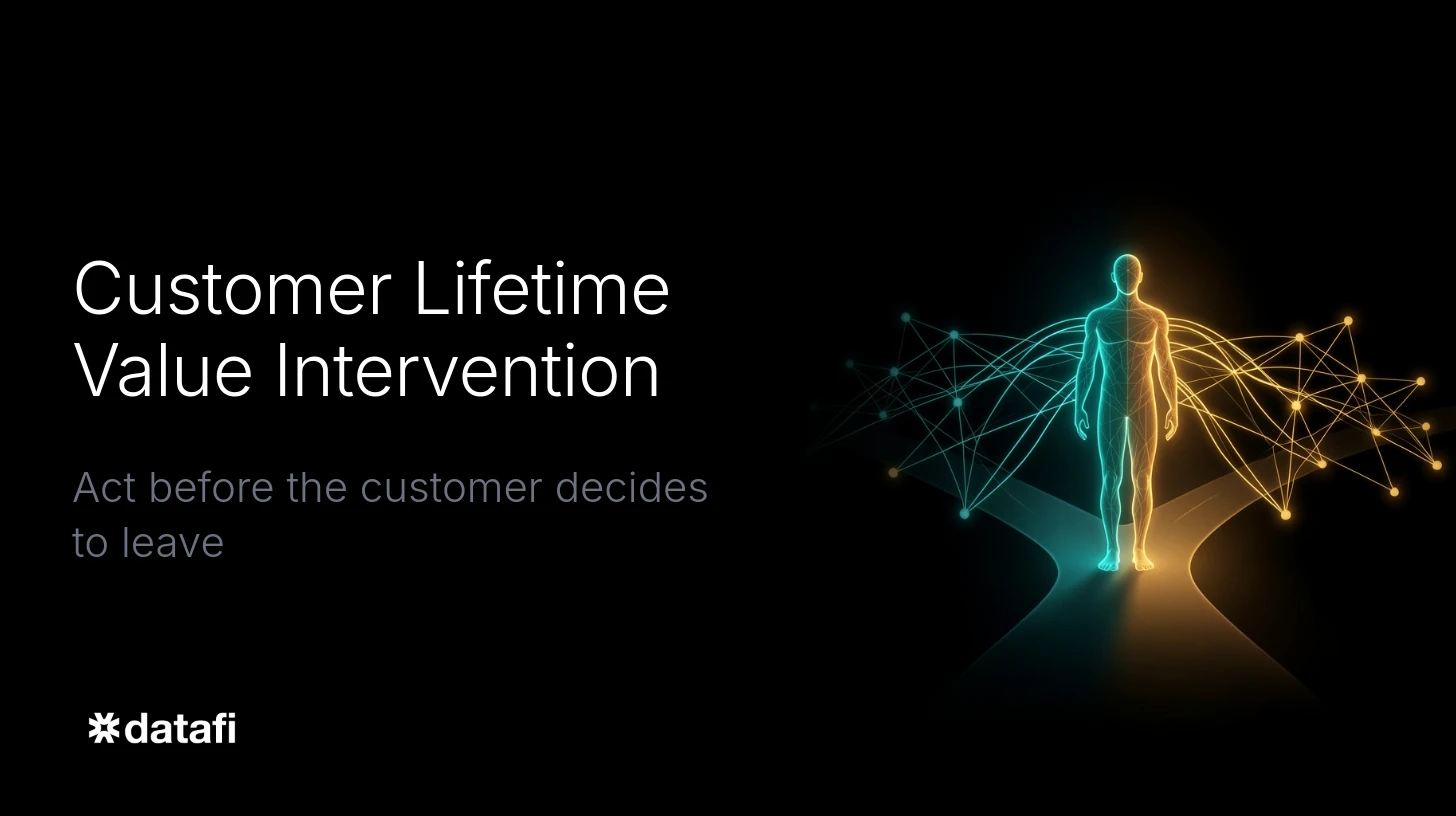
When the Cost of Losing a Customer Finally Has a Name
Every business loses customers. The question that separates high-performing organizations from the rest is not whether churn happens, but whether it was seen coming and whether anything was done about it in time.
Customer Lifetime Value (CLV) Intervention is not a new idea. The concept has been theorized in marketing literature for decades, and most enterprise software platforms offer some version of churn prediction scoring. What has remained elusive, however, is the ability to act on that intelligence with the speed, precision, and contextual awareness that actually changes outcomes. Knowing a customer is at risk is only the beginning. The harder problem is understanding why, determining the right intervention, orchestrating the response across teams and systems, and doing all of this before the window closes.
This is where Datafi changes the equation entirely.
Knowing a customer is at risk is only the beginning. The real competitive advantage comes from understanding why, determining the right intervention, and acting before the window closes, all of which requires AI with full business context, not just prediction scores.
The Gap Between Prediction and Action
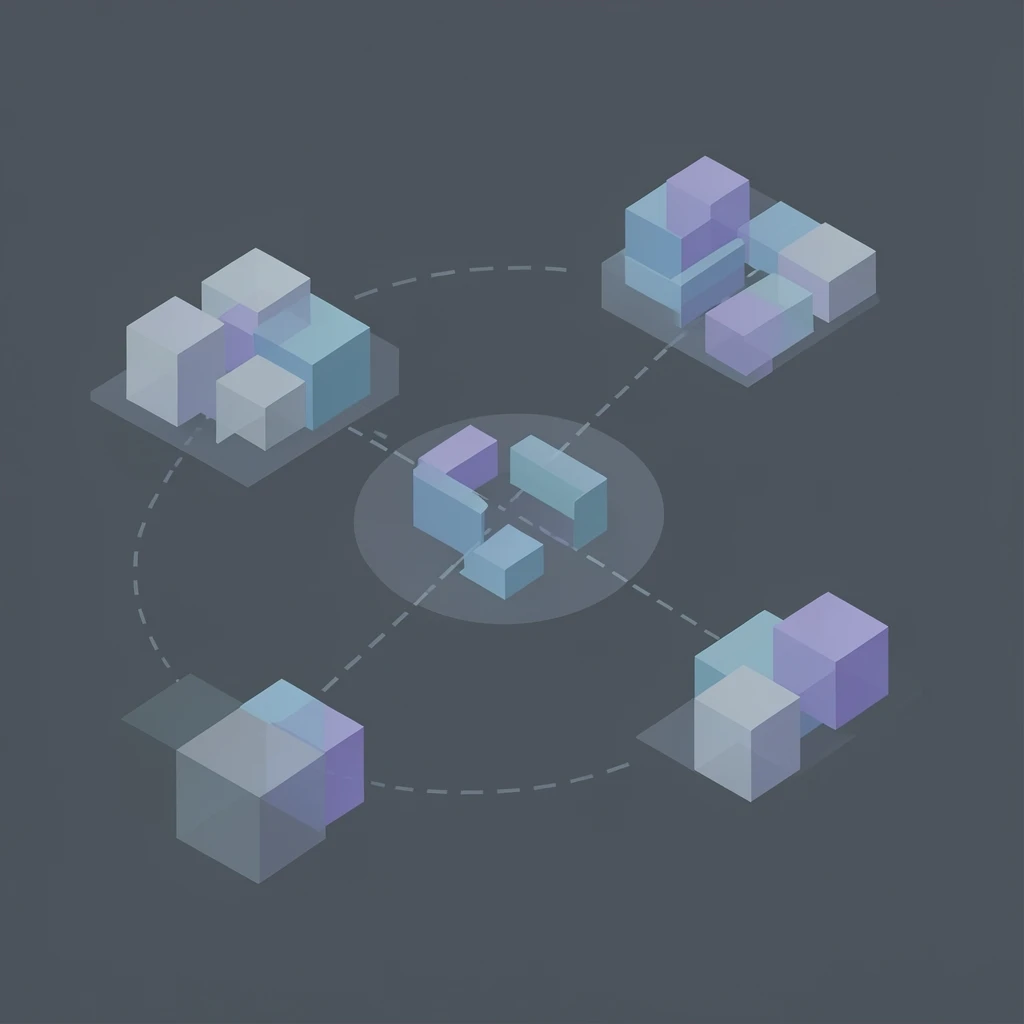
Most organizations accumulate CLV-related data across a fragmented landscape: CRM records, support ticket histories, product usage logs, billing and renewal data, NPS and satisfaction surveys, email engagement rates, and sales activity timelines. The data exists. The signals are there. But they are spread across systems that do not speak to one another, interpreted by analysts who are working from static reports rather than live context, and acted upon by teams that receive recommendations too late or too abstractly to be useful.
A customer success manager who receives a weekly churn risk report on a Monday morning is already working with stale intelligence. A signal that emerged on Wednesday of the prior week has had five days to compound. That customer may have already started evaluating alternatives, stopped using a core feature, or escalated a support issue that went unresolved.
The conventional approach to CLV management is structured around lag. Data is collected, processed, reviewed, and eventually acted upon through a chain of handoffs that was designed for a world where information moved slowly. That world no longer exists. Customers move fast. Their satisfaction erodes in hours, not months. Their decisions accumulate invisibly until they do not.
Datafi was built for the speed at which customer relationships actually operate.
What Datafi Brings to CLV Intervention
Datafi’s vertically integrated data and AI stack connects directly to the full ecosystem of data sources that define a customer relationship. This is not a matter of ingesting summarized reports or pre-defined metrics. Datafi works from the raw, live fabric of customer interaction data: product telemetry, support interactions, contract and billing records, communication histories, usage patterns, and external signals where relevant.
The Datafi platform provides the AI layer with complete business context. This distinction is critical. When an AI model is asked to assess customer health without access to the actual data that defines that health, it is forced to reason from abstractions. It can identify that a metric is declining without understanding the sequence of events that drove it there. It can flag a risk without understanding the history of the relationship or the commitments made. It can recommend an action without understanding what resources and constraints the responding team is working within.
Datafi closes that gap. The AI operates with full awareness of the customer’s journey: how long they have been a customer, what they purchased and why, how their usage has evolved, what problems they have encountered, how those problems were resolved or not, what their renewal timeline looks like, and what value they have realized against the outcomes they were promised at the point of sale.
This depth of context transforms what the AI can do. It is no longer scoring risk. It is diagnosing a relationship.
This depth of context transforms what the AI can do. It is no longer scoring risk. It is diagnosing a relationship.
A Use Case in Practice
Consider a mid-market SaaS company with several hundred enterprise accounts. Their product is used daily by operations teams, and contract renewals are annual. The revenue exposure from even a small number of at-risk accounts is material.
Prior to Datafi, the company’s customer success team relied on a manually maintained health scorecard updated weekly by the CS managers themselves. The score was based on a handful of metrics they could access in the CRM: last login date, open support tickets, and notes from the most recent QBR. The system depended entirely on the humans in the loop having time to update it, interpret it, and act on it. In a team of eight managers each covering thirty accounts, the attention was inevitably uneven.
With Datafi, the organization connects its product telemetry, CRM, support platform, billing system, and customer communication history into a unified data environment. Datafi’s AI continuously monitors this environment, not on a weekly update cycle, but in real time.
When signals of risk begin to accumulate around a specific account, Datafi does not simply raise a flag. It assembles an intervention brief: a synthesis of what is happening, why it matters, what the likely trajectory is if nothing changes, and what actions have the highest probability of reversing the trend. The brief draws on the full relationship history, the account’s contract terms, the team members who have the strongest relationship with the relevant stakeholders, and the resolution patterns from similar historical situations.
The customer success manager assigned to that account receives a notification that is specific, contextual, and actionable. Not “Account XYZ health score declined to 62.” Instead, something with actual intelligence behind it: a synthesis that identifies a 34% drop in usage of the platform’s core reporting module over the past 18 days, correlates it with an unresolved support ticket opened three weeks ago that has had no activity in two weeks, notes that the account’s renewal is 90 days out, and identifies that this same pattern preceded churn in two comparable accounts in the prior fiscal year.
The manager does not need to investigate. The investigation has already been done. What they need to do now is act, and Datafi tells them how.
Agentic Capacity: From Insight to Orchestration
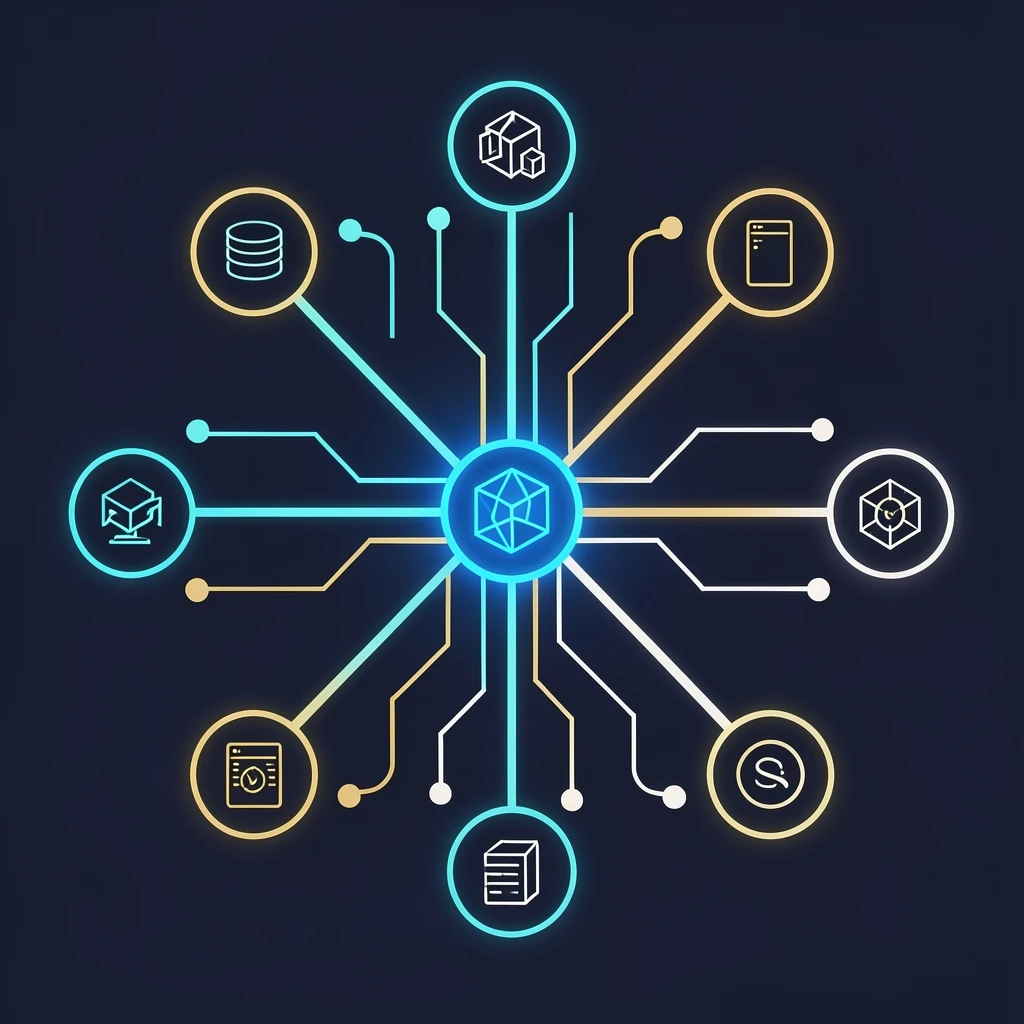
What separates Datafi’s approach from conventional analytics or even AI-assisted reporting is its agentic capacity. The platform does not stop at surfacing insight. It can initiate action.
In the CLV intervention context, this means Datafi can autonomously draft the outreach email to the customer, prepare the internal escalation to the product team about the unresolved support issue, schedule the follow-up touchpoint on the CS manager’s calendar, pull together a customized ROI summary that speaks to the value this specific customer was promised and how the platform has delivered against it, and update the account record in the CRM with a structured intervention log that keeps the entire team aligned.
Human judgment remains at the center of consequential decisions. The CS manager reviews, refines, and approves. But the preparation work, which in a manual workflow might consume two to three hours across multiple systems, has already been completed. The manager’s time is spent on relationship and strategy, not on data retrieval and document assembly.
This is the distinction between AI that answers questions and AI that solves problems. A system that tells a manager a customer is at risk has answered a question. A system that equips the manager with everything they need to act on that risk, and has already initiated the preparatory steps on their behalf, has solved a problem.
The Value Side of the Equation
CLV intervention is ultimately a financial discipline as much as a customer success one. Every retained customer represents not just preserved revenue, but the cumulative value of a relationship that continues to compound: expansion opportunities, referrals, reduced acquisition cost on equivalent new business, and the reputational value of a customer who advocates rather than detracts.
Datafi enables organizations to quantify the value at stake in each intervention. When the AI assembles its intervention brief, it includes a CLV calculation for the account in question, drawing on contract value, historical expansion trajectory, and benchmarked probability of renewal given current health indicators. The team understands not just that a customer is at risk but what the financial consequence of losing them would be relative to the cost of the intervention required to retain them.
This changes how leaders prioritize. When a CS team has twenty at-risk accounts and the capacity to deeply engage ten of them in a given week, the triage decision needs to be driven by data, not intuition. Datafi provides that prioritization layer, ranked by a combination of risk severity, CLV exposure, and probability of successful intervention given available resources and relationship dynamics.
Designed for Organizations of Every Size
One of the persistent myths in enterprise AI is that capabilities of this depth and sophistication are only accessible to organizations with large data engineering teams, mature data infrastructure, and significant technology investment. Datafi was built to make that assumption obsolete.
The platform’s vertically integrated architecture means that organizations do not need to build a data pipeline before they can benefit from AI-driven CLV intervention. Datafi connects to the systems already in use, whether that is a mid-market CRM, a product analytics tool, or a support platform, and begins generating intelligence from the data that is already there.
A 50-person SaaS company can run CLV intervention workflows on Datafi with the same functional sophistication as a 5,000-person enterprise. The AI does not require a data science team to configure it or a dedicated analyst to interpret its outputs. The outputs are designed to be consumed directly by the people closest to the customer relationship, in the language of their day-to-day work.
A New Standard for Customer Intelligence
The organizations that will win the next decade of customer relationships will not be the ones with the most data. They will be the ones whose data is actually woven into the way their teams operate and decide. Customer lifetime value has always been a metric that justifies its own management. What has changed is the availability of platforms capable of turning that management into something real-time, autonomous, and reliably effective.
Datafi does not promise that no customer will ever churn. What Datafi makes possible is that when a customer is on the edge, the organization knows it immediately, understands it completely, and is equipped to do something about it before the decision is made.
That is the difference between a business that reacts to customer loss and a business that intervenes before it happens. It is also the difference between AI that reports on your business and AI that runs alongside it.
Datafi. Solve problems. Don’t just answer questions.