


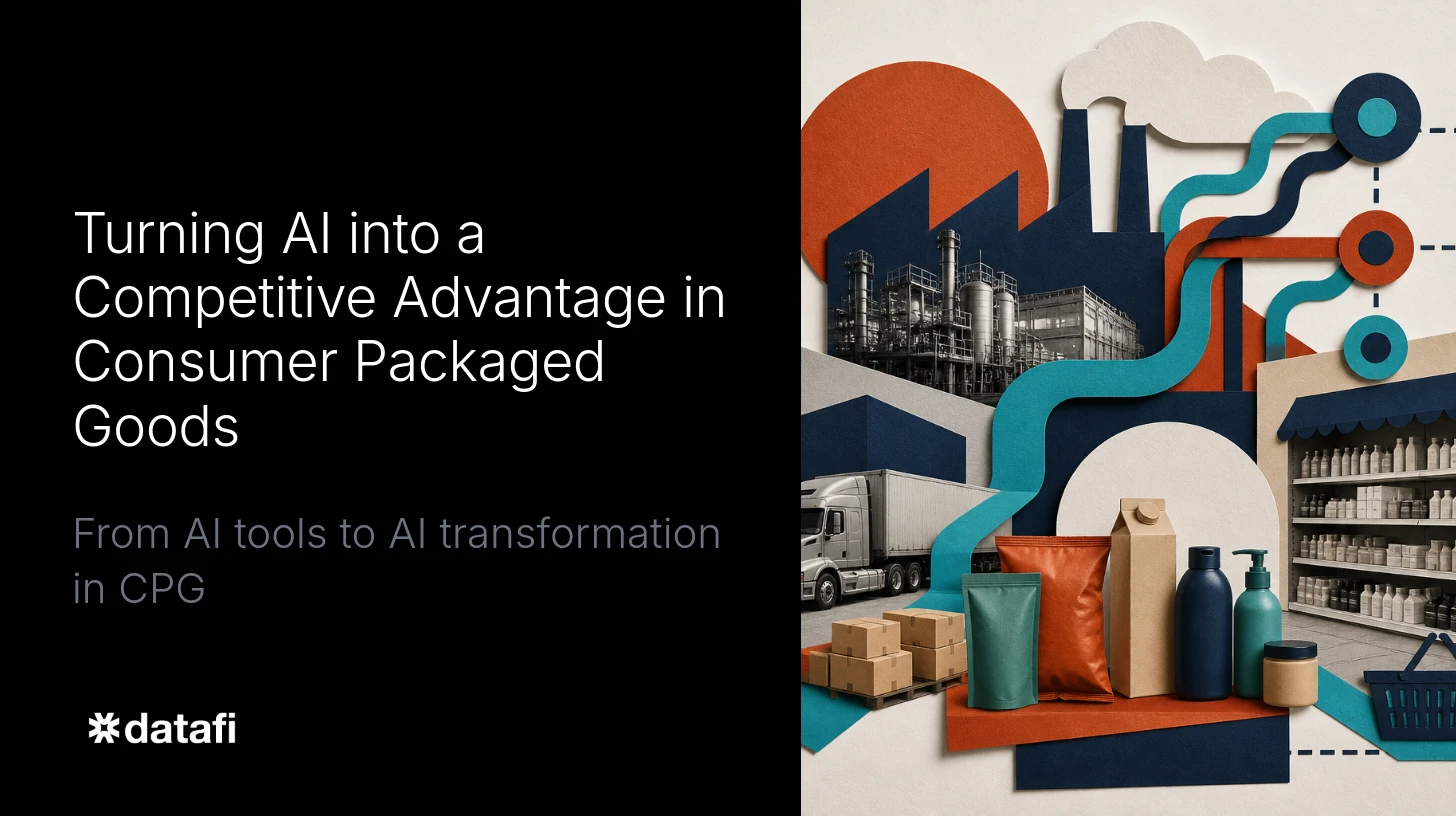
The consumer packaged goods industry is at an inflection point. Margin compression, supply chain volatility, shifting consumer preferences, and the relentless pace of retail innovation have pushed CPG leaders to look everywhere for competitive differentiation. Most have looked to artificial intelligence and found something disappointing: a collection of tools that answer questions but cannot solve problems.
That distinction matters more than it might seem. Answering questions is a feature. Solving problems is a transformation. The CPG organizations that will lead the next decade are not the ones that deployed AI fastest. They are the ones that figured out how to make AI work across the full complexity of their business, from the factory floor to the category review, from demand sensing to strategic portfolio planning.
At Datafi, we have built an operating system for AI that makes this possible. Not a dashboard. Not a copilot layered onto legacy tools. An operating system: a vertically integrated data and AI technology stack that gives every employee, from supply chain analysts to brand managers to plant operators, access to the intelligence locked inside their data ecosystem, governed by the policies and controls that enterprise-grade decisions require.
The CPG organizations that will lead the next decade are not the ones that deployed AI fastest, but the ones that made AI work across the full complexity of their business, from the factory floor to strategic portfolio planning, through a unified operating system rather than a collection of disconnected tools.
Why First-Wave AI Tools Failed CPG
The first wave of enterprise AI investment in CPG followed a predictable arc. Organizations deployed large language model-based tools for search, summarization, and question answering. Knowledge management improved. Certain repetitive workflows accelerated. Boards were shown demos. Executives declared transformation underway.
Then the results arrived, and they were underwhelming.
The reason is structural, not technical. First-wave AI tools were designed to sit on top of existing data infrastructure, not integrate deeply within it. They could surface what was already documented, but they could not reason across fragmented data environments. They could answer “what happened last quarter in our eastern region?” but they could not autonomously investigate why it happened, connect it to upstream supply signals, assess downstream retail implications, and recommend a corrective action plan, all within the same workflow.
CPG businesses are structurally complex. A mid-sized CPG company might operate across dozens of SKUs, hundreds of retail partners, multiple manufacturing facilities, and sprawling distribution networks. Demand sensing requires integrating point-of-sale data, syndicated data, weather feeds, promotional calendars, and social sentiment. Trade promotion optimization requires understanding retailer economics, shopper behavior, and internal margin thresholds simultaneously. Predictive maintenance across production assets requires real-time sensor data correlated against historical failure patterns, parts inventory, and production schedules.
No copilot answers those questions. An operating system does.
The Datafi Business AI Operating System
The Datafi Business AI Operating System is built on three integrated capabilities that, together, create the conditions for AI to function in genuinely transformative roles across the CPG enterprise.
Full Business Context. LLMs performing meaningful work in a CPG environment cannot operate from partial information. They need to know the business: its structure, its priorities, its terminology, its performance benchmarks, its relationships with retail partners, its cost structures, and its strategic objectives. Datafi builds and maintains this contextual layer as a living representation of the organization, updated continuously from the data ecosystem it connects. This is what separates an AI that can discuss demand forecasting in general terms from one that can reason about your demand forecast for your SKU in your category with your specific constraints.
Access to the Complete Data Ecosystem. The data that matters in CPG is spread across ERP systems, trade promotion management platforms, manufacturing execution systems, syndicated data providers, retail portals, logistics systems, and more. Datafi integrates across this full ecosystem, not as a point connector but as a unified data experience that agents and workflows can query, analyze, and act on. Silos do not just limit reporting. They limit the quality of every AI-driven decision built on top of them.
Embedded Governance, Policies, and Control. Enterprise AI deployment in CPG is not a technology problem alone. It is a governance problem. Who can access what data? What actions can AI take autonomously? What decisions require human review? What audit trail is required for regulatory compliance? Datafi embeds policy and control into the operating system itself, so that expanded AI autonomy does not come at the cost of compliance, security, or accountability. This is how organizations move from AI that assists to AI that acts, with confidence rather than anxiety.
The result is an AI-enabled environment where autonomous agents and multi-step workflows can take on the complex analytical and operational roles that have historically required teams of specialists, cycle time measured in days, and manual data assembly that introduces error and delay at every step.
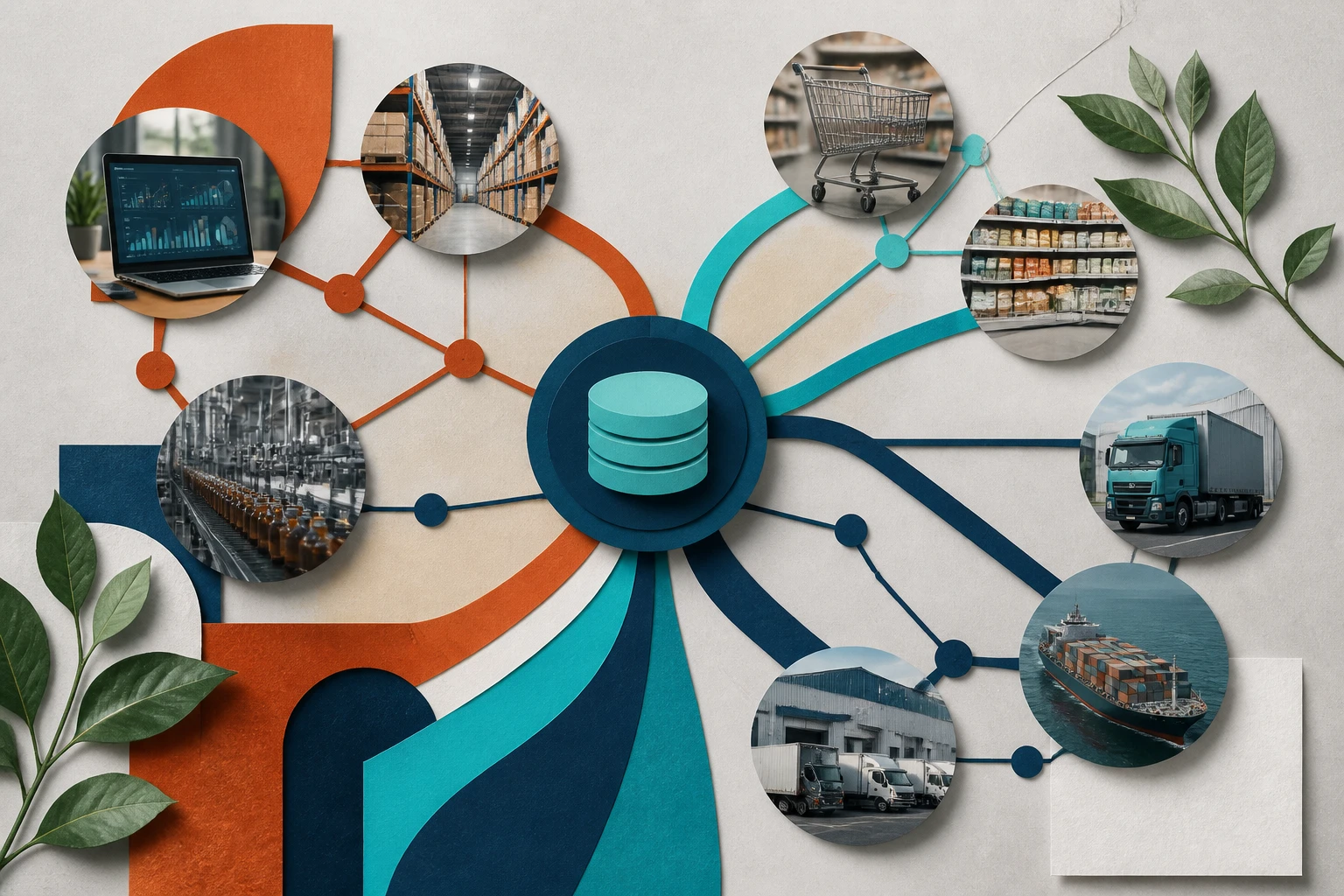
What This Looks Like Across CPG Functions
Demand Sensing and Forecasting
Traditional demand forecasting in CPG involves a monthly or weekly S&OP cycle, intensive analyst effort, and a planning horizon constrained by the speed at which data can be assembled and reconciled. The results are often stale before they drive decisions.
With Datafi, demand sensing becomes a continuous autonomous function. AI agents monitor real-time POS data, syndicated scan data, weather patterns, promotional activity, and retail inventory signals. They detect anomalies, identify emerging trends, and recalibrate forecasts without waiting for a human to schedule the analysis. When a weather event is projected to disrupt demand in a key region, the system does not flag it for a human to investigate next week. It recalculates the impact, assesses inventory positioning, and surfaces recommended responses within the workflow of the people who need to act.
This is not AI answering a question. This is AI reducing the cycle time of a critical business process from weeks to hours, while improving the accuracy of the output.
Trade Promotion Optimization
Trade promotion spending is one of the largest line items in a CPG P&L, often representing 15 to 20 percent of gross revenue. It is also one of the most analytically complex and most frequently managed through a combination of spreadsheets, historical intuition, and negotiated commitments that take months to evaluate for ROI.
Datafi’s operating system enables AI agents to evaluate promotional performance in near real-time, correlating sell-in data, scan data, retailer inventory, and internal cost structures to assess whether a promotion is achieving its intended lift. More importantly, it enables forward-looking scenario modeling that accounts for the full complexity of the trading relationship: retailer margin requirements, competitive activity, cannibalization across the portfolio, and strategic account objectives.
Brand and customer development teams gain access to analytical depth that previously required weeks of data science work, delivered through a conversational interface designed for non-technical users. The analyst does not need to write SQL or understand the data architecture. They need to ask the right business question, and Datafi ensures the AI has the context, the data access, and the reasoning capability to answer it with precision.
Predictive Maintenance and Asset Management
Manufacturing efficiency is a margin driver in CPG that often goes underoptimized because the data required to manage it well is fragmented across operational technology systems, maintenance records, parts inventories, and production schedules. The consequence is reactive maintenance, unplanned downtime, and the production losses that cascade through the supply chain whenever a critical asset fails unexpectedly.
Datafi connects across the OT/IT boundary, integrating sensor data from production equipment with maintenance histories, parts availability, production schedules, and supplier lead times. AI agents monitor asset health continuously, detect early indicators of degradation, and generate maintenance recommendations that account for the full operational context: not just that a motor is showing anomalous vibration, but whether the production line can tolerate a scheduled stop this week, whether the required parts are on hand, and what the downstream impact of an unplanned failure would be compared to a planned intervention.
The outcome is a shift from reactive to predictive maintenance that reduces unplanned downtime, extends asset life, and optimizes maintenance labor without requiring engineers to manually correlate data across systems that were never designed to talk to each other.
Operations Optimization
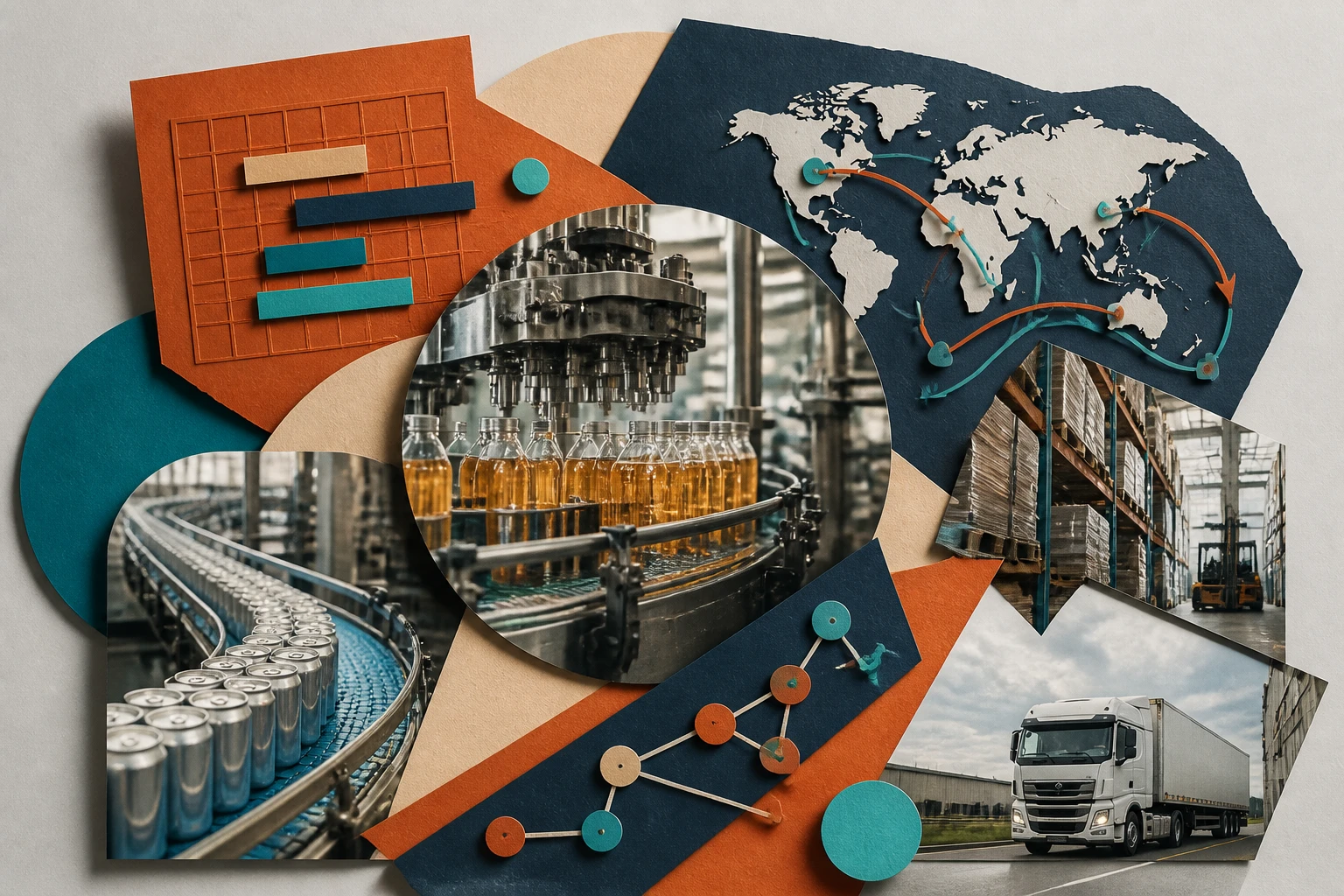
Beyond individual assets, Datafi enables operational AI agents that optimize at the system level: production scheduling, network optimization, logistics planning, and inventory positioning across the supply chain. These are problems of genuine complexity, requiring the simultaneous consideration of dozens of variables and constraints that change continuously.
AI operating on partial data or without the business context to understand the relative priority of competing objectives will optimize for the wrong thing. It will minimize cost in a scenario where service level is the critical constraint, or optimize production throughput in a week when a retail partnership requires a specific product assortment that conflicts with efficient line changeovers.
Datafi ensures the AI has the full picture. Not just the operational data, but the strategic priorities, the commercial commitments, and the organizational policies that define what a good decision looks like in that specific moment for that specific business.
Strategic Planning and Portfolio Management
CPG portfolio decisions, brand architecture, innovation pipeline prioritization, M&A evaluation, and category strategy are among the highest-stakes analytical challenges in the business. They are also among the most data-intensive, drawing on market research, financial modeling, competitive intelligence, consumer trend analysis, and internal performance data simultaneously.
Datafi enables AI agents to function as analytical partners in strategic planning workflows, assembling and synthesizing the information required for high-quality strategic decisions at a fraction of the time and cost of traditional approaches. Scenario modeling that previously required weeks of analyst time becomes an interactive capability available to strategy teams and senior leaders on demand.
This does not replace strategic judgment. It elevates it. When decision-makers have access to richer, faster, more comprehensive analysis, they spend less time assembling information and more time on the judgment and creativity that AI cannot replicate.
The Unified Data Experience for Every Employee
One of the most important capabilities of the Datafi Business AI Operating System is one that often goes underappreciated in the focus on advanced analytical use cases: the democratization of data access for every employee, regardless of technical background.
In most CPG organizations, the ability to extract insight from data is concentrated in a relatively small group of analysts, data scientists, and technical users. Everyone else either waits for those resources or makes decisions without the data they need. Both outcomes are costly.
Datafi’s Chat UI is designed from the ground up for non-technical users. A brand manager does not need to understand data modeling to ask a meaningful question about their brand’s performance. A logistics coordinator does not need to write queries to investigate a shipment anomaly. A plant manager does not need a data analyst to understand what the maintenance data is telling them about their production line.
When the intelligence embedded in a CPG organization’s data ecosystem becomes accessible to every employee through a natural-language interface backed by full business context and complete data access, the compounding effect on decision quality across the organization is significant. Better decisions made faster, by more people, with less reliance on scarce technical resources.
From Efficiency to Transformation
CPG organizations have spent the last several years pursuing AI-driven efficiency gains. Those gains are real and worth capturing. But efficiency is not transformation. The organizations that will define the competitive landscape in CPG over the next decade will be the ones that use AI not just to do existing work faster, but to do work that was previously impossible at scale.
Continuous demand sensing at the SKU and store level. Real-time trade promotion evaluation across thousands of retail accounts. Predictive maintenance across a distributed manufacturing network. Dynamic operations optimization that responds to supply chain disruptions in hours rather than weeks. Strategic analysis that synthesizes the full complexity of the business in service of sharper decisions.
These are not efficiency improvements. They are capability expansions, and they require an AI operating system rather than a collection of AI tools.
At Datafi, we have built that operating system. Organizations of any size can deploy it. The path from AI investment to AI advantage in CPG is not longer or more expensive than most leaders assume. It requires the right foundation: unified data, full context, embedded governance, and AI designed not to answer questions but to solve problems.
The companies that understand that distinction, and build accordingly, will not just compete. They will lead.
Datafi is the Business AI Operating System for CPG and other data-intensive industries. Built on a vertically integrated data and AI technology stack, Datafi enables unified data experiences, autonomous AI workflows, and embedded governance that transform how organizations use AI across the enterprise.