


Answers are not outcomes
Most enterprises have had their first taste of generative AI. Employees draft emails in Copilot, summarize contracts in ChatGPT and ask Claude to explain a spreadsheet. The productivity is real. Yet when an operations manager asks which shipments will miss their delivery window today, the assistant has nothing useful to say. The answer lives in the TMS, the ERP and a dispatcher’s inbox, none of which the AI can see.
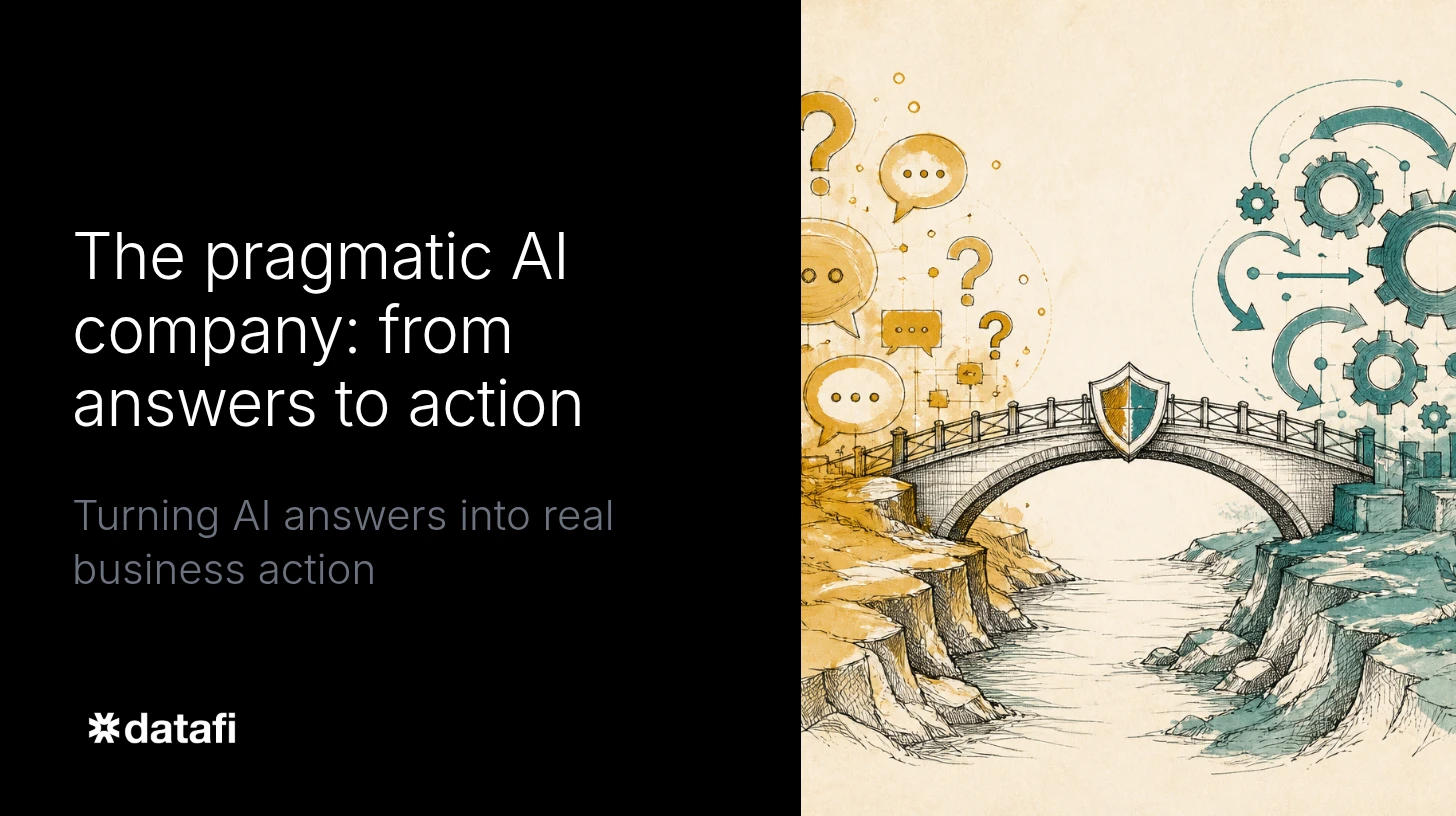
That gap defines enterprise AI in late 2026. Pilots succeed, then stall. AI can recommend, but it has no governed path into the systems where work actually happens. The next phase belongs to AI that takes action to solve problems, not AI that just answers questions. Getting there is less about bigger models and more about pragmatic engineering.
Pragmatic AI meets people in the AI tools they already use, then makes every request governed, observable and grounded in business context. Safety and adoption stop competing when the sanctioned path is also the easiest one.
The premise worth questioning
There are two common responses to this gap, and both deserve credit. The first is to standardize on one AI vendor and wait for its connectors to mature. Microsoft and Google are investing heavily, and for data that already lives in their clouds, native tools work well. The second is to build. Model Context Protocol has made it easier than ever for an internal team to expose a database to an AI client.
Both underestimate the problem. Mid-enterprise data rarely lives in one cloud. It sits in an ERP, a policy administration system, an on-premise database and file shares that predate the cloud. A production-grade MCP server is also only the beginning. Teams still need per-user access control, business context so that “margin” means what finance means, and an audit trail of every request. Most IT teams would rather spend that effort on use cases.
What governed, context-aware access unlocks on day one
The first step toward AI that acts is giving any AI client access to internal business systems, with governance applied at the moment of every request. Four properties matter.
-
Consistent. Finance can work in Copilot while sales uses ChatGPT and engineering uses Claude. Every tool reaches the same data through the same rules, so answers agree across departments.
-
Governed. Each request is checked against who is asking. The AI never sees more than the person does, down to the row.
-
Observable. Every question, query and response is logged in one place, giving security and compliance teams a complete record instead of a blind spot.
-
Context aware. A business context layer carries company terminology, metrics and relationships, so the AI reasons the way the business does.
Together these properties address the quiet risk inside most enterprises: shadow AI. When employees cannot use AI with business data through sanctioned channels, they paste it into personal accounts. Sensitive records leave the building with no log and no policy. Governed access removes the incentive. The fastest path for an employee becomes the safe path, and IT gains visibility into usage it could not see before.
From reading data to changing it
Access alone still produces answers. Transformation begins when agentic workflows read live data and update the systems of record themselves, within the same governance that applies to people.
Consider a regional LTL carrier running an exception agent against its delivery commitments throughout the day. The agent spots a late linehaul, drafts the customer notification, updates the expected delivery date in the TMS and routes a rebooking decision to a dispatcher for approval. Nothing waits on an overnight copy to a warehouse. The agent works on live data, acts where policy allows and pauses where a person should decide.
One operating system instead of an assembled stack
This is the problem Datafi was built to solve. Datafi sits between the AI clients your people use and the systems your business runs on, connecting them over MCP with no data migration. Organizations use it two ways. With Converse, employees talk to their complete business data from Copilot, ChatGPT, Claude, Gemini or Datafi’s own Business Chat, a chat experience designed for non-technical users. With Activate, teams build apps, agents and automated workflows that turn answers into action.
Behind both sits a vertically integrated platform. Studio lets analysts and domain experts build agents visually. Runtime orchestrates models, tools and system integrations in production. Control Tower applies centralized policies, observability and audit trails. Cyber checks every agent action against identity, policy and context before it executes.
Because the layers are integrated, every new agent inherits existing data connections, policies and security. Developers building custom applications work on that foundation rather than wiring together models, connectors, governance and orchestration themselves. Each use case extends the platform instead of adding another point solution to secure.
Why we call it pragmatic
My work with data and AI has taught me that transformative outcomes rarely come from the most impressive model. They come from giving capable models what they need to act: the full context of the business, access to the complete data ecosystem, clear policies and controls, and an interface every employee can use. More powerful models make this more true, not less, because they benefit most from richer context.
More powerful models benefit most from richer context. The contextual layer is not a workaround; it is the foundation that makes every model better.
Our customers increasingly want AI in critical thinking, workflow automation and analytical roles. In those roles the contextual layer becomes the foundation for agents that learn and solve hard business problems autonomously. Pragmatism is how organizations of any size get there: start with one dataset and one real use case, prove value quickly, then extend with confidence. A Datafi launch workshop puts a first use case into production in three days or less, with zero data migration.
That is what it means to be the pragmatic AI company. Not smaller ambitions, but a faster and safer path to them.
Plan a launch workshop to see Datafi working on your own data.
Datafi is the pragmatic AI company. Its Business AI Operating System connects the AI clients people already use to live business systems, with governance, observability and security built in, so organizations can move from AI that answers questions to AI that solves problems. Learn more at datafi.co.