

For years, the promise of AI at work has been smaller than it should be. Companies built dashboards. They ran reports. They called it intelligence. But all they were really doing was finding faster ways to answer questions that people had already thought to ask.
The bigger question is this: can AI be trusted to find and solve problems that nobody has thought to ask about yet?
The difference between AI that answers questions and AI that solves problems is not about how smart the model is. It is about context, access, and architecture. Companies that build a connected foundation for AI, rather than stacking disconnected tools, will be the ones that unlock its full potential.
The AI We Always Imagined
Ask anyone who has worked inside a large company what their perfect AI assistant would look like. Most people describe something similar.
It would know the business deeply. Not just facts, but how everything connects. It would keep an eye on what matters without being told what to watch. It would bring the right answer at the right moment. It would never forget a detail, and it would never lose track of how a delay from one supplier might affect a promise made to a customer three departments away.
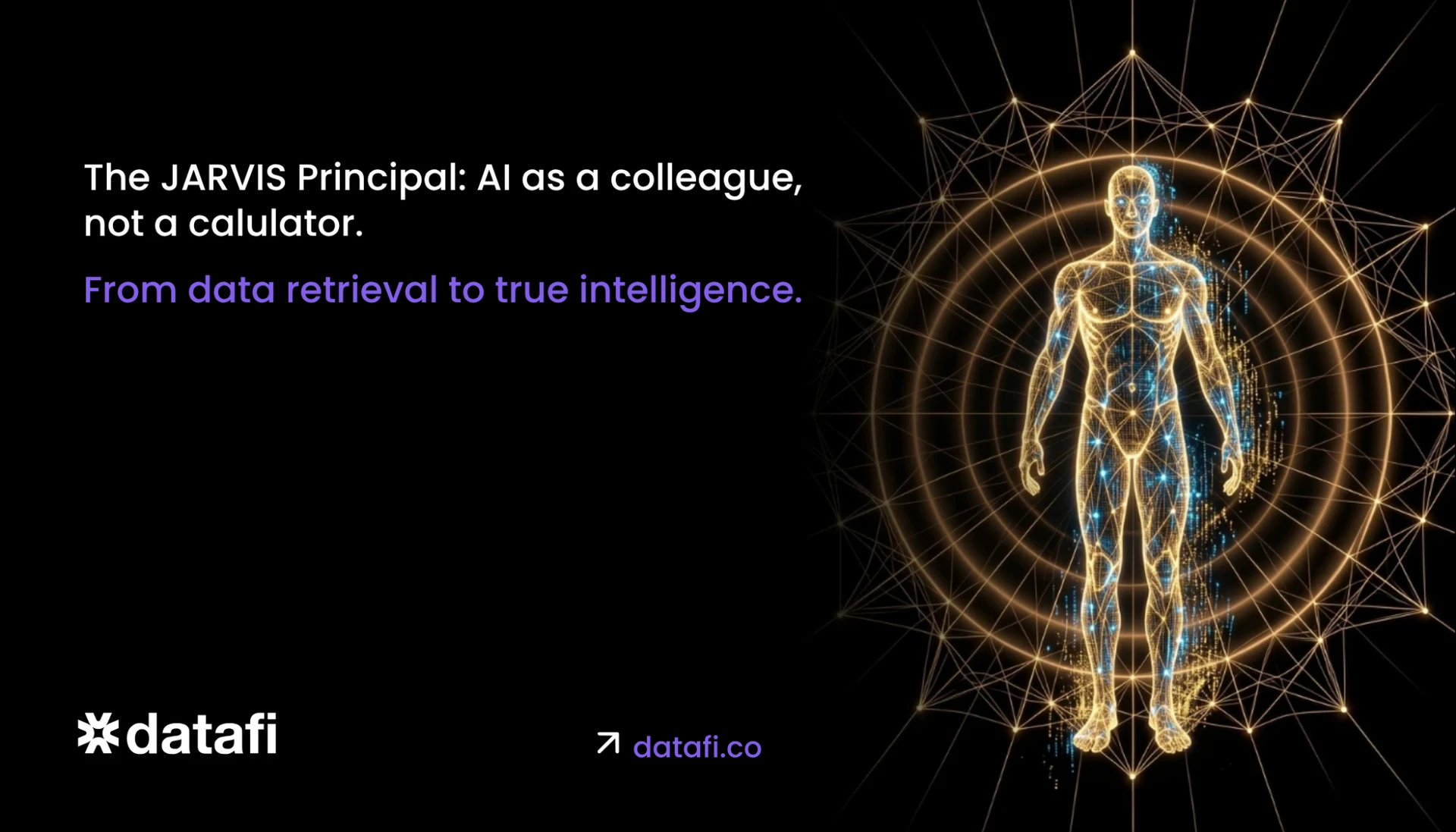
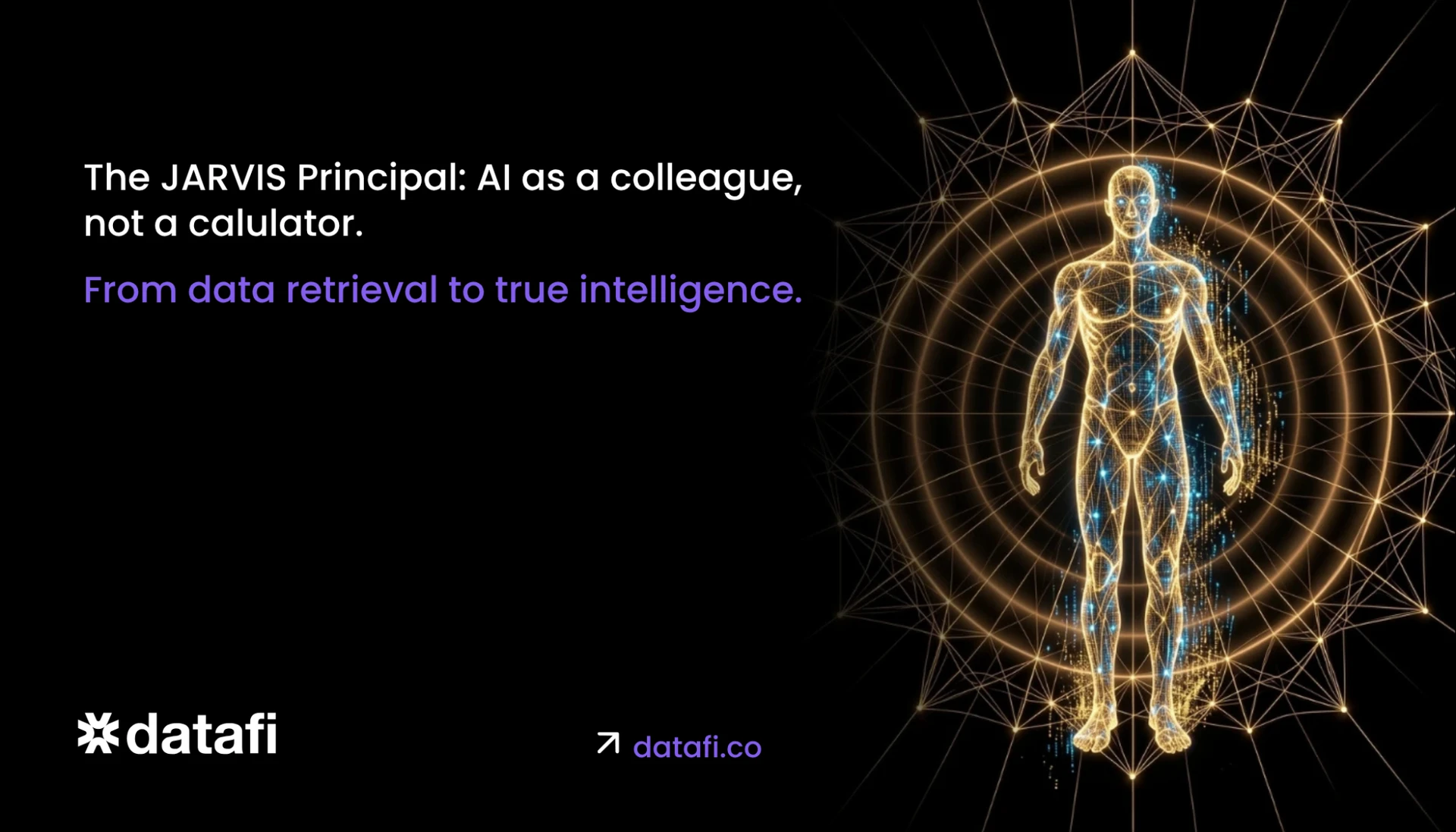
That idea has a name most people recognize: JARVIS.
JARVIS is the idea of an AI that handles complexity on behalf of a company. Not a search engine. Not a report generator. A real partner that understands the full picture and acts on it.
JARVIS knew more than just facts. It understood what those facts meant together. That is the key difference between AI that looks things up and AI that truly understands and acts. That difference is the biggest challenge and the biggest opportunity in business technology today.
We are at the beginning of what you might call the JARVIS moment in business AI. The companies that get there first will not do it by buying more disconnected AI tools. They will get there by building one connected foundation that gives AI the full picture of how the business works.
“The difference between AI that answers questions and AI that solves problems is not about how smart the model is. It is about context, access, and architecture.”
Why Separate AI Tools Do Not Work
Right now, companies are buying AI tools by the dozens. One tool for customer service. One for financial planning. One for supply chain. Each one works well on its own. But each one is blind to what the others see.
This is not just inconvenient. It blocks the kind of results that AI is actually capable of delivering.
Here is a simple example. Imagine a company where the AI tracking equipment repairs cannot see how long it takes to order parts. And the AI watching the supply chain cannot see the repair schedule. And neither one can see the customer orders that depend on everything running smoothly. The result is three expensive tools giving three correct but conflicting answers.
Trying to fix this by connecting all those tools with custom software is like adding more lanes to a traffic jam. It delays the problem without fixing the root cause. What is missing is a shared layer of understanding that all AI tools and all people can use at the same time.
The Vertically Integrated Imperative
At Datafi, we have worked directly inside enterprise data systems for years. We have seen what happens when companies try to build real AI results on scattered, disconnected data. The pattern is predictable. High costs. Low adoption. Small gains. And a growing gap between what AI was supposed to deliver and what it actually did.
The fix is not another AI tool. It is a single, connected system that runs from the raw data all the way to the business decision, no matter where that data lives or what format it is in.
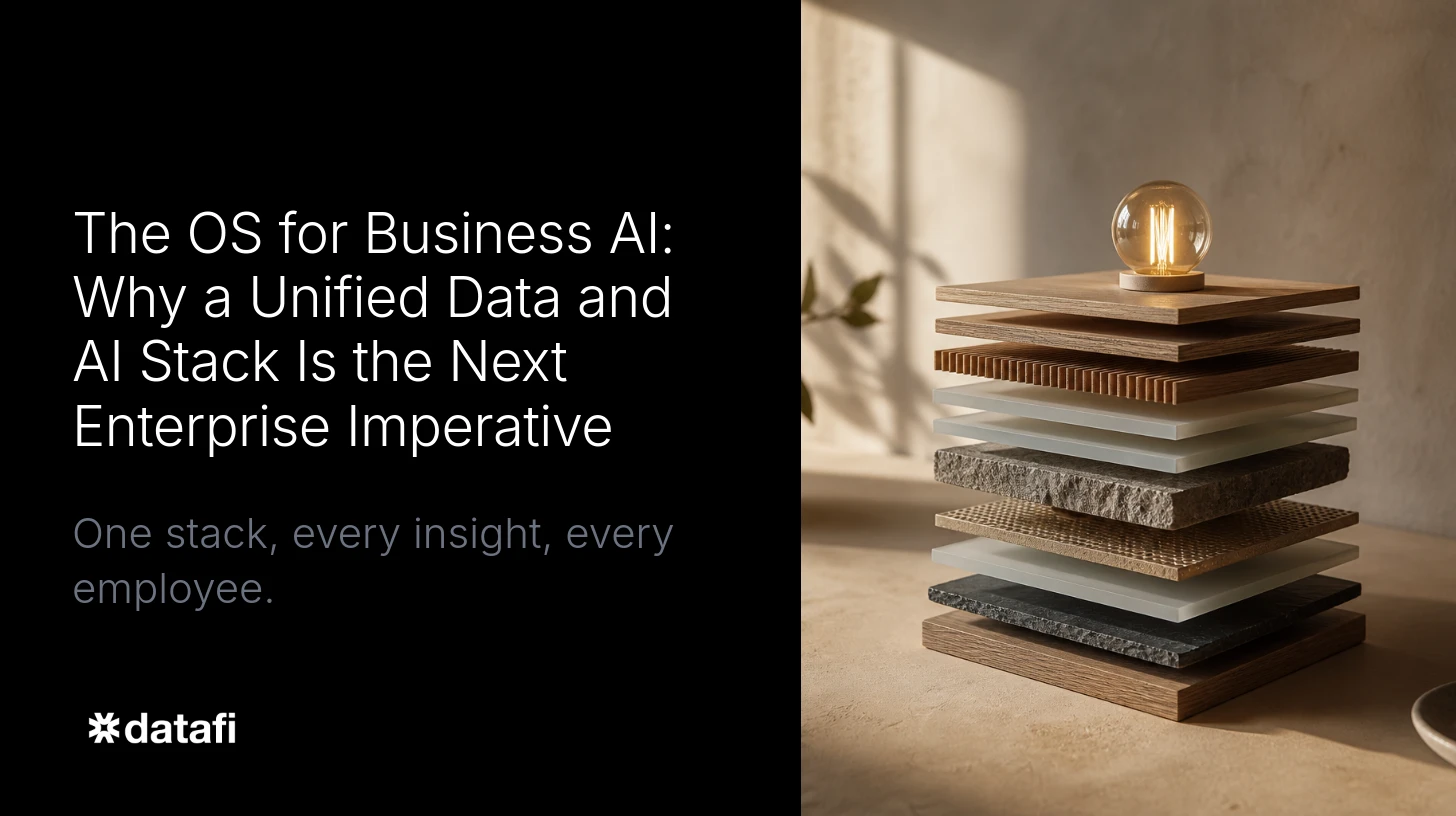
The Datafi AI Operating System
Layer 1: Chat Interface for Everyone
Plain-language access for every employee, whether they work in tech or not.
Layer 2: Autonomous Agents and Workflows
AI that can act across the whole business without needing constant instructions.
Layer 3: Global Business Context Layer
A live picture of the business, including how everything relates to everything else.
Layer 4: Data Access Without Moving Data
Connect to all data sources where they are, without copying or transferring anything.
Layer 5: Built-In Rules and Controls
Policies and oversight baked into the system from the start, not added later.
Every layer depends on the others. A chat interface without context is just a toy. Context without data access is just a guess. Agents without rules are a risk. The connection between all layers is what makes it work. That is what vertically integrated means.
The Context Layer: AI That Actually Knows Your Business
The biggest leap forward in business AI over the next few years will not be a smarter AI model. It will be the context layer that tells the model what everything means inside your specific business.
Think about what it takes for an AI to truly understand a mid-size manufacturer. Reading financial documents is not enough. The AI needs to know how the maintenance schedule for one machine affects the orders that depend on that machine. It needs to know how a delay from a supplier ripples through the production line and puts a customer delivery at risk. It needs to understand that a rise in energy costs at one site changes the profit math on a product that leadership is presenting to the board next week.
That is what a real business context layer provides. Not a database. Not a collection of documents. A living, connected picture of how the business works, what it cares about, and what actually matters, updated as things change.
This is the JARVIS idea applied to real business AI. Not an assistant that waits to be asked. An intelligent system that keeps a constant, complete understanding of the organization and acts on it without being told to.
“AI systems need to know the full context of the business. They need access to all the data. And they need to work on their own in real roles to learn and solve hard problems. That is what makes complex AI agents possible.”
AI for Every Employee, Not Just the Tech Team
One of the most common mistakes in business AI is thinking it is only for technical people. Data scientists build models. Analysts run queries. Engineers maintain systems. Everyone else waits for a report.
That model does not work anymore. And it does not have to.
When the entire AI stack is connected, and when there is a simple chat interface that any employee can use, the value of AI spreads across the whole company. When an operations manager can ask a plain-language question and get an answer built from live data across the whole business, the return on investment changes completely.
The JARVIS idea was never about helping just one person at the top. The real value of an AI that knows the whole business is that it can help every person in the company at the same time, adjusted for their role, their decisions, and what they are allowed to see. The goal is not to turn everyone into a data scientist. The goal is to give every employee the ability to tap into the intelligence of the entire organization in a way that fits how they actually work.
Where AI Agents Make a Real Difference
The use cases for AI agents that work inside a connected, context-aware system are not theoretical. They are showing up across industries right now.
Predictive Maintenance and Asset Management
AI agents that constantly monitor equipment data, check repair history, track part lead times, and watch production schedules. They spot problems before they happen and coordinate fixes without waiting for someone to notice.
Operations Optimization
Constant balancing of logistics, staffing, inventory, and demand, across more variables than any human team could track at once. The AI surfaces the best decision with full context already built in.
Customer and Passenger Experience
Agents that catch problems in the customer journey before the customer does, fix them across operating systems in real time, and personalize every interaction based on the full history.
Strategic Planning and Scenario Analysis
AI that can build, test, and compare business strategies using real data, real constraints, and real market signals. Work that used to take weeks of analyst time can happen in hours.
What all of these have in common is that the AI needs to see across the whole organization, act without constant supervision, and understand not just what a data point says but what it means in the context of everything else.
Control and Oversight Are Not Optional
As AI agents take on bigger roles in business decisions, the question of oversight becomes critical. Not in an abstract, theoretical way, but in a very practical way.
Who approved this agent to access this data? What policy did this recommendation follow? How do we review a decision an autonomous system made at 2am?
These questions cannot be answered after the system is built. They have to be answered by the design of the system itself. Embedding policies, access controls, audit logs, and monitoring into the foundation, rather than adding them later, is what makes AI safe enough to use in high-stakes roles in industries like finance, healthcare, energy, and life sciences.
This is why Datafi’s Control Tower and built-in policy layer are not features. They are requirements. The ability to put AI agents into important business functions depends entirely on the organization’s ability to define, enforce, and monitor the rules those agents operate under.
The Advantage Is in the Architecture, Not the Model
Every company in the world can use the same AI models. GPT-4, Claude, Gemini, Llama, and whatever comes next are increasingly available to everyone. The competitive advantage is not which model a company chooses. It is whether the company has built a system that gives that model full, governed, meaningful business context, and the ability to act on it precisely.
Companies that build a vertically integrated AI operating system now, one that connects to all their data without copying it, builds a real business context layer, puts AI tools in the hands of every employee, and runs AI agents inside clear rules, are building an advantage that grows over time.
Every automated workflow captures institutional knowledge. Every agent that is deployed understands the business a little better. Every conversation through the chat interface adds to a richer context layer. Once the foundation is in place, it builds on itself.
The JARVIS Vision Is No Longer Science Fiction
The idea of an AI that manages organizational complexity with full context, constant awareness, and the ability to act on its own has moved from imagination to engineering. Every technical piece needed to build it exists today. The models are capable. The data exists. The computing power is there. What has been missing is the system to bring it all together in a way that is connected, governed, and accessible to everyone in the organization, not just the engineers who built it.
That is exactly what a vertically integrated AI operating system provides. Not AI as a department. Not AI for the technical few. AI as the operating system of the entire enterprise, always learning, always acting, always bringing forward the decisions that move the business ahead.
The future of work is not a world where AI replaces people. It is a world where every employee is made more capable by an AI that knows the business as well as they do and can act on that knowledge faster, more completely, and more consistently than any team working alone.
The organizations that start building toward that future today are the ones that will lead their industries tomorrow.
Ready to Build Your AI Operating System?
Discover how the Datafi platform helps mid-enterprise organizations unify data, deploy AI agents, and deliver real outcomes at scale.
Visit datafi.co