


There is a pattern that repeats itself across almost every enterprise AI deployment in the market today. Organizations invest in powerful models, connect them to a handful of data sources, and ask their teams to start prompting. What they get back are answers. Summaries. Explanations. Content. The AI performs impressively in the demo and underwhelms in practice because answering questions, no matter how fluently, was never the hard part of running a business.
The hard part is making decisions. Identifying failure before it happens. Coordinating complex workflows across systems that were never designed to talk to each other. Acting on insight before the window closes. These are not question-and-answer problems. They are reasoning, planning, and execution problems. And solving them requires a fundamentally different architecture than the one most organizations are currently deploying.
At Datafi, we have spent years developing a perspective on this gap, shaped by direct experience working in the space where data, AI, and enterprise operations collide. That perspective has produced a clear conviction: the organizations that extract transformative value from AI will not be the ones that deployed the best models. They will be the ones that built the right operating environment for those models to function in.
That operating environment is the Datafi AI operating system for knowledge agents.
The organizations that win with AI will not be those that deployed the best models. They will be the ones that built the right operating environment: one with deep contextual data access, rigorous governance, and autonomous agentic reasoning working together as a coherent system.
Why General-Purpose AI Falls Short in the Enterprise

Large language models are remarkable. They encode vast knowledge, reason across domains, and generate fluent outputs at a scale no human team could match. But deploying one into an enterprise context without the right infrastructure produces a predictable set of problems.
The model does not know your business. It does not know your terminology, your cost structures, your regulatory obligations, your operational rhythms, or the informal logic that experienced employees carry in their heads after years on the job. Without that context, the best it can do is speak in generalities. It answers questions that approximate the one you meant to ask, using knowledge that approximates the reality of your organization.
It also cannot act. Even when a model produces an insight that is accurate and useful, turning that insight into an outcome requires touching systems, triggering workflows, routing decisions, and coordinating across teams. General-purpose AI tools are not built to do that. They are built to generate responses.
Finally, most enterprise AI deployments are not governed. The data that feeds them is not curated for accuracy or recency. The outputs are not constrained by policy. Access is not differentiated by role. In environments where data quality and compliance matter, this is not a minor inconvenience. It is a fundamental barrier to deployment in critical workflows.
Addressing all three of these gaps simultaneously is what an AI operating system is designed to do.
The Datafi Architecture: Vertical Integration as a Competitive Advantage
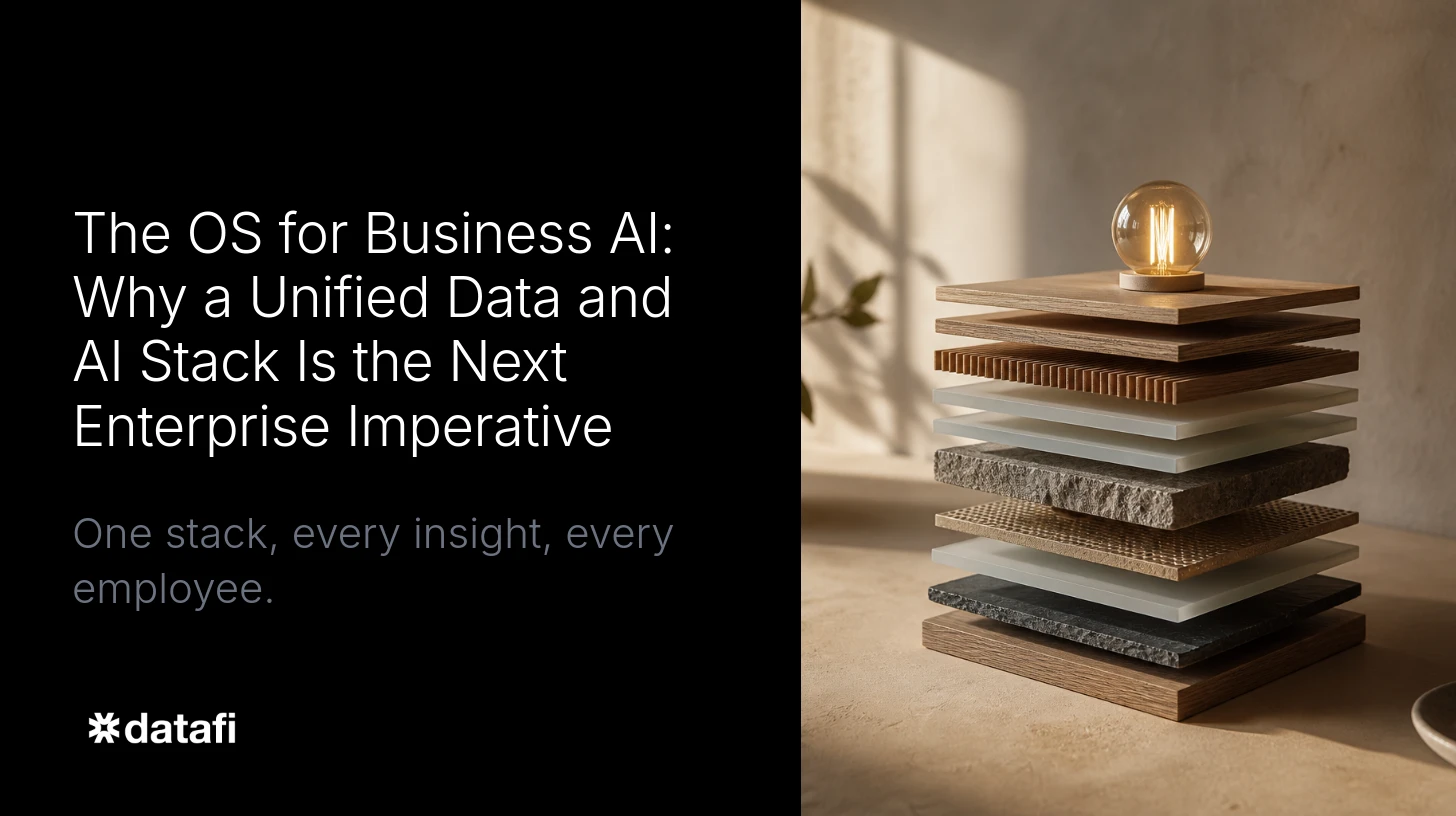
The Datafi operating system for AI is vertically integrated. That phrase gets used loosely in the industry, but at Datafi it has a precise meaning. Every layer of the stack, from data access through governance through agentic reasoning through user experience, is designed and built to work together. There are no seams where context gets lost. No translation layers that dilute the signal. No hand-offs that require a human to bridge the gap.
At the foundation is the data ecosystem layer. Datafi connects to the full breadth of an organization’s data: structured databases, data warehouses, real-time event streams, unstructured documents, operational systems, and external data sources. This is not a simple query interface. It is a live, contextual data environment that gives the AI layer access to the complete information landscape of the business. When a knowledge agent needs to understand inventory levels, maintenance history, workforce skills, financial exposure, or customer sentiment simultaneously, that information is available, current, and accessible in a single coherent context.
Above the data layer sits the policy and governance engine. This is the layer that transforms raw data access into enterprise-grade deployment. Role-based permissions ensure that every agent, and every human user, operates within the boundaries appropriate to their function. Sensitive data is protected without being hidden from the people and systems that legitimately need it. Every query, every action, and every workflow execution is auditable. Organizations operating in regulated industries, or simply those that take data stewardship seriously, can deploy AI in critical workflows without creating new compliance risks.
The agentic reasoning engine sits at the center of the architecture. This is where the intelligence lives. Unlike systems that treat AI as a query processor, the Datafi agentic layer is designed for complex, multi-step reasoning. It draws on the full context of the business, maintains continuity across interactions, and executes autonomous workflows that extend beyond conversation into action. When a problem requires pulling data from ten sources, applying domain-specific logic, surfacing a recommendation, and triggering a downstream process, the agentic layer can orchestrate all of it without a human directing each step.
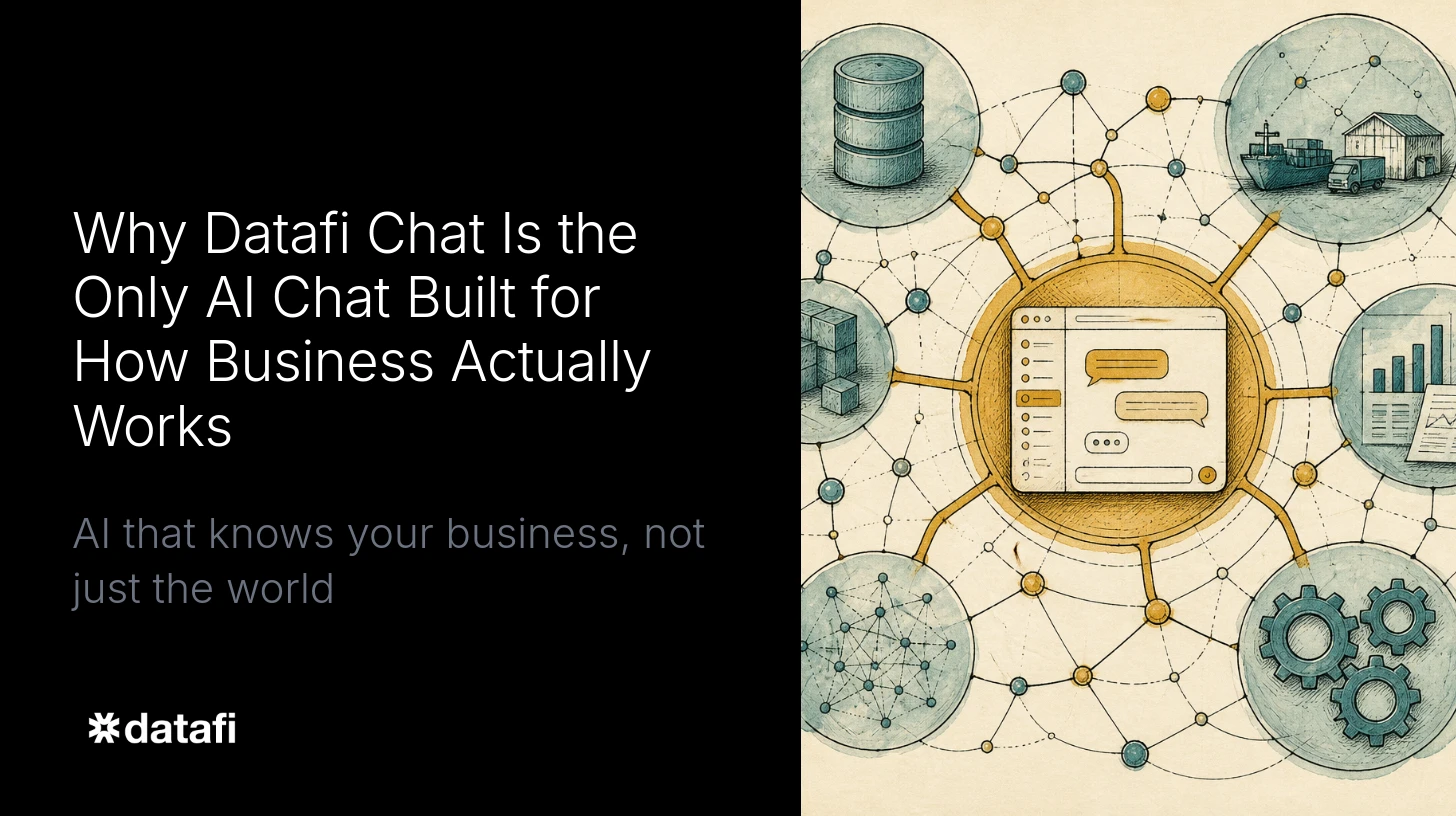
At the surface of the stack is the Chat UI, designed specifically for non-technical users. This is not a developer interface or a data analyst’s workbench. It is a natural language environment where any employee, regardless of their technical background, can access the full power of the AI operating system. A maintenance technician can ask about asset health. A sales leader can explore pipeline scenarios. A supply chain planner can model disruption impacts. The interface translates their questions into actions on the underlying system and returns results in the language they actually use.
Real-World Outcomes Across the Enterprise

The power of this architecture becomes concrete when you look at what it enables in practice.
In asset-intensive industries, predictive maintenance represents one of the highest-value AI applications available. Traditional approaches rely on scheduled maintenance intervals and manual inspection, which are expensive and imprecise. A Datafi knowledge agent can continuously monitor sensor data across thousands of assets, correlate current performance patterns with historical failure signatures, and surface early warnings before a failure event occurs. More importantly, it can act on those warnings: scheduling maintenance crews, ordering parts, rerouting capacity, and updating maintenance records, all as part of a single autonomous workflow. The outcome is not a report about asset health. It is reduced downtime and reduced maintenance cost.
In transportation and logistics, passenger experience has become a primary differentiator. Delays, disruptions, and poor communication erode loyalty faster than almost any other factor. A Datafi knowledge agent operating across real-time operations data, customer history, and communication systems can identify disruptions as they develop, model impact across affected passengers, generate personalized rebooking recommendations, and trigger communication workflows, all faster than any human team could coordinate. The agent does not just answer the question of who is affected. It executes the response.
Operations optimization is a domain where the contextual depth of the Datafi stack produces results that simpler tools cannot match. Most optimization problems are not technically complex. They are contextually complex. Optimizing a production schedule requires knowing machine availability, labor constraints, material supply, demand forecasts, and a dozen other factors simultaneously. An AI agent with access to the full data ecosystem can hold all of that context at once, reason across it continuously, and surface recommendations that reflect the actual state of the operation rather than a simplified model of it.
Strategic planning benefits from AI in a different but equally important way. Senior leadership teams are often well-supplied with data and poorly equipped to synthesize it into coherent strategic options under time pressure. A Datafi knowledge agent can function as a genuine analytical partner: building scenario models, stress-testing assumptions, surfacing risks hidden in financial or operational data, and maintaining a running synthesis of market and internal signals. This is not business intelligence in the traditional sense. It is a reasoning partner that helps leadership teams think more clearly and move more confidently.
Workforce intelligence is an area where many organizations have abundant data and limited insight. Attrition signals, skills gaps, engagement patterns, and deployment inefficiencies are all visible in the data if you know how to look. A Datafi knowledge agent can identify retention risks before they materialize, recommend development pathways based on current skills and organizational needs, and flag mismatches between workforce capacity and business demand. These are not reports that HR teams review quarterly. They are continuous signals that inform daily decisions.
The Contextual Layer: Why It Has to Be Built, Not Bought
One of the most important things we have learned at Datafi is that the contextual layer cannot be purchased off the shelf. It has to be developed, and developing it requires an architecture that is designed for that purpose from the beginning.
The contextual layer is the accumulated understanding that makes an AI agent genuinely useful in a specific organizational environment. It includes the relationships between data entities that are not captured in any schema. The operational logic that experienced employees apply intuitively. The institutional history that explains why certain decisions get made the way they do. The vocabulary and framing that makes outputs legible to the people who need to act on them.
Building this layer requires continuous exposure to the full data ecosystem, the ability to learn from interactions and outcomes, and an architecture that preserves and applies what has been learned over time. This is why the Datafi operating system is not simply a wrapper around a language model. It is an environment designed to develop and sustain the contextual depth that separates AI that performs in demos from AI that performs in production.
As the contextual layer matures, agents become progressively more capable in their domain. They begin to anticipate, not just respond. They learn which signals matter and which are noise. They develop the organizational fluency that makes their outputs trustworthy enough to act on without constant human review.
A New Standard for What AI Can Do
The organizations that will look back on this period as a turning point in their competitive position are not the ones that deployed AI the fastest. They are the ones that deployed it the right way, with a foundation deep enough to support genuine autonomy, governance rigorous enough to sustain that autonomy in critical workflows, and a user experience broad enough to extend the benefit across the entire organization rather than concentrating it in a technical elite.
At Datafi, we believe a vertically integrated AI operating system is the only architecture capable of delivering on that standard. Not because of the individual components, but because of what becomes possible when they function together as a coherent system. Data that is truly accessible. Governance that is truly enforceable. Agents that are truly autonomous. Users who are truly empowered.
The transition from AI that answers questions to AI that solves problems is not a matter of model capability. It is a matter of infrastructure, context, and design.
That transition is what the Datafi operating system for knowledge agents is built to enable.