



The Hidden Tax on Healthcare Delivery
There is a process embedded in the American healthcare system that most patients never see but almost every provider dreads. It sits between the moment a physician makes a clinical decision and the moment care is actually delivered. It consumes hours of administrative labor for every decision it touches. It delays treatment, exhausts staff, and in the worst cases, it harms patients. It is called prior authorization, and it has become one of the most consequential operational problems in modern healthcare.
Prior authorization exists for a legitimate reason: it is a cost and appropriateness check that payers use to ensure clinical decisions align with coverage policies before they approve payment. In principle, it is a reasonable mechanism. In practice, it has become a bureaucratic labyrinth that costs the U.S. healthcare system an estimated $35 billion per year in administrative overhead, not including the downstream costs of delayed care, abandoned treatments, and physician burnout.
Prior authorization is not a knowledge problem. It is a data orchestration problem: the clinical criteria, patient records, and payer policies already exist. What is missing is a system that can bring all of that context together in real time and reason across it intelligently, without requiring staff to manually traverse every source.
The average prior authorization request requires a provider staff member to navigate a payer portal, assemble patient history, locate the right clinical criteria, draft a justification letter, submit documentation, wait for a response, and then manage appeals when the initial request is denied. Multiply that process by dozens of requests per day across a mid-sized practice, and you begin to understand why administrative labor is now the fastest-growing cost category in healthcare operations.
The irony is that most of the information required to complete a prior authorization request already exists somewhere in the organization. It lives in the EHR, in clinical notes, in lab results, in prior claim histories, in payer policy documents, and in formulary databases. The problem is not that the information is missing. The problem is that it is scattered, unstructured, and locked inside systems that do not talk to each other in any meaningful way. Staff must manually locate, interpret, and synthesize that information for every single request, from scratch, every time.
This is precisely the problem that Datafi was built to solve.
Why Prior Authorization Is an AI-Ready Problem

Prior authorization is not a knowledge problem. It is a data orchestration problem dressed up as a knowledge problem. The clinical criteria for a decision already exist. The patient record already exists. The payer policy already exists. What is missing is a system that can bring all of that context together in real time, reason across it intelligently, and produce a well-formed authorization request without requiring a human to manually traverse every source.
For most AI tools currently marketed to healthcare organizations, prior authorization represents a boundary condition. A general-purpose AI assistant can help a user draft text or summarize a document it has been handed. But it cannot reach into the EHR to pull a patient’s diagnosis history. It cannot cross-reference that history against the payer’s current coverage criteria. It cannot check whether a prior claim was filed for the same service. It cannot flag which clinical data points are required for a specific authorization code and alert a staff member when documentation is incomplete. It can answer questions, but it cannot solve the problem.
Datafi operates differently. The Datafi platform is built on the principle that AI cannot deliver transformative outcomes without full access to the data ecosystem in which a business operates. That means connecting not just to one system, but to all of them: the EHR, the payer portals, the claims database, the formulary, the internal policy documents, the coding references, and the workflow tools that staff use every day. When an LLM on the Datafi platform reasons about a prior authorization request, it is not working from a narrow prompt. It is working from the complete operational context of the organization.
That distinction is the difference between AI that drafts a letter and AI that resolves a case.
How Datafi Accelerates Prior Authorization
The Datafi approach to prior authorization is built around four core capabilities that work together as a unified system.
Connected Data Context
The foundation of the Datafi platform is its ability to integrate with every data source that is relevant to a given workflow. For prior authorization, that means establishing governed, real-time connections to the EHR for clinical history, the payer portal for coverage and criteria data, the claims system for prior authorization history, and any internal clinical documentation that provides supporting evidence.
Most AI deployments in healthcare operate on data extracts: static, scheduled exports that are always slightly out of date and never complete. Datafi connects to live data sources through a governed data access layer that enforces the permissions and compliance boundaries required in regulated environments. Staff are not moving data around manually. The AI is accessing the right data, from the right sources, at the right time, with full audit traceability.
When a prior authorization request is initiated in Datafi, the platform does not wait for a human to gather information. It begins pulling the relevant context immediately: patient diagnosis codes, treatment history, recent lab values, prescribing provider credentials, and the applicable payer policy for the requested procedure. By the time a staff member opens the request, the relevant data has already been assembled.
Agentic Workflow Execution
Datafi’s platform supports agentic AI behavior, meaning the system does not simply respond to individual questions. It can execute multi-step workflows autonomously, moving through a prior authorization process the way an experienced authorization specialist would, checking criteria, identifying gaps, retrieving supporting documentation, and escalating when human judgment is required.
When the Datafi platform receives an authorization request, it applies the payer’s specific criteria for the requested service against the patient’s clinical record. It identifies which requirements are met and which are not. If a required piece of documentation is missing, it flags the gap and identifies where in the clinical record that information might exist or whether it needs to be generated. If the payer requires a specific clinical narrative, the platform drafts one, grounded in the actual patient data, not a generic template.
For cases where the clinical evidence clearly supports the request, the platform can prepare a complete, submission-ready authorization package with minimal staff intervention. For cases where the evidence is ambiguous or incomplete, it surfaces the specific issues that need clinical attention before submission. Either way, the time a staff member spends on each case drops dramatically, and the quality of the submission improves because the AI is working from complete, accurate data rather than whatever a rushed coordinator could locate in a few minutes.
Denial Intelligence and Appeals Acceleration
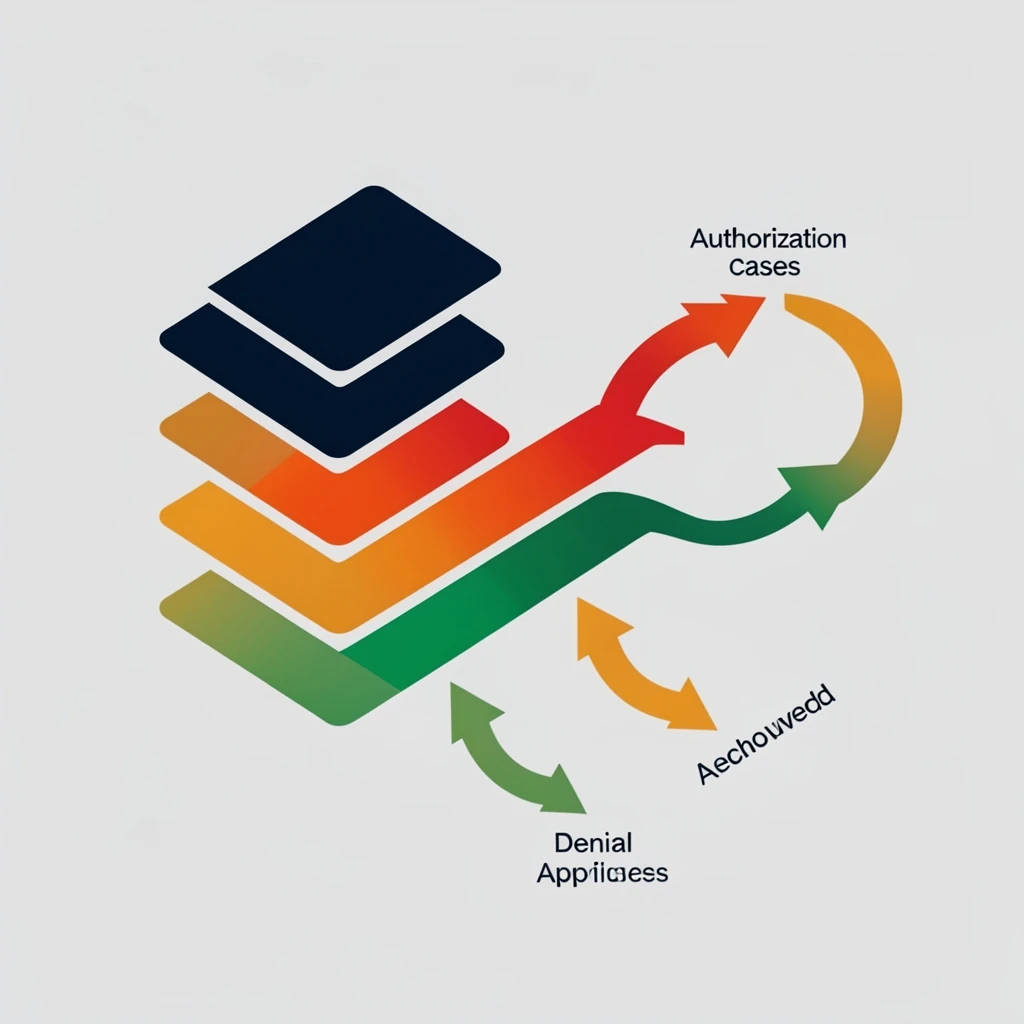
One of the most costly stages of the prior authorization process is managing denials. Industry data consistently shows that a significant percentage of prior authorization denials are overturned on appeal, which means the initial denial was often a process failure, not a clinical one. The case was submitted without the right documentation, or the clinical narrative did not align with the payer’s specific criteria language.
Datafi addresses this at two points. Before submission, the platform applies denial risk scoring to each request, using the payer’s historical denial patterns and the specific criteria language to assess whether the case as assembled is likely to be approved. If the risk score is elevated, the platform identifies the most probable reason for denial and recommends specific actions to strengthen the submission before it is sent.
After a denial, the platform does not start from scratch. It analyzes the denial reason code, cross-references it against the patient record and the payer’s criteria, and generates a structured appeals response that directly addresses the stated reason for denial. Appeals that previously required a senior clinical staff member to draft over the course of an hour can be produced in minutes, with the same quality of clinical grounding.
Governance, Compliance, and Auditability
Healthcare organizations operate under strict regulatory requirements governing data access, patient privacy, and clinical documentation. Any AI system deployed in a prior authorization workflow must be able to demonstrate that it is operating within those boundaries, not just assert it.
Datafi was built for governed environments. Every data access event is logged. Every AI-generated recommendation is traceable to the source data that informed it. Every action taken within the platform can be reviewed by a compliance officer, a payer auditor, or a quality assurance team. The platform supports role-based access controls that ensure staff members can only access patient data within their authorized scope, and it generates the audit trails required to demonstrate compliance during an audit.
For organizations operating under HIPAA, this is not a checkbox. It is a foundation. The Datafi platform treats compliance as a structural property of the system, not a feature layered on top.
The Outcome: A New Operational Baseline
Healthcare organizations that deploy Datafi for prior authorization are not simply automating a manual process. They are establishing a new operational baseline for what the process can be.
Authorization cycle times that previously measured in days compress to hours. Staff who spent the majority of their time on administrative assembly shift toward higher-value tasks: managing clinical escalations, building payer relationships, and handling the complex edge cases that genuinely require human judgment. Denial rates fall because submissions are more complete and more precisely aligned with payer criteria. Appeal success rates improve because responses are faster, more detailed, and better grounded in clinical evidence.
The financial impact is direct and measurable. Faster authorizations mean faster treatment initiation and faster claims submission. Lower denial rates mean less revenue held in appeals queues. Reduced administrative overhead means lower cost per authorization, which compounds significantly across a high-volume authorization operation.
When the administrative friction around prior authorization decreases, care happens faster. Patients begin treatment sooner. Physicians spend less time managing paperwork and more time practicing medicine. The system moves closer to what it is supposed to be.
Prior Authorization as a Proof of Concept for the Broader Problem
Prior authorization is a specific use case, but it is illustrative of a broader pattern that exists across healthcare operations and across every data-intensive industry. The pattern is this: critical processes are slowed, degraded, or made unnecessarily expensive because the information required to execute them is fragmented across systems that were never designed to work together, and the humans caught in the middle are forced to manually bridge the gap.
Every organization that has lived through that pattern has also asked some version of the same question: can AI fix this? The honest answer is that most AI deployments, as currently configured, cannot. They are tools built to answer questions within a limited context. They do not have access to the full data environment in which the question is being asked, and they do not have the agentic capacity to execute the multi-step workflows that turning an answer into an outcome requires.
Datafi was built to close that gap. The prior authorization use case demonstrates what becomes possible when an AI platform has genuine access to all relevant data, operates with agentic capability across that data, and is governed in a way that meets the compliance requirements of a regulated industry.
The question is not whether AI can accelerate prior authorization. In the Datafi platform, it already does. The question is what your organization will do differently once it no longer has to accept the process as it is.
Datafi is an applied AI platform for governed, agentic data experiences. To explore how Datafi can transform prior authorization and other high-friction workflows in your organization, speak with a member of our team.