


A Datafi Potential Success Story
SoFi Technologies has done what many said was impossible. In little more than a decade, it grew from a Stanford startup refinancing student loans into a nationally chartered digital bank serving nearly 14 million members across an integrated suite of financial products: lending, banking, investing, insurance, and payments. With $3.61 billion in 2025 revenue, nine consecutive quarters of GAAP profitability, and a technology platform that powers over 128 million accounts for other fintechs and banks, SoFi is not a fintech insurgent anymore. It is a full-stack financial institution competing at scale against some of the most established names in the industry.
And yet, for all of this momentum, SoFi faces a version of a problem that every fast-scaling financial institution eventually confronts: the complexity of its own data ecosystem has outpaced the capacity of its people and its tools to act on it. Its three business segments, Lending, Financial Services, and Technology Platform, each generate enormous volumes of data across credit performance, member behavior, transaction activity, deposit flows, platform API usage, fraud signals, and market dynamics. The challenge is not a shortage of data. The challenge is closing the gap between data and decisions, at speed and at scale, across every function in the organization.
This is the challenge Datafi was built to solve.
The defining challenge for fast-scaling financial institutions like SoFi is not a shortage of data, it is closing the gap between data and decisions at speed and scale across every function. An AI operating system with governed, contextual access to the full data ecosystem is what makes that possible.
From Answering Questions to Solving Problems
The first wave of enterprise AI delivered tools that could search, summarize, and respond. What it could not do was act. These tools were built to answer questions, and in answering questions they created a new category of bottleneck: highly capable AI sitting behind a query interface, waiting to be asked, unable to take initiative, unable to hold institutional context from one session to the next, unable to coordinate across the data ecosystem that defines how the business actually operates.
For a company like SoFi, where competitive advantage depends on the speed of insight-to-action across lending decisions, member personalization, risk management, and platform innovation, that limitation is not a minor inconvenience. It is a ceiling on the business.
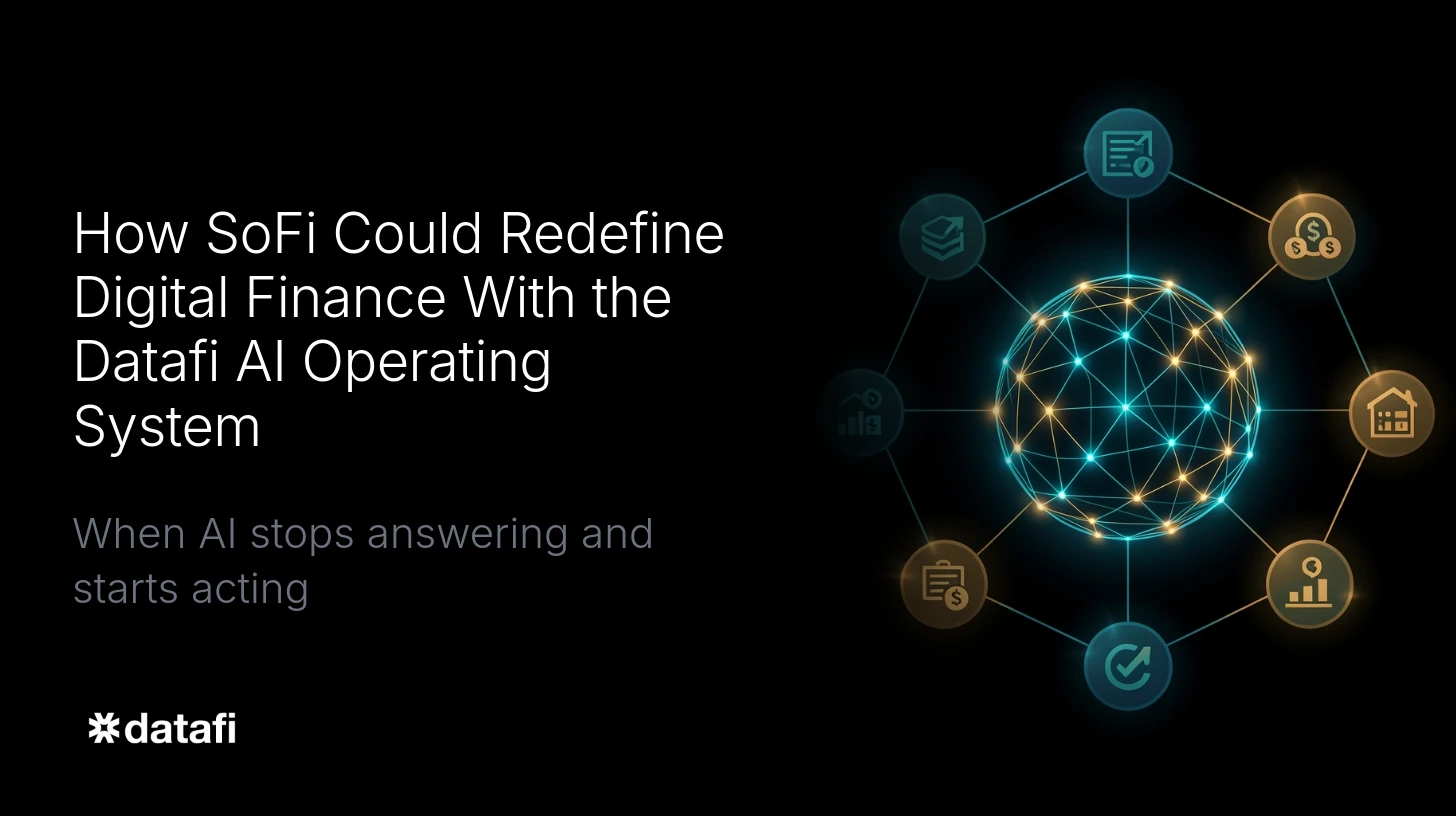
Datafi’s Business AI Operating System was designed to remove that ceiling. The platform is built on a vertically integrated data and AI technology stack that unifies an organization’s data ecosystem, governance policies, and AI orchestration layer into a single operating environment. This is not middleware layered on top of disconnected systems. It is an integrated architecture that gives AI agents the full business context they need to reason, decide, and act autonomously, across every department, every function, and every level of the organization.
At the center of that architecture is a Chat UI built for non-technical users. Because transformative AI outcomes cannot depend on an organization’s willingness to write queries or manage dashboards. When every employee, from a loan operations analyst to a compliance officer to a product manager, can engage a contextually aware AI agent in plain language and receive not just an answer but an action, the economics of the business begin to shift in fundamental ways.
Intelligent Loan Underwriting and Credit Risk Management
SoFi’s lending segment remains its largest revenue driver, with personal loan originations reaching $7.5 billion in a single quarter in 2025. At that volume, the difference between a credit model that is merely good and one that is continuously learning and self-optimizing is measured in hundreds of millions of dollars of risk-adjusted yield.
Today, credit risk teams operate in a cycle of model development, validation, deployment, and monitoring that can take weeks to months. Datafi collapses that cycle. By giving AI agents continuous access to the complete data ecosystem, including application data, bureau signals, behavioral indicators from SoFi Money and SoFi Invest accounts, macroeconomic indicators, and portfolio performance data, the Datafi platform enables autonomous credit workflows that learn from outcomes in near real-time.
The practical impact is significant. A financial institution operating loan origination workflows at SoFi’s scale could expect a reduction in early delinquency rates of 10 to 15 percent through tighter pre-approval targeting. Automated exception handling and document verification in the underwriting process, currently managed by large operations teams, could be reduced by 30 to 40 percent through agentic workflow automation. Applied to SoFi’s annualized origination volume of approximately $35 billion, even conservative efficiency gains in underwriting operations translate to $80 to $120 million in annual cost reduction, while improving credit quality simultaneously.
Accelerating the Financial Services Productivity Loop
SoFi’s most powerful competitive asset is what it calls the Financial Services Productivity Loop: the idea that each product a member adopts increases engagement and reduces churn, which lowers acquisition costs and increases lifetime value. Forty percent of SoFi’s new products in Q3 2025 were adopted by existing members. That number represents an enormous opportunity, and an equally enormous challenge: how do you identify the right moment to offer the right product to the right member, at scale, across 13.7 million relationships?
Today’s approach relies on segmentation models, campaign logic, and marketing automation tools that operate on historical data with a lag. Datafi replaces that approach with autonomous member intelligence agents that monitor behavioral signals continuously, draw on the full context of a member’s financial life across all SoFi products, and initiate personalized engagement at the moment of maximum relevance, without waiting for a human to approve a campaign brief.
Consider what this means for the SoFi Relay and Cash Coach products. Both are built on the insight that members who receive proactive, personalized financial guidance are more engaged and more likely to consolidate their financial life within SoFi. With Datafi agents reasoning continuously across deposit balances, spending patterns, credit utilization, investment activity, and life-stage signals, the quality and timing of those recommendations improve by an order of magnitude. Industry benchmarks suggest that AI-driven personalization at this level of contextual depth can improve cross-sell conversion rates by 20 to 35 percent.
Applied to SoFi’s current member base and product adoption trajectory, an improvement in cross-sell conversion of even 15 percent could generate an additional $400 to $600 million in annual revenue from incremental product adoption, without acquiring a single new member.
Autonomous Compliance, Fraud Detection, and Risk Operations
Financial services is the most regulated industry in the world, and SoFi operates under the scrutiny that comes with a national bank charter. Compliance costs for institutions at this scale typically run into the hundreds of millions annually when you account for staffing, legal, audit, model validation, and regulatory reporting. At the same time, fraud losses in digital banking are accelerating as attack vectors grow more sophisticated.
Datafi agents embedded in compliance and fraud workflows do not simply flag anomalies for human review. They reason across the full transaction history, counterparty network, behavioral baseline, and regulatory context of every account, in real time, and take action: blocking suspicious transactions, escalating to the appropriate human authority, generating regulatory documentation, and updating risk models, all within a governed, auditable framework.
SoFi’s Galileo subsidiary has already begun developing AI-driven fraud detection capabilities for sale as a standalone SaaS product to other financial institutions. Datafi’s platform would accelerate that development substantially by providing the contextual layer that makes fraud models genuinely predictive rather than reactive. The economic benefit is dual: reduced internal fraud losses, which industry data suggests could be 20 to 30 percent lower with autonomous AI monitoring, and an enhanced product offering for Galileo’s enterprise customers, potentially adding $50 to $100 million in incremental Technology Platform revenue over three years.
On the compliance side, automating regulatory reporting workflows, BSA/AML monitoring, and audit preparation could reduce compliance operations headcount requirements by 25 to 35 percent, representing $30 to $50 million in annual savings for an institution of SoFi’s size and complexity.
Unified Operational Intelligence for 5,000 Employees
One of the most underestimated benefits of the Datafi AI Operating System is what it does for the employees who are not data scientists or engineers. SoFi has approximately 5,000 employees operating across lending, banking, investing, technology, compliance, marketing, and customer experience. Every one of those employees makes decisions every day that depend on data, and most of them spend significant time searching for it, waiting for it, or working around the fact that it lives in a system they cannot easily access.
Datafi’s Chat UI democratizes that access. A product manager can ask an autonomous agent to analyze the conversion funnel for a new credit card feature and receive a synthesized, actionable response in minutes rather than submitting a data request and waiting days. A customer experience lead can ask why member satisfaction scores declined in a specific cohort and receive a root-cause analysis that spans product, operations, and support data simultaneously. A treasury analyst can ask for a scenario model on deposit repricing and receive one that already incorporates the latest macroeconomic signals.
The productivity impact of this kind of universal data access is substantial. Research consistently shows that knowledge workers spend 20 to 30 percent of their time searching for information or waiting on analytical support. Even a 50 percent reduction in that friction, applied to SoFi’s workforce, translates to the equivalent of 500 to 750 additional full-time employees of productive capacity, without adding a single headcount. At average fully-loaded compensation costs, that represents $75 to $120 million in recovered productive value annually.
Powering the Technology Platform With a Contextual AI Layer
SoFi’s Technology Platform, built on the Galileo and Technisys acquisitions, is the infrastructure that powers digital banking for fintechs and financial institutions globally. It is a significant and growing revenue stream, generating over $114 million in a single quarter in 2025. And it represents a strategic asset that Datafi could transform into something considerably more powerful.
The financial institutions that rely on Galileo and Technisys need exactly what Datafi provides: a way to activate their data ecosystems for AI-driven workflows, member intelligence, and autonomous operations, without the years of engineering investment required to build those capabilities independently. By integrating Datafi’s AI Operating System into the Technology Platform stack, SoFi could offer its enterprise clients a turnkey path to autonomous AI operations, creating a category-defining product that is not available anywhere else in the market.
This is the kind of strategic leverage that transforms a technology platform from infrastructure into competitive moat. The addressable revenue opportunity in the enterprise AI platform market is enormous, and SoFi is already inside the walls of hundreds of financial institutions that will need exactly this capability.
The Contextual Layer That Makes It All Possible
None of these outcomes are achievable with AI that only answers questions. The loan origination agent that reduces delinquency needs to understand credit policy, portfolio targets, macroeconomic context, and member history simultaneously. The member personalization agent that drives cross-sell needs to reason across every product interaction a member has had and every life event that might make a new product relevant. The compliance agent that reduces regulatory risk needs to know not just what happened in a transaction, but why, and what the regulatory framework says about it.
This is why Datafi’s architecture begins with the contextual layer. LLMs are extraordinarily capable reasoning engines, but they are only as effective as the context they have access to. A model that knows financial theory but does not know SoFi’s credit policies, SoFi’s member base characteristics, SoFi’s current portfolio composition, and SoFi’s regulatory obligations is an expensive search engine. A model embedded in Datafi’s vertically integrated stack, with governed access to the complete data ecosystem, is something categorically different: an autonomous agent that can solve hard problems the same way your best analyst would, except continuously, at scale, and without fatigue.
A model embedded in Datafi’s vertically integrated stack, with governed access to the complete data ecosystem, is something categorically different: an autonomous agent that can solve hard problems the same way your best analyst would, except continuously, at scale, and without fatigue.
A Transformed Enterprise
SoFi built its competitive position on a simple premise: that digital-first, integrated financial services could outperform the branch-based incumbents by delivering better products, faster, at lower cost, to members who deserve more from their financial institution. That premise has proven itself. SoFi is profitable, growing, and increasingly diversified.
The next phase of that story belongs to AI, not AI as a feature or a marketing claim, but AI as an operating system that runs across the entire enterprise, solving problems autonomously, learning continuously, and delivering economic outcomes that compound over time.
Datafi is that operating system. For a company like SoFi, the combination of a vertically integrated data and AI stack, governed access to the complete data ecosystem, and a Chat UI that empowers every employee to participate in data-driven decisions represents a genuine step change. Not an incremental improvement in efficiency, but a structural transformation in how the business operates and what it is capable of becoming.
The financial services industry is about to find out what it means to have AI that does not just answer questions. SoFi has the data, the technology infrastructure, and the strategic ambition to lead that discovery.
Datafi is ready to help make it happen.
Datafi’s Business AI Operating System is purpose-built to give enterprises the vertically integrated data and AI infrastructure required for autonomous, transformative AI outcomes. Learn more at datafi.com.