


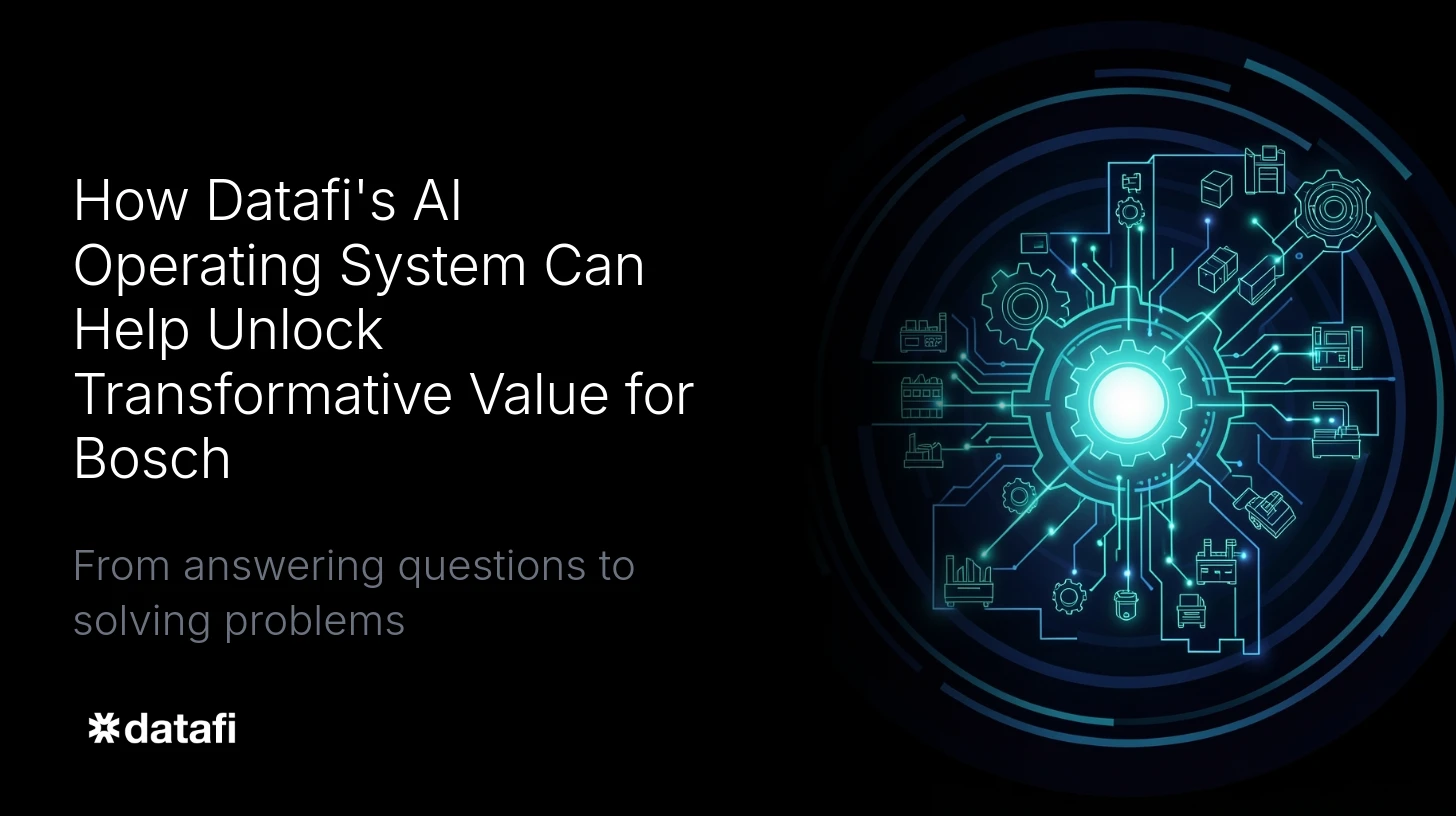
How Datafi’s AI Operating System Can Help Unlock Transformative Value for Bosch
What happens when a global technology leader stops using AI to answer questions and starts using it to solve problems? For Bosch, the answer could reshape over $90 billion in annual operations.
Bosch is not a company standing still. With nearly 418,000 associates across more than 450 locations in over 60 countries, four major business sectors, and a declared investment of more than $2.7 billion in AI through 2027, the company has made its strategic ambitions unmistakably clear. AI is not a side project at Bosch. It is a declared growth driver, a competitive differentiator, and a mechanism for transformation at a scale few organizations on earth are equipped to pursue.
And yet, even Bosch faces the same fundamental constraint that limits every organization attempting AI-led transformation: the gap between what AI promises and what it actually delivers when it cannot see the full business context.
That gap is exactly what the Datafi AI Operating System is built to close.
AI tools constrained to isolated workflows and fragmented data will always be limited to answering questions. Transformative enterprise value only unlocks when AI has access to the full business context, including every data domain, governance layer, and operational workflow across the organization.
The Problem No Point Solution Can Solve
Bosch’s complexity is not a weakness. It is a competitive moat built over 138 years of engineering excellence. But that same complexity creates a data challenge that point-solution AI tools are simply not designed to handle.
Consider what it means to operate at Bosch’s scale. The Mobility sector, which accounts for 61 percent of global revenues, manages vehicle components and systems across dozens of product lines serving hundreds of OEM customers. The Industrial Technology division runs manufacturing automation across global facilities. Consumer Goods and Energy and Building Technology each carry their own supply chains, regulatory environments, commercial workflows, and operational rhythms. Every one of these sectors generates data at extraordinary volume, in different systems, under different governance models, and in service of different business outcomes.
First-wave AI tools were designed to answer questions in this environment. They were bolted onto existing data infrastructure, deployed in isolated workflows, and handed to specific user groups who already knew how to work with data. The results were predictable: impressive demos, limited enterprise impact, and a growing suspicion among executive teams that AI adoption had stalled somewhere short of transformation.
The reason is not the AI. The reason is the architecture. LLMs and AI agents operating without full business context, without access to the complete data ecosystem, and without the governance frameworks that allow them to act autonomously will always be constrained to answering questions. They cannot solve problems they cannot fully see.
Datafi was built on the conviction that this is the defining challenge of enterprise AI. And solving it requires a vertically integrated data and AI technology stack that gives AI access to the entire business, not just the parts that have already been cleaned up and curated for a dashboard.
What Datafi Brings to Bosch
The Datafi AI Operating System creates a unified data experience and workflow intelligence layer across the enterprise. It integrates with the existing data ecosystem, establishes policies and governance controls appropriate to the organization, and delivers a Chat UI designed for every employee, not just the technical ones. For an organization like Bosch, where operational intelligence is distributed across plant floors, finance teams, R&D centers, and commercial organizations, this is not a marginal improvement. It is a structural shift in how the enterprise uses information.
The architecture matters because the use cases Bosch is already pursuing demand it. Bosch has been working with multi-agent systems to monitor devices in manufacturing, predict maintenance requirements, and optimize personnel scheduling. These are exactly the kinds of critical thinking and workflow automation roles where AI can deliver transformative outcomes, but only if the agents operating in those roles have access to the full operational context: asset history, production schedules, supplier lead times, workforce availability, cost structures, and real-time sensor data unified into a single coherent picture.
Datafi’s vertically integrated stack creates that picture. It is not an aggregator of dashboards. It is an operating system for AI, one that allows agents and workflows to learn continuously, act autonomously, and develop the contextual layer required to solve hard business problems rather than surface the data that describes them.
Five Domains of Measurable Impact
1. Predictive Maintenance and Asset Management
Bosch’s early implementations of AI-driven predictive maintenance have already demonstrated maintenance cost reductions of up to 25 percent and downtime reductions approaching 30 percent across select manufacturing facilities. These results were achieved with first-generation AI tools operating on streams of sensor data. They represent a genuine achievement and a clear signal that the ceiling has not yet been reached.
With Datafi, predictive maintenance moves from a monitored sensor feed to a fully autonomous operational intelligence layer. AI agents with access to asset history, spare parts inventory, supplier relationships, production scheduling, and workforce data can move beyond predicting failures to orchestrating the full response: sourcing parts, scheduling technicians, adjusting production loads, and updating financial forecasts, all before a machine stops running.
Applied across Bosch’s more than 450 global locations, a 30 percent reduction in unplanned downtime and a further 15 to 20 percent reduction in total maintenance costs represents hundreds of millions of euros in recoverable value annually. For a company managing tens of billions in capital-intensive manufacturing assets, the compounding effect on asset longevity and capital expenditure reduction alone justifies the investment.
2. Operations Optimization
Bosch’s manufacturing operations span automotive components, semiconductors, consumer appliances, building technology, and industrial automation equipment. Each of these production environments runs on a combination of process parameters, quality controls, supply inputs, and labor resources that interact in ways no static model can fully capture.
AI agents operating through Datafi’s operating system can analyze production data holistically, identifying optimization opportunities across the full parameter space in real time. Industry evidence consistently shows that AI-optimized manufacturing processes can reduce scrap rates by up to 60 percent and cut production losses by up to 30 percent. At Bosch’s scale, a 10 percent improvement in operational efficiency across the Industrial Technology and Mobility sectors alone would represent billions of euros in recovered margin.
More importantly, Datafi enables this intelligence to flow to the people who need it, at every level of the organization, through a Chat UI that requires no technical expertise to operate. A plant supervisor in Bangalore, a production manager in Stuttgart, and a supply chain analyst in Detroit can each access the same AI-driven operational intelligence in language they understand, framed in the context of the decisions they are responsible for.
3. Supply Chain and Demand Intelligence
Bosch operates one of the most complex supply chains in global industry. With 490 subsidiaries and regional companies across 60 countries and a supplier base spanning thousands of relationships, supply chain disruptions represent a material financial risk. The 2024 annual report reflected the pressure these dynamics create: Mobility revenues declined 4.9 percent as market conditions shifted faster than traditional planning models could accommodate.
Datafi’s AI Operating System enables supply chain intelligence that is continuous, contextual, and autonomous. AI agents can monitor supplier signals, logistics data, demand trends, geopolitical indicators, and internal inventory positions simultaneously, surfacing risks and opportunities before they become disruptions. Scenario modeling that previously required days of analyst work becomes a real-time capability available to every decision maker in the supply chain organization.
For a company generating over 90 billion euros in annual revenue, even a 1 to 2 percent improvement in supply chain efficiency translates to 900 million to 1.8 billion euros in recovered value. Applied to working capital management, sourcing optimization, and demand-responsive production scheduling, the compounding impact is substantially larger.
4. Strategic Planning and Executive Intelligence
Bosch’s leadership team is managing a company in active strategic transition: accelerating electrification, expanding software-defined mobility capabilities, investing in semiconductor manufacturing, and repositioning multiple business units in response to shifting market conditions. These decisions require a quality of analytical depth and cross-domain synthesis that no executive team can sustain through traditional reporting cycles.
Datafi’s AI Operating System creates a strategic intelligence layer that gives Bosch leadership continuous access to the full context of the business. Rather than receiving periodic reports assembled by analyst teams working from fragmented data sources, executives can engage directly with AI agents that understand the company’s strategic objectives, financial position, operational performance, market dynamics, and competitive landscape as a unified whole.
This is not a search engine for business data. It is an autonomous thinking partner that can run scenario analyses, identify second-order consequences of strategic decisions, and surface the implications that would otherwise remain buried in the noise of organizational complexity. The value here is not easily captured in a single line item, but organizations that make better strategic decisions faster compound that advantage across every dimension of performance.
5. Workforce Productivity and Knowledge Amplification
Bosch employs approximately 87,000 associates in research and development alone, across 136 locations globally. The organization’s collective expertise in sensor technology, software, automotive systems, industrial automation, and consumer technology represents an extraordinary knowledge asset. But knowledge assets only generate value when they are accessible to the people who need them, at the moment they need them.
Datafi’s Chat UI gives every Bosch associate, regardless of technical background, direct access to the organization’s data ecosystem and the AI intelligence built on top of it. An engineer troubleshooting a production issue can access maintenance records, quality data, supplier specifications, and engineering documentation through a single conversational interface. A commercial team member preparing a customer proposal can surface competitive positioning, pricing history, and product performance data in seconds rather than days.
The productivity impact of this kind of universal data access is consistently underestimated in AI planning exercises. Research consistently shows that knowledge workers spend 20 to 30 percent of their time searching for information. For a workforce of 418,000 associates, recovering even a fraction of that time through intelligent, contextual information access represents billions of euros in productive capacity.
The Architecture That Makes It Real
What separates Datafi from the fragmented point solutions Bosch and organizations like it have been deploying is the vertical integration of the technology stack. Data connectivity, governance, AI models, agent frameworks, and user experience are not assembled from separate vendor relationships. They are designed to work together as a single operating system, with the organizational context, policies, and controls embedded throughout.
This matters for Bosch specifically because the company’s data environment is not a clean slate. It is a living, distributed, and deeply heterogeneous ecosystem built across decades of acquisitions, organic growth, and regional variation. Datafi does not require that ecosystem to be rationalized before AI can be deployed at scale. It integrates with the data ecosystem as it exists, applies governance appropriate to the business, and gives AI the full context it needs to act autonomously and responsibly.
LLMs operating in this environment are not just answering questions about what happened. They are solving problems: coordinating maintenance responses, optimizing production schedules, flagging supply chain risks, synthesizing strategic options, and accelerating the decisions that drive business outcomes.
The Opportunity in Front of Bosch
Bosch has already made the commitment. The investment is declared, the ambition is clear, and the early results in predictive maintenance and agentic manufacturing confirm that the potential is real. The question is not whether AI will transform Bosch’s operations. It is whether the architecture supporting that transformation is capable of delivering outcomes at enterprise scale.
Point solutions will continue to produce point results. They will answer questions in the corners of the business where the data is already structured and the use cases are already defined. They will not close the gap between AI’s potential and the transformation that Bosch’s leadership, its associates, and its shareholders are counting on.
The Datafi AI Operating System was built for exactly this moment, and exactly this scale. When AI has access to the full context of the business, the complete data ecosystem, and the governance frameworks that allow it to operate autonomously across the enterprise, it stops answering questions and starts solving problems.
For Bosch, the economic outcomes of that shift are not incremental. They are transformative.
Datafi is the Business AI Operating System for the modern enterprise. Built on a vertically integrated data and AI technology stack, Datafi gives every employee unified data access and gives AI agents the full business context required to work autonomously, learn continuously, and solve the problems that drive competitive advantage.