


There is a story enterprises tell themselves before they begin an AI initiative. It goes something like this: once we clean the data, once we consolidate the warehouses, once we resolve the governance issues, once we build the unified catalog, then we will be ready for AI. This story has delayed meaningful AI adoption in more organizations than any technology limitation ever has. And it is, at its core, a myth.
The belief that AI readiness is primarily a data hygiene problem misunderstands what modern AI systems actually require to deliver transformative value. Clean, well-catalogued data sitting in a governed repository is not an AI strategy. It is an infrastructure milestone. The gap between that milestone and AI that genuinely solves hard business problems is where most enterprises remain stuck today, investing in preparation without ever arriving at impact.
The binding constraints on enterprise AI are not data quality, but access, context, and architecture. Enterprises that build a rich contextual layer across their full data ecosystem, with native governance, will move from AI evaluation to genuine business transformation.
What follows is a frank assessment of where enterprise AI actually stands, what it genuinely requires to move beyond question-answering into problem-solving, and why the architecture of the system matters as much as the quality of the data within it.
The Myth That Froze Enterprise AI
The perfect-data myth did not emerge from nowhere. It was a logical extension of the discipline that preceded AI: business intelligence. In the BI era, the quality of an insight was directly bounded by the quality of the underlying data. Garbage in, garbage out. That principle shaped decades of data engineering culture, producing a belief that the data layer must be pristine before anything useful can sit on top of it.
AI changes the calculus fundamentally, and in two directions at once.
First, large language models are remarkably capable of reasoning across imperfect, heterogeneous, and incomplete data, provided they have the context to do so. They can synthesize signals across datasets that would never be formally joined in a warehouse schema. They can surface patterns in unstructured content alongside structured records. They can hold ambiguity rather than rejecting it, which is exactly what complex business problems require. Waiting for perfect data before deploying these capabilities means leaving the most powerful tool in the history of enterprise computing idle while competitors move.
Second, and more importantly, the kind of insight that matters most in business is rarely clean. Executive decisions are made with incomplete information, competing signals, and meaningful uncertainty. Customer behavior is noisy. Supply chains are disrupted. Workforce dynamics are contextual and often qualitative. An AI system designed only to operate on pristine data is an AI system designed for a world that does not exist.
The organizations making the most meaningful progress with AI are not the ones with the cleanest data estates. They are the ones that gave AI access to the broadest, most contextually rich view of the business, and then built the governance layer that made that access safe.
What Enterprises Actually Need from AI

Enterprises do not fundamentally need AI that answers questions faster. They have search engines for that. What they need is AI that reduces the cognitive burden on skilled workers, automates complex analytical workflows, surfaces risks before they become losses, and compounds institutional knowledge rather than letting it walk out the door.
That is a different design target entirely.
Consider what it takes to support predictive maintenance at an industrial scale. The AI system needs access to sensor telemetry, maintenance history, parts inventory, supplier lead times, production schedules, and the experiential knowledge embedded in work orders written by engineers over decades. No single database contains all of that. No single team owns all of it. And the decision that matters, which assets to prioritize for intervention to prevent an unplanned outage, requires reasoning across all of it simultaneously.
Or consider executive decision intelligence. A chief operating officer preparing for a board review needs a synthesis of financial performance, workforce capacity, customer sentiment, competitive positioning, and forward-looking indicators. That synthesis lives across a dozen systems, three reporting tools, and a constellation of analysts who each own one piece of the picture. Today, that synthesis takes days and still arrives incomplete. An AI system with genuine business context and agentic capacity could produce it continuously, updated in real time, flagging anomalies and surfacing the scenarios that matter most.
The same pattern holds across passenger experience optimization in transportation, operational throughput in manufacturing, attrition risk management in human resources, ESG reporting in finance, and contract obligation tracking in legal. In every case, the value comes not from answering a single well-formed question but from holding the full context of the business and reasoning across it persistently and autonomously.
The Contextual Layer Is the Competitive Asset
One of the clearest insights to emerge from working closely with enterprise AI deployments is that the contextual layer, meaning the accumulated, structured understanding of how a specific business works, is the most durable competitive asset in an AI-powered organization.
Raw LLM capability is commoditizing rapidly. What does not commoditize is the depth of business context that an AI system has internalized about a specific organization: its customers, its products, its workflows, its risk tolerances, its historical decisions, and the reasoning behind them.
Building that contextual layer requires more than indexing documents and connecting a chatbot to a data warehouse. It requires an architecture that gives AI persistent access to the complete data ecosystem, not just the clean parts. It requires the ability to learn from interactions over time, not just retrieve on demand. It requires governance controls that make it safe to give AI that level of access, without exposing sensitive information to unauthorized users or creating audit liability.
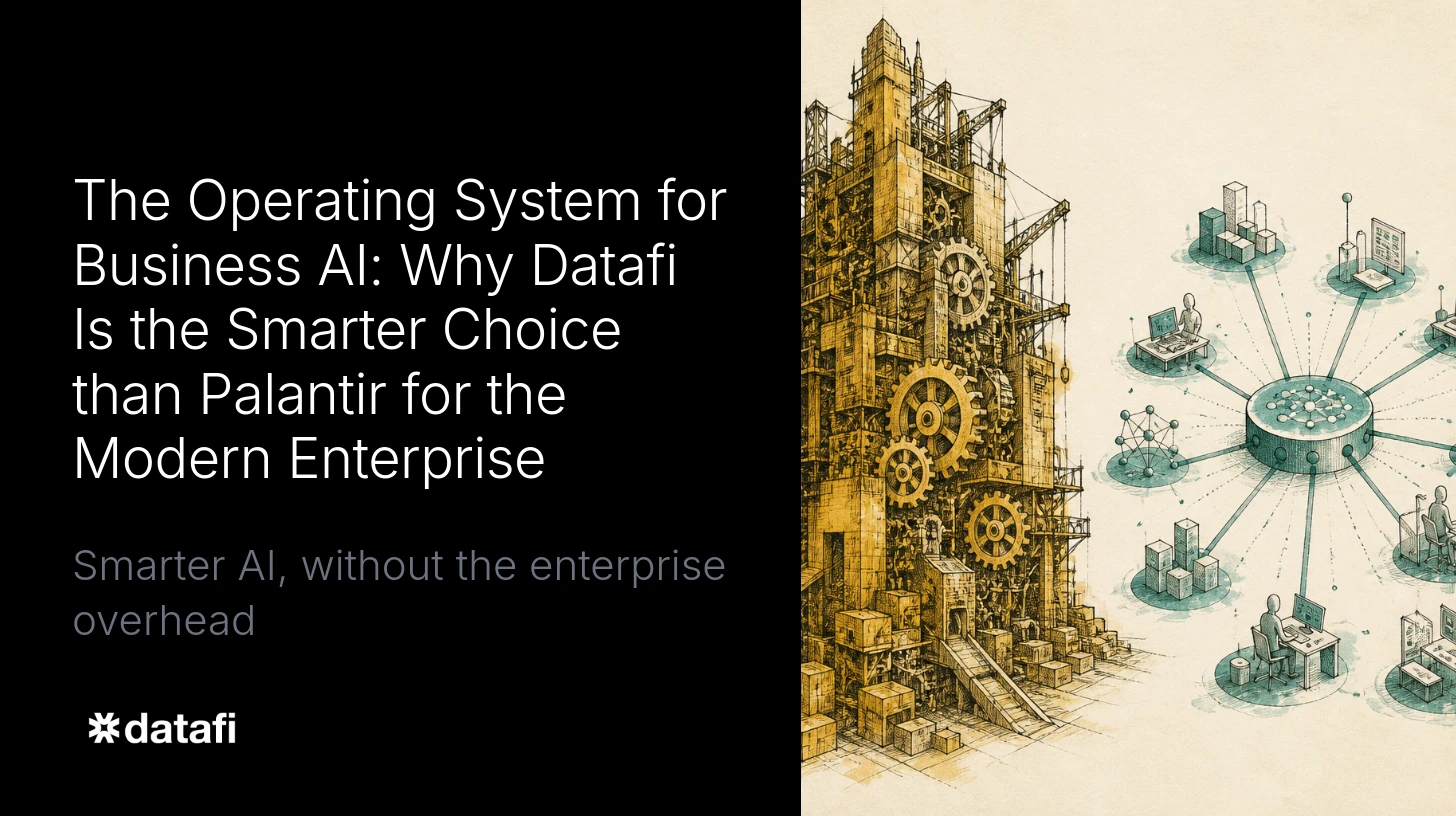
This is precisely why the vertically integrated approach to AI infrastructure matters so much. A point solution that provides AI access to one system, or one data type, or one department, is not building a contextual layer. It is building a local optimization. The contextual layer only emerges when the AI system can reason across the full scope of the business, and that requires a stack designed from the ground up to provide that scope safely.
The Architecture That Makes It Real

The Datafi operating system for AI was built on a foundational premise: LLMs need to know the full context of the business, access the complete data ecosystem, and function in fully autonomous roles to learn from and solve hard business problems.
That premise has three concrete implications for how the system must be designed.
The first is data ecosystem access. This means connecting to structured databases, cloud warehouses, data lakes, document repositories, APIs, and real-time streams, not through brittle point integrations but through a unified access layer that presents the full enterprise data environment to the AI as a coherent whole. When an agent working on a supply chain optimization problem needs to cross-reference purchase order history with real-time logistics tracking and supplier financial stability scores, that cross-referencing should be seamless, not a custom engineering project.
The second is policy and governance as a native layer, not an afterthought. Broad data access without governance is not a product. It is a liability. The governance layer in an enterprise AI operating system must be fine-grained enough to enforce role-based access at the field level, dynamic enough to respond to changing compliance requirements, and transparent enough to satisfy audit requirements. Governance cannot be bolted on after the fact without creating seams that limit either access or safety. In Datafi, policy and control are architectural primitives, not configuration overlays.
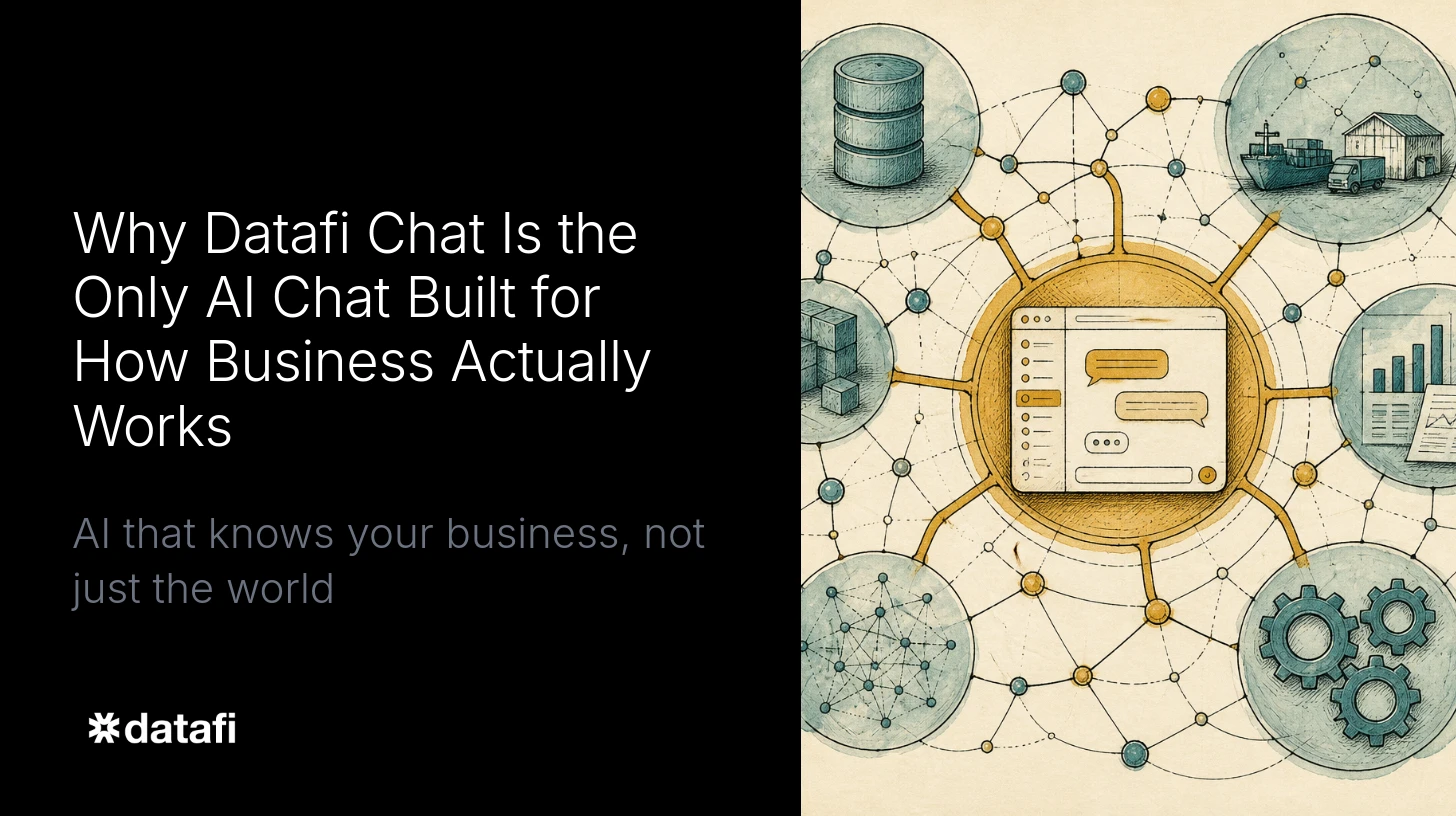
The third is a Chat UI designed for non-technical users. The vast majority of enterprise employees who would benefit most from AI are not data scientists or prompt engineers. They are analysts, operations managers, HR business partners, financial planners, and customer success teams. If the interface to AI requires technical fluency, the value is captured by a small subset of the organization. The whole promise of AI as a broadly applicable workforce multiplier requires an interface that translates natural language into precise, governed, contextually aware AI action, without requiring the user to understand what is happening underneath.
From Automation to Autonomy
The near-term benefit of enterprise AI is workflow automation: taking processes that currently require human orchestration and delegating them to AI agents that can execute reliably and at scale. Predictive maintenance alerts, financial close checklists, regulatory reporting, candidate screening, and customer escalation routing all fit this model. The AI is doing something humans currently do, faster and with less variability.
But the more significant horizon is autonomy: AI agents that are not just executing defined workflows but actively learning, forming hypotheses, designing experiments, and improving outcomes over time. This is where AI transitions from a cost-efficiency tool to a genuine source of strategic differentiation.
Achieving that transition requires building the contextual layer now, even before the autonomous agents are ready to use it. The organizations that will lead in autonomous AI are not the ones that will start building context when agents become available. They are the ones building it today, through every interaction, every workflow, every integrated data source, so that when fully autonomous agents are deployed, they inherit a rich, validated understanding of the business rather than starting from zero.
This is why the Datafi architecture is designed not just for today’s agentic use cases but for the trajectory that enterprise AI is clearly on. The data ecosystem access, policy controls, and interaction history that power a Chat UI today become the training ground and memory substrate for autonomous agents tomorrow.
The Unified Experience Is the Strategy
Organizations of any size can achieve something that has historically been reserved for companies with large, well-resourced data teams: a unified AI experience for every employee that is contextually aware, governed, and capable of driving meaningful workflow outcomes.
This is not about putting a chatbot in front of a database. It is about giving every employee, regardless of technical background, access to the full analytical and operational intelligence of the organization, in a form that accelerates their work and amplifies their judgment.
For the operations manager, that means asking a natural language question about production capacity and receiving not just a number but a synthesized view across equipment status, workforce scheduling, and pending orders, with a recommendation and the reasoning behind it.
For the HR business partner, it means receiving a proactive signal about attrition risk in a specific team, grounded in sentiment data, tenure patterns, compensation benchmarks, and manager effectiveness scores, with enough context to act before the risk becomes a resignation.
For the executive, it means having a continuously maintained strategic intelligence layer that surfaces material changes, flags risks, and presents the decision landscape in real time rather than through a slide deck that is obsolete before it is presented.
That unified experience is not a nice-to-have feature. It is the strategy. The enterprise that gives every employee this capability will make faster, better-informed decisions, execute more consistently, and identify opportunities and risks earlier than competitors who are still waiting for the data to be clean enough.
Moving Past the Myth
The perfect-data myth is understandable. It emerged from a genuine discipline, applied to a genuine problem. But it is a constraint that belongs to a previous era of enterprise computing, one where the analytical tools were rigid enough that data quality was the binding constraint on insight quality.
That era has ended. The binding constraints today are access, context, and architecture. Enterprises that recognize this and invest in building the contextual layer, through a vertically integrated AI operating system with broad data ecosystem access, native governance, and a user experience designed for every employee, will find that AI moves from a capability they are evaluating to a system that is genuinely transforming how work gets done.
The data does not need to be perfect. The architecture does.
Datafi was built for this moment: to take enterprises from the readiness conversation to the outcomes conversation, and to give every employee, at every level, access to an AI that does not just answer questions but solves the problems that matter most.
Datafi is an applied AI software company building a vertically integrated data and AI operating system for the enterprise. To learn how Datafi can accelerate your organization’s AI strategy, contact us or explore our use case library.