


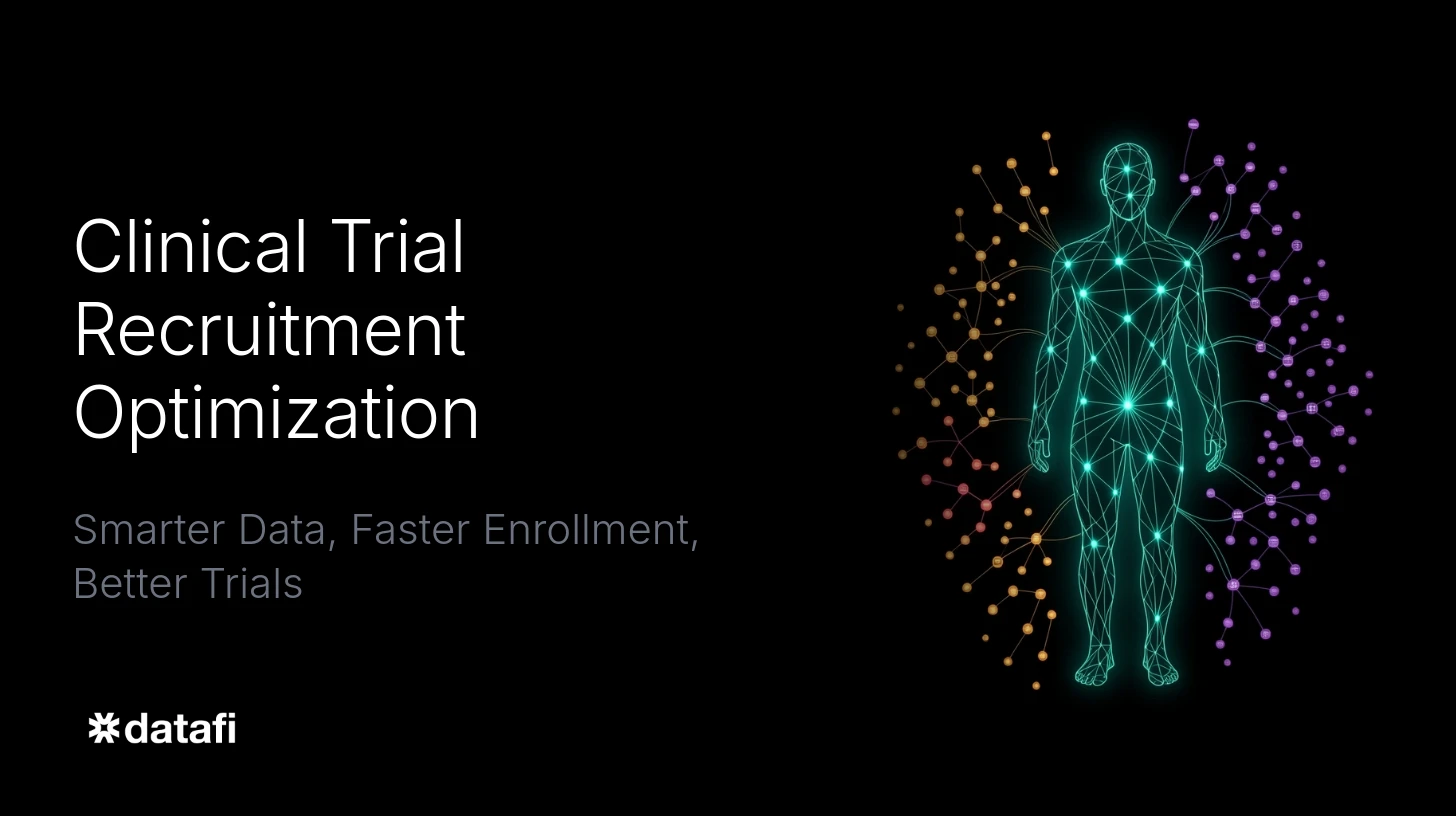
Clinical Trial Recruitment Optimization
The Problem That Has Held Clinical Research Back for Decades
Clinical trials are the engine of medical progress. Every approved therapy, every breakthrough treatment, every life-saving drug started as a trial looking for the right patients. And yet, by most estimates, over 80 percent of clinical trials fail to meet their enrollment deadlines. Nearly a third are abandoned before completion. The bottleneck is rarely the science. It is almost always recruitment.
The consequences are significant. Delayed enrollment extends development timelines by months and sometimes years. Regulatory submissions slip. Costs escalate. Patients who need novel therapies wait longer. And for the sponsors, CROs, and site teams managing these trials, the pressure of under-enrollment becomes a chronic operational problem with no clean solution in sight.
The reason this problem has persisted is not a shortage of potential participants. In most therapeutic areas, the patients exist. The challenge is finding them, qualifying them, and connecting them to the right trial at the right moment. That requires navigating fragmented, siloed data across electronic health records, claims systems, lab databases, patient registries, and site-level records, all while operating under strict regulatory and privacy constraints. It is a data and AI problem at its core. And it is exactly the kind of problem Datafi was built to solve.
Clinical trial enrollment failures are fundamentally a data and AI problem. The patients exist; the challenge is reasoning across fragmented, siloed sources to find, qualify, and connect them to the right trial at the right moment.
Why Conventional Approaches Fall Short
The traditional response to enrollment challenges has been to add more sites, more study coordinators, and more manual effort. These approaches scale cost without scaling insight. A coordinator reviewing patient charts one by one is doing work that consumes hours per screening decision. A site investigator trying to match complex eligibility criteria against a patient population spread across multiple systems is working from incomplete information by default.
Point solutions have emerged to address pieces of this problem. EHR-integrated screening tools can flag potential matches within a single system. Patient recruitment vendors run outreach campaigns. Analytics platforms produce enrollment dashboards. But these tools operate in isolation. They answer questions about individual data assets without synthesizing the full picture. They require data and analytics specialists to operate. And they are disconnected from the operational workflows where coordinators and investigators actually make decisions.
The result is that trial teams are data-rich and insight-poor. They have access to more information about potential participants than ever before, but no practical way to bring it together, reason across it, and act on it in real time.
What Datafi Does Differently

Datafi is a vertically integrated data and AI platform that gives clinical research teams the ability to ask complex questions across all of their data sources and receive answers they can act on, delivered through a governed, compliant interface accessible to anyone on the team, not just data scientists.
The Datafi difference starts with data connectivity. Rather than requiring organizations to consolidate all of their patient data into a single warehouse before AI can be useful, Datafi connects to data where it lives. EHR systems, clinical data management systems, lab information systems, site performance databases, patient registries, and external reference datasets can all be made available as part of a unified data ecosystem. Each source retains its access controls and governance policies. Datafi layers governance and compliance on top, ensuring that data access is role-appropriate, auditable, and aligned with HIPAA, ICH-GCP, and applicable regulatory requirements.
On top of that connected ecosystem, Datafi gives the underlying language models full business context. This is what separates AI that answers questions from AI that solves problems. When a study coordinator asks Datafi to identify patients who may be eligible for a Phase II oncology trial, the platform is not querying a single table and returning a list. It is reasoning across structured clinical data, lab values, prior treatment history, comorbidity profiles, geographic proximity to trial sites, and protocol eligibility criteria simultaneously. The AI has the context it needs to do real analytical work, not just retrieve records.
And because Datafi is built with agentic capacity, the platform does not stop at insight generation. It can initiate workflows, surface eligible patients to the right care teams, track pre-screening conversations, monitor enrollment progress across sites, and flag emerging risks before they become enrollment crises.
The Recruitment Workflow, Transformed
Consider how a clinical operations team running a large multi-site trial experiences the enrollment challenge today versus with Datafi in place.
Without Datafi, identifying potentially eligible patients requires coordinators to run manual chart reviews, query each EHR system separately, and cross-reference against protocol inclusion and exclusion criteria that may span dozens of parameters. A single screening pass across a medium-sized site database can take days. Coordinators spend more time on screening logistics than on patient engagement. Eligible patients who are not active in the healthcare system at the moment of screening are missed entirely.
With Datafi, the study coordinator opens a familiar chat interface and describes what they need. “Show me patients in the oncology program aged 45 to 70 with confirmed EGFR-mutant non-small cell lung cancer, no prior third-generation EGFR inhibitor therapy, and adequate organ function based on lab values in the past 60 days.” Datafi reasons across the connected data ecosystem, applies the protocol criteria, and returns a prioritized list of candidate patients with supporting data, confidence indicators, and flags for any data gaps that require follow-up confirmation.
That same query, which previously required multiple manual steps and multiple days, now takes minutes. The coordinator’s time shifts from data retrieval to patient outreach and relationship building, where human judgment and empathy actually matter.
The coordinator’s time shifts from data retrieval to patient outreach and relationship building, where human judgment and empathy actually matter.
The platform also serves the site principal investigator and the sponsor’s clinical operations team simultaneously. Site performance dashboards are generated through natural language queries rather than manual reporting. Enrollment projections are updated continuously as new data flows in. Bottlenecks at underperforming sites are surfaced automatically, along with the context needed to understand why. Is a site falling behind because the eligible population is smaller than projected? Because screening failure rates are high for a specific exclusion criterion? Because coordinators are stretched across too many competing protocols? Datafi makes the distinction clear, enabling targeted intervention rather than generic pressure to enroll faster.
Diversity and Inclusion as a Data Problem
One of the most significant and underappreciated challenges in clinical trial recruitment is the persistent lack of demographic diversity in study populations. Regulatory guidance from the FDA and other agencies increasingly requires sponsors to actively plan for and demonstrate enrollment across diverse patient populations. But achieving diversity in practice requires identifying and reaching patient groups who are underrepresented in traditional research participation.
This is fundamentally a data access and AI reasoning problem. Datafi’s connected ecosystem approach allows trial teams to look beyond the patients already engaged at research-active academic sites and reason across community health system data, federally qualified health center records, and population health datasets that have historically been excluded from recruitment workflows.
By giving the AI full context about demographic targets, protocol requirements, and community health data sources, Datafi enables coordinators to proactively identify eligible patients in underserved communities, route them to appropriate sites, and track diversity metrics in real time throughout the enrollment period. Diversity goals shift from aspirational reporting targets to operational priorities embedded in the recruitment workflow.
Governing AI in a Regulated Environment

Clinical research is among the most highly regulated operating environments in any industry. Data governance, participant privacy, and audit trail requirements are not optional considerations. They define how every system must behave.
Datafi was designed with this reality as a starting assumption, not an afterthought. Every query executed through the platform is logged and auditable. Data access is governed by role-based controls that ensure coordinators see only the patient populations and data fields appropriate to their site and study assignment. Sponsor oversight teams have visibility into aggregate performance without accessing participant-level data they are not authorized to see. The entire governance model is configurable to match the specific requirements of each trial and each organization.
This means Datafi is not a shadow IT workaround that trial teams use because it is convenient but which compliance teams have concerns about. It is a governed AI experience that compliance and data privacy teams can stand behind, audit, and report on. That distinction matters enormously in an industry where trust in systems is as important as the capability of those systems.
Agentic Recruitment: Moving from Insight to Action
The next frontier in clinical trial recruitment is not just faster screening. It is autonomous, agentic AI that can manage the orchestration of recruitment activities across the full enrollment lifecycle without requiring manual triggering at each step.
Datafi’s agentic capability means the platform can monitor the trial’s eligibility pipeline continuously, alert coordinators when a previously ineligible patient becomes eligible based on new lab values or updated chart information, initiate pre-screening outreach workflows based on configurable triggers, and escalate to site leadership when enrollment trajectories diverge from plan. These are not one-time queries. They are ongoing intelligent processes that run in the background, surface relevant information at the moment it is needed, and take defined actions within the boundaries the organization has established.
This capacity to act, not just inform, is the difference between AI as a reporting layer and AI as a genuine operational contributor. For clinical operations teams managing complex multi-site trials under constant enrollment pressure, this is the capability that changes the economics of clinical research.
The Organizations That Benefit
Clinical trial recruitment optimization with Datafi is relevant across the full spectrum of organizations conducting or supporting clinical research.
Biopharmaceutical sponsors managing their own trial portfolios gain a platform that connects their data ecosystem, accelerates site-level enrollment, and gives their clinical operations teams the real-time visibility needed to make faster, better-informed decisions. CROs providing recruitment services to sponsors gain a competitive advantage through faster, more thorough patient identification and a governed AI capability they can offer as part of their service model. Academic medical centers and health systems operating as trial sites gain a tool that helps their coordinators manage a growing portfolio of active protocols without proportional growth in staffing. Patient advocacy organizations and community health networks gain a pathway to connect underrepresented patient populations with relevant research opportunities in a compliant, respectful way.
The Datafi platform was built on the conviction that unified, intelligent data experiences should not be the exclusive province of the largest and best-resourced organizations. Community oncology practices, regional hospital systems, and specialized CROs all have the same fundamental need as the largest pharma companies: AI that understands their data, their context, and their operational reality well enough to do more than answer questions. AI that actually solves problems.
From Enrollment Crisis to Enrollment Advantage
Clinical trials exist to generate evidence that improves human health. Enrollment failures that delay or kill those trials are not just operational problems. They are a quiet human cost that rarely makes headlines but accumulates over time in the form of therapies delayed, patients underserved, and research investments that never reach their potential.
Datafi addresses this problem at the level where it actually lives: the intersection of fragmented data, complex eligibility reasoning, regulatory constraints, and the real-world capacity of the people managing enrollment every day. By giving those teams a governed, agentic AI platform with full business context, Datafi transforms recruitment from a resource-intensive manual process into an intelligent, continuously optimized workflow.
The result is trials that enroll faster, more equitably, and with the operational visibility that allows problems to be caught and corrected before they become crises. For sponsors, that means accelerated development timelines and lower per-patient costs. For sites, it means coordinators focused on patients rather than paperwork. And for the patients who need access to innovative therapies, it means the research that could help them reaches them sooner.
That is what solving the problem looks like. That is what Datafi makes possible.
Ready to see how Datafi can transform recruitment for your next trial? Talk to our team.