Navigation
Featured
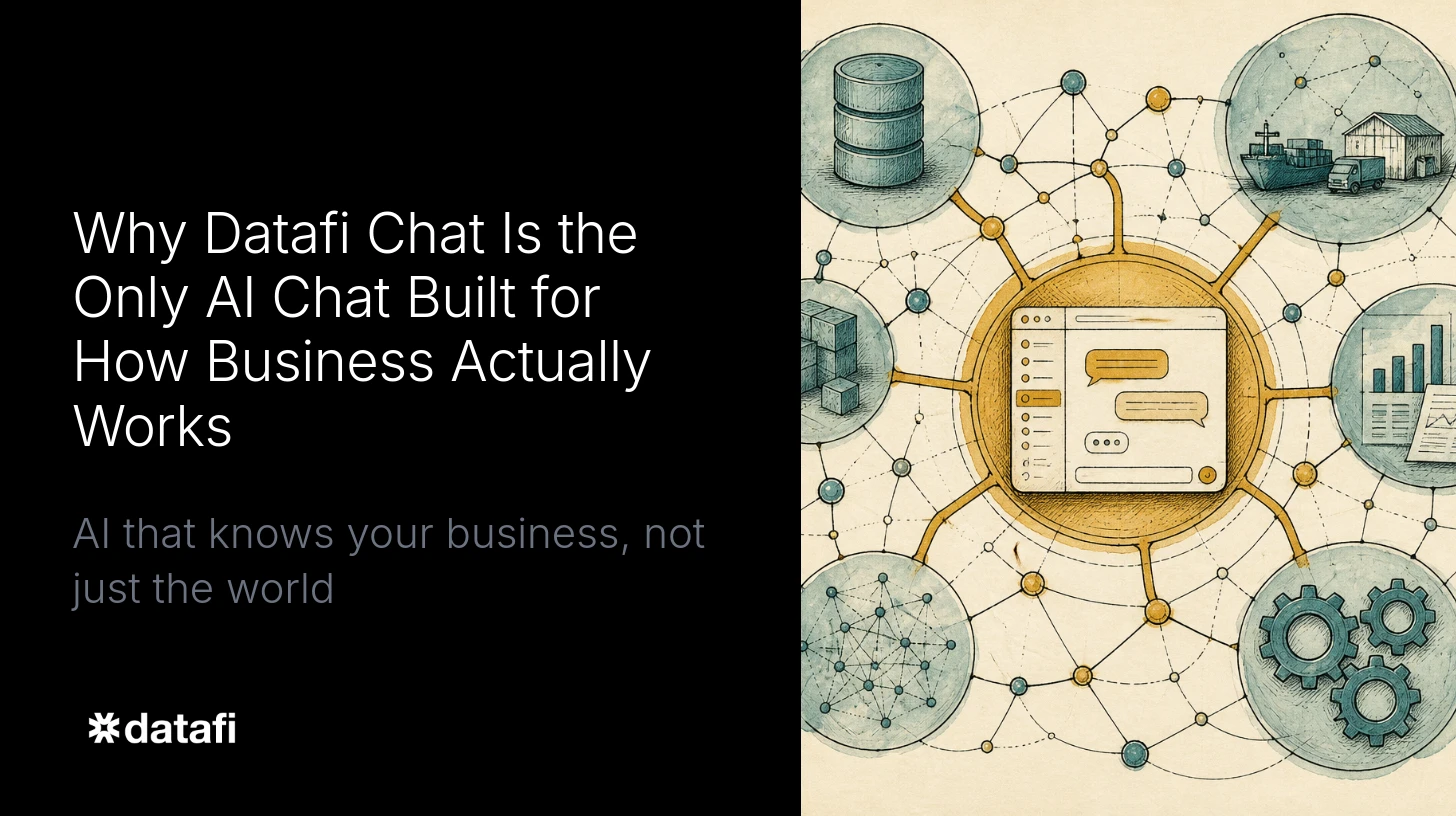
Why Datafi Chat Is the Only AI Chat Built for How Business Actually Works
Datafi Chat is the only AI chat built on a Business AI Operating System, delivering governed, context-aware intelligence to every employee in the enterprise.
The JARVIS Principal — AI Systems as a Colleague, Not a Calculator
Discover why enterprise AI needs a vertically integrated architecture, not point solutions, to deliver JARVIS-level intelligence across your entire organization.
Building AI Systems for the AI-Native Enterprise
Discover why the global contextual layer, not models or data lakes, is the true intelligence backbone powering autonomous, agentic AI in the enterprise.
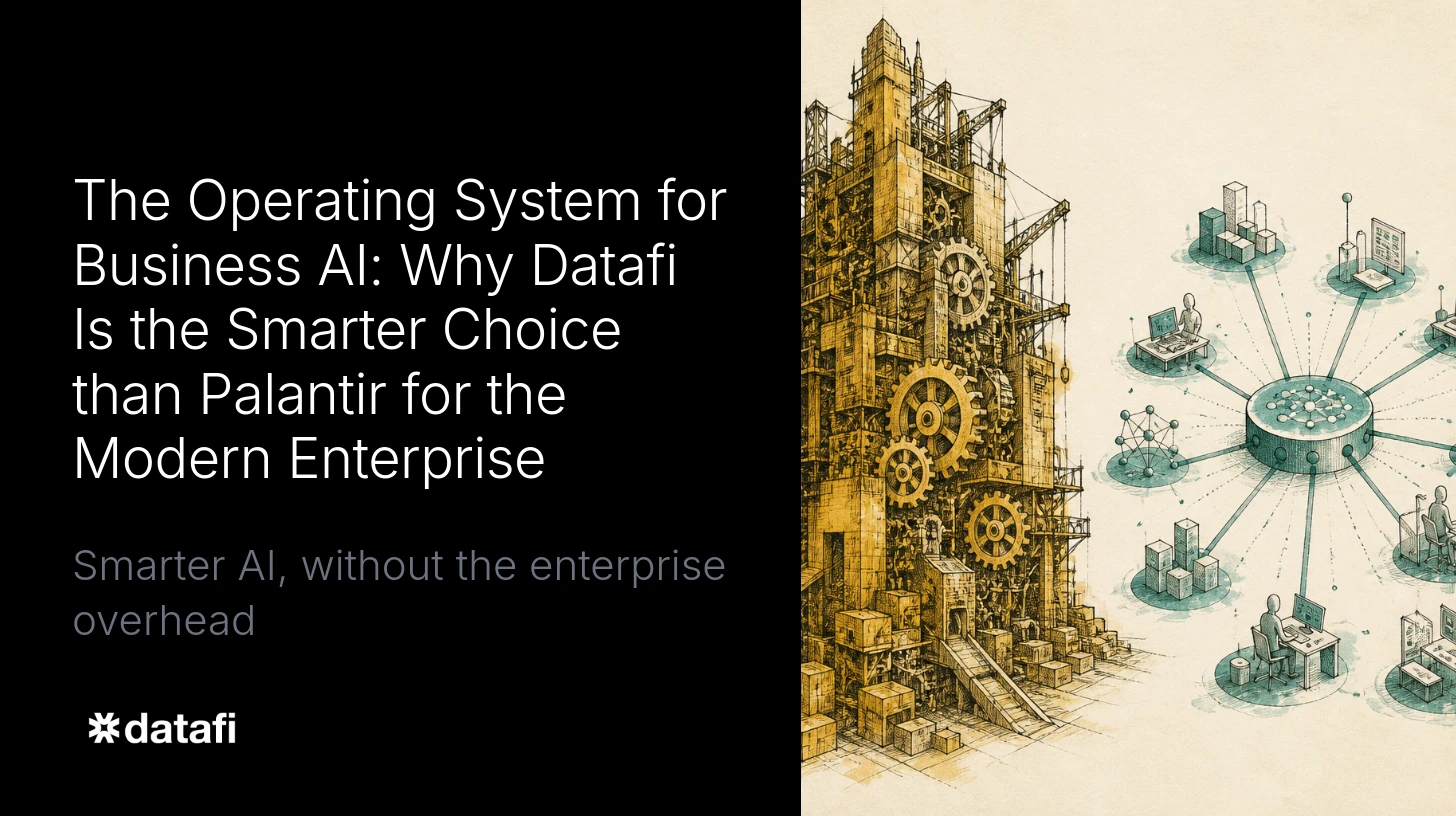
The Operating System for Business AI: Why Datafi Is the Smarter Choice than Palantir for the Modern Enterprise
Discover why Datafi's vertically integrated AI platform is the smarter enterprise choice over Palantir: faster deployment, native governance, and AI that solves problems.
The Datafi Difference
Datafi provides a unified data operating system that enables enterprise organizations to deploy AI securely and at scale across all business functions.
Get Started

Links
Find out what kind of AI partner you need.
12 questions. About five minutes. Free.
Question 1 of 12
Data foundation
Here's where you actually stand.
Six dimensions, scored from your answers. The weakest one is the one that decides how fast anything else can move.
Data foundation
Data quality
AI maturity
Governance and risk
Strategy
People and skills
Your weakest link
What to do first
Make your data reachable before you make it smart.
Pick the two systems that show up in every important question and get read access into one place. Not a migration, a connection. You want a working path to real data inside ninety days.
Warehouse consolidation, retiring legacy systems, and any platform standardization can wait. None of it is required to prove a first use case.
Define the handful of terms everyone argues about.
Take the five or six metrics that appear in leadership conversations and write one definition each, agreed by the teams that use them. Attach sources to answers from day one.
A full data catalog, master data management, and cleaning historical records can wait until something in production actually depends on them.
Land one workflow, end to end, with real users.
Choose a task a team does manually every week, ship it inside a quarter, and measure it against a number you already report. One finished thing beats four pilots.
Platform selection for the next five years, model strategy, and centers of excellence can wait until you have evidence to plan against.
Get visibility before you get policy.
Find out which AI tools are already in use and what data they touch, then give people one sanctioned option that logs prompts and respects existing permissions. Visibility first, rules second.
A comprehensive AI policy, formal review boards, and certification programs can follow once you can see what is actually happening.
Name one outcome and one owner.
Attach AI to a result the business already wants this year, with a named owner and a real budget line. Ambition without an owner is how these programs quietly end.
Multi-year roadmaps and enterprise-wide operating models can wait. They tend to be written before anyone knows what works here.
Put building in the hands of the people with the problem.
Give two or three business people no-code tools and a real problem, and let them ship something small. Watch what they hit. That tells you more than a capability assessment will.
Hiring a data science team, formal training programs, and internal certification can wait until you know where the demand actually is.
The full write-up
The part that tells you what to look for in a vendor.
The partner profile that fits your situation, the questions worth asking any vendor, and the terms worth holding out for. Sometimes the answer is that Datafi is not your fit, and it says so.
It's on its way.
The full write-up is below. A copy, written up as a report for your situation, is on its way to your inbox. No sequence, no calls unless you ask for one.
You need a data partner first, and an AI vendor second.
At this stage the honest answer is that no AI platform will help much yet. What you are missing is reachable data and one team with permission to act. Buying an AI product now tends to produce a demo that impresses a steering committee and then quietly stops being used.
Datafi is probably not your first purchase. Talk to a data engineering partner, or spend a quarter connecting two systems yourself. Come back when you can get to your own data, and we will be useful then.
Questions to ask any vendor
- What do we have to move or migrate before your product does anything useful?
- Can you work against our systems as they are today, or do we need to change them first?
- What does the smallest real deployment look like, in weeks and in dollars?
- Who does the work on our side, and how many of them do we need?
Terms worth holding out for
- A paid pilot with a defined end date, not an annual license.
- No migration as a precondition of value.
- An exit that returns your data and configuration in a usable format.
You need a partner who will land one thing, not sell you a platform.
You have the pieces and no proof. The risk at this stage is buying scale you cannot yet use: an enterprise agreement sized for a program you have not started. What you need is one workflow live, measured against a number your leadership already looks at.
This is where Datafi tends to fit well, because it runs against your existing systems and your own team can build with it. Test that claim rather than take it. If a vendor cannot show you a working use case on your data inside a quarter, the shape of the deal is wrong.
Questions to ask any vendor
- Show me a use case live on our data in weeks. What do you need from us to do that?
- Can our business team build without your professional services, and what happens when they cannot?
- What of this becomes yours and what stays ours if we leave?
- How does your pricing change when we go from one team to five?
Terms worth holding out for
- Start with one team and one use case, expand on evidence rather than on renewal dates.
- Pricing you can forecast without a call.
- Contract length that matches your confidence, not their revenue target.
You need a partner who will not become your ceiling.
You have something working and a real basis for expansion. The failure mode from here is lock-in: a platform that is easy to grow inside and expensive to grow out of. Portability is worth more to you now than any single feature on a comparison grid.
A platform like Datafi earns its place here by staying replaceable: your data stays where it lives, models can be swapped, and workflows move with you. Hold us to that. A vendor confident in the work does not need switching costs to keep you.
Questions to ask any vendor
- If we replace you in two years, what do we lose and what comes with us?
- Can we change the underlying model without renegotiating the contract?
- How do permissions from our systems carry into your answers?
- What in your roadmap depends on us consolidating onto your stack?
Terms worth holding out for
- Your data, models, and workflows stay portable, in writing.
- Model choice is yours as the market shifts.
- Expansion priced on usage you can predict, not seats you have to guess.
You need a governance and coordination layer, not another AI tool.
You are past the question of whether AI works here. Your exposure is sprawl: multiple tools, uneven controls, and duplicated logic across teams that each solved the same problem differently. The next purchase should reduce the number of places where AI touches your data, not add one.
Datafi is worth a look for the governance and orchestration layer specifically, not as a replacement for what already works. If a vendor at this stage wants to rebuild what you have running, that is their business model talking, not your situation.
Questions to ask any vendor
- How do you sit alongside what we already run instead of replacing it?
- Can you give audit a single record of AI activity across tools, not just yours?
- How do multiple agents coordinate on multi-step work without us writing the glue?
- What is your answer when our security team asks where the data goes?
Terms worth holding out for
- Coexistence with your current tools, not a rip and replace.
- Audit and logging you can export into your own systems.
- Compliance evidence up front, so review does not restart every renewal.