


Series: Property & Casualty Insurance | Part 2 of 3
The Intelligence That Already Exists
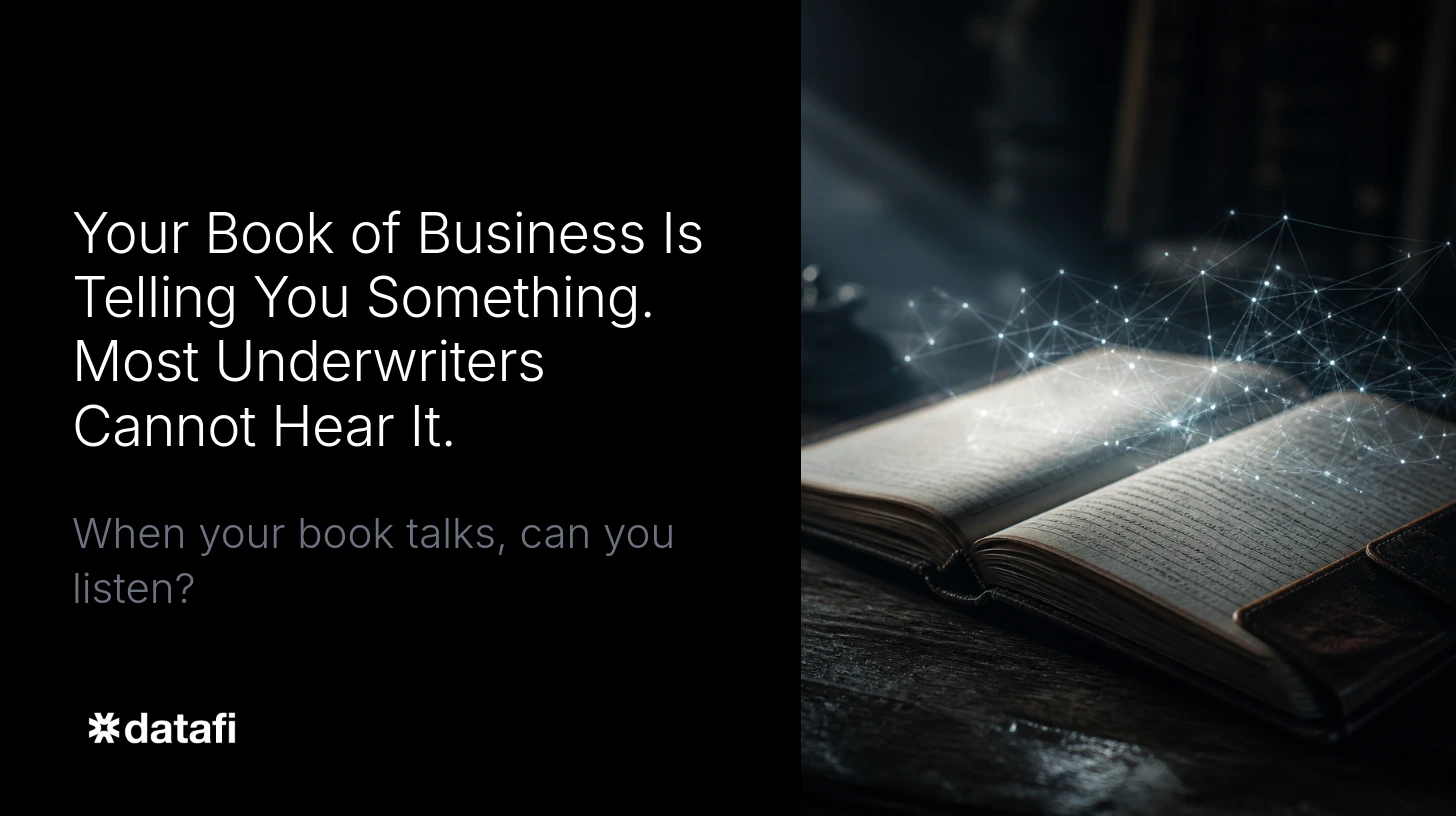
Every specialty insurance organization is sitting on one of the most valuable and underused strategic assets in its industry: the accumulated performance record of its own book of business.
Inside that record is a map of which risk characteristics predict favorable loss development and which predict deterioration. It contains signals about which classes are performing better or worse than pricing assumed, which geographies are trending in ways that actuarial models have not yet captured, and which broker channels are consistently delivering the kind of business the organization wants to keep writing.
Almost none of this intelligence is accessible in real time. It exists in fragments across policy administration systems, claims platforms, billing databases, and actuarial models that update on a quarterly or annual cycle. By the time it is synthesized into a view that underwriting leadership can act on, the market has already moved.
One of the largest specialty wholesale insurance organizations in North America recognized this as a structural problem, not a data problem. The data existed. The issue was that no system connected it into a coherent, continuously updated picture that could inform underwriting decisions, appetite adjustments, and portfolio strategy in anything close to real time.
The richest intelligence signal in any specialty insurer is the pattern inside its own book of business. Most organizations cannot read it until it is too late to act, because no system connects fragmented data into a continuously updated, decision-ready picture.
“The richest intelligence signal in any specialty insurer is the pattern inside its own book. Most organizations cannot read it until it is too late to act.”
The Gap Between Reporting and Intelligence
Most insurance organizations have reporting. They have dashboards that show premium volume, loss ratios, and exposure counts. They have actuarial analyses that run quarterly. They have management information systems that produce the data leadership needs to understand what has already happened.
What they do not have is portfolio intelligence in the sense that matters for real-time decision making: the ability to detect emerging patterns before they show up in the loss ratio, to surface anomalies in the book that warrant attention now rather than in the next quarterly review, and to generate specific, actionable guidance for underwriting teams based on what the book is actually telling them.
The distinction between reporting and intelligence is not semantic. Reporting tells you what happened. Intelligence tells you what is happening and what it means for what you should do next. In a market where underwriting cycles can shift significantly within a single policy year, the organizations that have access to continuous portfolio intelligence have a meaningful advantage over those that are operating on quarterly lag.
This is the capability gap that the specialty wholesale organization set out to close.
Building Portfolio Intelligence on the Datafi Operating System
The organization deployed the Datafi Business AI Operating System to connect its full data environment into a single governed intelligence layer: policy administration, claims platforms, financial systems, third-party enrichment feeds, and underwriting records. The goal was not to build another reporting layer. It was to enable AI agents that could monitor, analyze, and communicate what the book was signaling on a continuous basis.
The portfolio intelligence layer does several things simultaneously that were previously impossible to do in real time.
It monitors exposure concentration continuously, flagging when geographic or class concentrations approach thresholds that create meaningful correlated risk. When wildfire season approaches, the system already knows how the organization’s property book is positioned relative to historical CAT exposure, which accounts are renewing in affected regions, and what the aggregate net impact of a scenario event would look like under current portfolio composition.
It tracks loss development patterns at the class and segment level, surfacing emerging trends before they become visible in aggregate loss ratios. A class that is developing adversely in the most recent six months of experience is detectable long before it shows up in the next actuarial review if the system is watching the right signals.
It generates scenario analyses on demand. When a market event or regulatory change creates a question about portfolio exposure, underwriting leadership can ask the system directly and receive an executive-ready analysis, grounded in the organization’s actual book data, within minutes rather than weeks.
What Changes When Leadership Can See the Full Picture
The operational impact of continuous portfolio intelligence manifests at multiple levels of the organization.
At the portfolio level, appetite decisions become faster and more precise. When the data shows that a particular class is developing worse than expected, the response can be immediate. Appetite parameters can be tightened, renewal terms can be adjusted, and the entire underwriting organization can receive updated guidance, all before the next quarterly actuarial cycle would have surfaced the same signal.
At the individual underwriting level, the context available for pricing and terms decisions improves. When an underwriter is evaluating a renewal in a class or geography that the portfolio intelligence layer has flagged as trending adversely, that context is part of the decision packet. The underwriter does not have to rely on institutional knowledge or a phone call to a portfolio manager. The signal is built into the workflow.
At the distribution level, the organization can identify which broker channels and agency relationships are consistently contributing to the profitable parts of the book and which are associated with adverse development. That is a conversation that previously required manual analysis. It now happens automatically, with the data to support it.
“Appetite decisions that once waited for a quarterly actuarial cycle can now be made the week the data starts telling a different story.”
The Compounding Value of a Connected Book
There is a dimension of portfolio intelligence that does not get enough attention in discussions about AI in insurance: the compounding effect.
Every decision made on the Datafi operating system becomes part of the data environment. Every submission evaluated, every policy written, every claim processed adds to the contextual layer that the AI agents use to generate the next analysis. The longer an organization operates on this foundation, the richer and more precise its portfolio intelligence becomes.
This matters for competitive positioning in a specific way. The organizations that begin building this connected intelligence layer now are not just gaining access to current insights. They are building a structural advantage that widens over time, because the quality of their portfolio intelligence in three years will be a function of the data history they started accumulating today.
The organizations that delay are not maintaining the status quo. They are falling further behind as their competitors build a data foundation that will be increasingly difficult to replicate.
From the Quarterly Review to Continuous Intelligence
The transition from quarterly reporting to continuous portfolio intelligence is not a minor operational improvement. It is a change in the fundamental operating model of the underwriting organization.
Organizations that make this transition are not just faster at producing reports. They are structurally better positioned to adapt their underwriting posture to market conditions, to identify and act on emerging trends before competitors, and to give their underwriters the portfolio context they need to make better individual risk decisions.
The specialty wholesale organization’s experience demonstrated this clearly. Portfolio managers who previously spent weeks assembling scenario analyses now generate them in minutes. Underwriting leadership that previously operated on quarterly data cycles now has access to signals that update continuously. The book is still telling the same story it always was. The difference is that the organization can now hear it.
Datafi is the Business AI Operating System purpose-built for specialty insurance organizations. Learn more at datafi.co